- Published
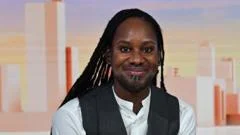
A Cambridge University professor has defended his academic work after finding himself at the centre of a plagiarism row.
The row erupted after another academic - self-defined "race realist" Nathan Cofnas, who was sacked from his Cambridge role in 2024 - said he found numerous instances of plagiarism in Prof Jason Arday's work and questioned some of his stated achievements.
While some critics say the treatment of Arday, who is black, has been motivated by racism, others have said the claims of plagiarism were legitimate.
Arday admitted errors in his work, telling the Times, external in an interview on Saturday that he was accountable for those mistakes but that "what I am not is a liar".
He told the newspaper: "There has been, since I arrived at Cambridge, a very well orchestrated and co-ordinated campaign to unseat me from my position."
He argued this was "racially motivated" and that he had become a "lightning rod" for criticism of diversity, equity and inclusion (DEI) policy.
Arday said some errors in his early academic work was because of his autism, as he relied on using mimicry to make sense of information, and that similar scrutiny would find similar errors in work by other academics.
"We're talking about academia here. I didn't murder somebody. I think the cruelty that I've experienced and the positioning of me as this kind of liar and fantasist is totally unacceptable," he told the newspaper.
In 2023, the then 37-year-old sociologist became the youngest ever black professor at Cambridge, telling the BBC at the time his work focused on neurodivergence and race in education.
He was diagnosed with autism and global development delay in his early years, to which his being unable to speak until the age of 11 and unable to read or write until 18 was attributed.
Arday worked as a PE teacher before earning his doctorate at Liverpool John Moores University and going on to teach at Roehampton, Durham and Glasgow.
Accusations of plagiarism in Arday's work were first voiced by Cofnas - a US researcher whose role at a Cambridge college was terminated after backlash to his view that under a true meritocracy black people would "disappear from almost all high-profile positions outside of sports and entertainment".
He claimed on Substack that he had put Arday's work through a plagiarism detection software, which found that "many passages are lifted with minimal editing, sometimes retaining copy-editing mistakes from the original source".
Cofnas reproduced several tracts of Arday's PhD dissertation which he said the software had found to be copied verbatim or lightly rephrased from prior academic works by other authors.
He also noted that a retired professor had previously raised concerns about Arday's subsequent academic articles, which led to two journals issuing correction notes.
Cofnas also questioned Arday's claims that he ran 30 marathons in 35 days, and 300 miles in three days for charity, which Arday said had raised more than £5m for charity, as well as running 600 miles on a treadmill in six days.
Arday told the Guardian, external that the £5m was raised with the help of others over a 20-year period, but said he could not name these people as he had signed non-disclosure agreements.
When asked by the newspaper about the 600 miles challenge, he said it was actually completed over a 12-day period to allow for rest days because of the "cumulative wear and tear of training" from previous challenges.
He told the Times that he stood by the other running records.
"I can't make people believe me," he said. "Nobody lives their life having a receipt for every single thing they say or they've done."
Arday did not dispute the allegations of plagiarism, but defended himself by arguing that he had not received adequate supervision during his PhD given his autism and learning disabilities, and that he could not afford a proofreader to catch mistakes when he started out in academia.
The controversy has attracted a range of opinions, including within the academic community.
More than 12,000 people - including Green Party leader Zack Polanski, at least five Labour MPs and some Cambridge academics - have signed a petition set up by the Good Law Project supporting Arday.
Kehinde Andrews, professor of black studies at Birmingham City University, said Arday was the victim of a "smear campaign" that was "as predictable as it is baseless", while Alan Lester, a University of Sussex geography professor who specialises in colonialism, called it a "non-story".
Simon Baron-Cohen - a cognitive neuroscientist and fellow at Trinity College, Cambridge - raised concerns about the impact the media coverage was having on Arday.
"We should of course always investigate plagiarism to protect academic standards," he wrote on Friday. "However, I cannot stand by and watch when an autistic man is on the ground and the kicking continues. This is relentless bullying of a vulnerable autistic man and raises safe-guarding issues. It's time to stop."
But some academics say there are questions to answer over academic propriety.
John Preston, an emeritus professor of sociology at the University of Essex, said "there is a case to answer here".
"Mistakes happen. If sociology of education is to ever be a field with any credibility, we need to be able to point these out, correct them, and move on," he wrote, adding that there was "no personal shame in making mistakes and admitting them".
A Cambridge University spokesperson told the BBC it took allegations of academic misconduct "incredibly seriously" but that it was "standard practice" that inverstigations were carried out by the institution at which the research was done.
They added: "Allegations of plagiarism regarding Professor Arday's thesis and some of his journal publications have been investigated by Liverpool John Moores University and the journals in question."