‘Very scary’: Greenland's Southeast Asian migrants caught in Trump’s takeover push
As United States President Donald Trump seeks control of Greenland, the island’s growing Southeast Asian migrant community faces uncertainty. In part one of this series, CNA looks at how Filipino and Thai migrants are responding.
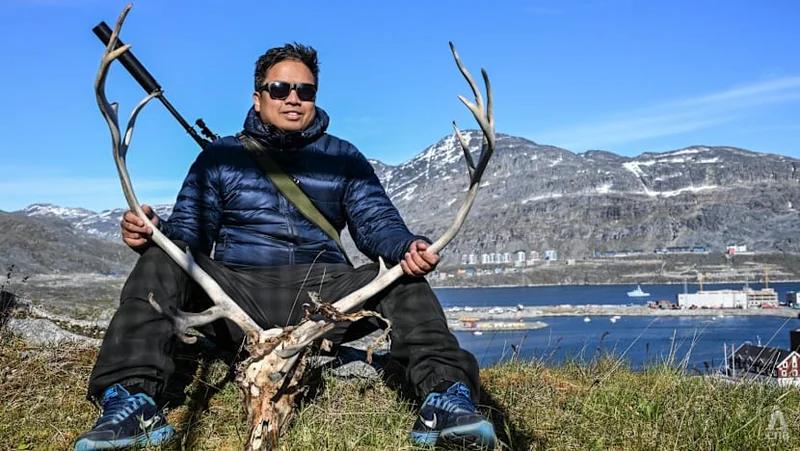
NUUK, Greenland: In deep winter January, GP Dupitas would turn his eyes towards the dark skies, as if waiting to see the silhouette of a military aircraft high above.
At a time when the sun barely lifts above the horizon, Greenland was on edge.
Dupitas, 42, a nurse from the Philippines working at the hospital in the capital city Nuuk, was nervous too. He had called Greenland home for more than a decade. Suddenly, it did not feel as safe as before.
“Everybody's looking up to see if there's some Hercules (aircraft) coming. It's like we're in an invasion,” Dupitas recalled.
After returning to power for a second term in office in January 2025, United States President Donald Trump had again insisted that Greenland should be under American control, leaving military options on the table to acquire the territory.
Early 2026 saw an unprecedented military build up in Greenland in response.
Denmark announced Operation Arctic Endurance and deployed an additional 200 troops, along with preparing surveillance and defence assets, with the promise of protecting Greenland during heightened international tension.
French President Emmanuel Macron also announced additional military deployments and committed to opening a consulate in Nuuk as a visible signal of support for Greenland.
Suddenly, soldiers from different countries mingled in hotel corridors. Red and white Greenlandic flags took root in the snow. And the political temperature belied the brutal winter temperatures of the high north.
The world’s largest island, an autonomous territory within the Kingdom of Denmark, is strategically vital – prized for its location, military significance and vast mineral resources.
And Trump wants it, stating at the beginning of the year that Washington would get it "the easy way" or "the hard way".
Trump’s moves were soon matched by protests on the streets. Thousands of Greenlanders marked their displeasure at his threats with mass demonstrations around the US consulate in the city.
Placards with slogans such as “Greenland Is Not For Sale” and “Make America Go Away” were held up by crowds adamant that they did not want their territory turned over.
It aligned with opinion polls at the time suggesting 85 per cent of Greenlanders opposed the territory joining the US.
For Greenlanders, the debate became one of sovereignty and self-determination. For Southeast Asian migrants, who have rapidly increased in number in recent years - with Filipinos and Thais the largest diaspora populations - the situation threatened the viability of staying in their chosen new home.
Now they find themselves caught in the middle of tense global power politics.
Dupitas’ apartment lies along an elevated ridge. From a wooden balcony, he can look down onto the Port of Nuuk, where ferries, fishing boats, container ships and naval vessels all compete for space along the waterfront.
Further beyond lies the Akia peninsula, largely undeveloped rolling tundra and rocky slopes. The idea of seeing American warplanes emerging over the peaks seemed like a genuine possibility.
“The longer it went on ... it got so real,” Dupitas said. “If I look back, it's kind of funny, but that time was actually very scary. I also want to protect my kids, my family.”
He said his wife wanted the family to uplift their lives in Greenland and find something more secure and certain in Denmark, where they would also be permitted to work. But Dupitas saw starting again as a last resort.
“So we stayed and followed the advisories, saved water and food, and then in that way we feel safe that we're ready, even if something happens, we're prepared,” he said.
Others, though, were spooked. A week after the demonstration in Nuuk, heavy winds damaged the transmission line from the hydroelectric plant that supplies most of the capital's power.
A blackout ensued and the city’s water and internet were also impacted.
For Cebu City native Ursilito Esig, working at a brewery in Nuuk, losing electricity and heating in the middle of winter reinforced a feeling that Greenland had become an uncertain place to raise his young child.
“It's really hard if I have my family here. Especially when we don't have heat in our room, it was so dangerous for us. That's why we decided, me and my wife, that they will go to the Philippines for good,” he said.
He is alone now, working and sending money home to support his loved ones, well over 10,000 km away.
The separation is painful, he admits, but it also means he carries fewer concerns should tensions ever escalate.
“I have no family to worry about if there's some chaos going on.”
OPPORTUNITY AMID UNCERTAINTY
While world leaders discuss Greenland's strategic value, many of those keeping its economy running remain focused on much simpler concerns: staying safe, sending money home and planning their children's future.
Greenland still needs workers, and local businesses continue looking to Southeast Asia to fill persistent labour shortages.
Around 1,300 Filipinos and 460 Thais now live in Greenland, making them the country's largest foreign communities. The Filipino population has grown almost fivefold in just five years, while the Thai community has roughly doubled.
The sight of migration is evident everywhere in Nuuk, from the hotels to massage parlours, restaurants and seafood processing plants. And this movement of workers extends further, high above the Arctic Circle to Greenland’s remote settlements.
The island's uncertain future has become part of their everyday life.
Greenland is trying to diversify its economy beyond fishing, expanding tourism, mining, energy and service industries.
That growth is placing increasing pressure on an already stretched labour market, said Christian Kjeldsen, chief executive officer of the Greenland Business Association, the territory’s largest private sector employers' and trade organisation.
While opportunity remains, political flux is pulling a handbrake on some investment, which could impact broader migration pathways, he said.
“The risk is, obviously, we don't know what's going to happen. We don't know how this is going to end,” he said.
“There is a risk that this place could be a different jurisdiction in a couple of years. That's putting some tension in there for investors and people are scared at the moment. We've seen a lot of things over the years, but this year was bad.”
With Greenland thrust onto the global diplomatic stage, its leaders have been forced to recalibrate international relations after long relying - sometimes with “hyper focus” - on building up ties with Washington, said experts.
“It's very clear that rather than looking west to the US, they're looking back east to Europe, and to different partners,” said Rasmus Leander Nielsen, the head of the Centre for Foreign and Security Policy at the University of Greenland.
Tillie Martinussen, a former member of Greenlandic parliament, sees the possible upsides of closer relations with the European Union, a clarified relationship with Denmark and exposure to the world.
“There's a lot of ways that we're trying to put some positive spin to it. It's already a saying here, ‘so, thank you, Trump’. It's a little bit ironic, but I think we're going to see a tourism boom this year and it's going to be good for our economy,” she said.
“We just don’t want to be a part of the United States.”
Some business owners are cautiously optimistic too. Meena Manly, originally from northeastern Thailand, has operated Smile Thai Massage and Beauty in Nuuk since 2019.
She has gradually expanded her operation, and hired more practitioners from Thailand.
As more cruise ships pull into the local harbour, and flights land directly from the US, the 54-year-old believes the attention surrounding Greenland could translate into more customers.
“It’s exciting for tours, and there are a lot of people I’m sure, keeping an eye on business also,” she said.
“Now a lot of people want to know where Greenland is.”
“ENOUGH ALREADY”
Despite a few months of relative calm, the shadow of America still hangs over Greenland. And any sense that tensions had eased has proven short-lived.
With Russia entrenched in the Arctic and China expanding its presence, Washington has long seen Greenland as increasingly important to its own security. And there have been constant reminders of that over the past 18 months.
In a Facebook post on Greenland's National Day in June, Trump's special envoy to the territory, Jeff Landry, suggested the US' 251st birthday next year could be celebrated with the addition of a 51st state.
And Greenland was back on the president’s agenda at the NATO summit in early July, when he suggested Washington could rethink its military commitment to Europe if Denmark refused to cooperate over the territory.
“That should be controlled by the United States, not by Denmark. And when they wouldn't go along with it, and with all the money we spend to help them with Russia, we don't have to spend any money. We could remove all of our soldiers out of Europe,” he said in Ankara on Jul 7.
The US government has also upgraded its presence in Nuuk. It recently moved its consulate into a larger modern building in the city centre, the portrait of Trump visible through its glass doors, next to the Great Seal of the United States.
In the downtown core, the new consulate’s sheer scale stands out.
At 2,800 sq m, the complex is far larger than the diplomatic footprint many Greenlanders had become accustomed to, standing in stark contrast to the modest offices and historic buildings that have traditionally housed foreign representations in Nuuk.
Hundreds of Greenlanders protested its opening in June, interpreting this sprawling facility as evidence that Washington intends to play a much more active role in Greenland's future.
“Not really knowing what the motivation of the Trump administration was - an annexation or a bargaining situation - was quite difficult to digest,” said Nielsen.
Alongside the demonstrators, Southeast Asian migrants walked in support of Greenland’s sovereignty too, like Merlyn Mejala from Mindanao in the Philippines, who moved to Nuuk with her Danish husband in 2010.
“Of course, we are also devastated, because we love what we have. And then suddenly there's tension,” she said. “We get affected. We don't want this. It's enough already.”
Combined with Trump and Landry’s latest utterings, it has been enough to keep Greenland's lawmakers on edge too.
Bo Martinsen, a member of the Greenlandic parliament for the Democrats party, said he believes nothing about Trump’s messaging has changed, even if it is currently less frequent than before.
“We always have to be cautious when a big nation threatens your freedom,” he said.
“I feel very mad, but also sad, that individuals can feel like they are in their right mind to own a country or their people. It's a very sick way of thinking, in my opinion.”
From many Greenlanders' perspectives, especially the indigenous population, much of the international conversation misses the point. They increasingly reject being portrayed as an object to be acquired or competed over.
Their message has become simple: decisions should be made with Greenlanders, not about them.
“You cannot forget that there are actually people living in the Arctic; it's not just a pristine national park, or polar bears running around everywhere,” said Nielsen.
That sense of dehumanisation has become one of the defining frustrations of Greenland's current geopolitical situation.
“It seems like everyone is just talking about us like we're kind of a savage people, or like a block of ice, as Trump said at Davos, and it's a little disheartening,” said Martinussen.
“First it was frightening, now it's annoying. And I think one of the most prevalent things I've seen is anger,” she said.
She said that within political circles there has been a conscious effort to move beyond fear, instead focusing on unity and hoping to outlast the Trump presidency.
Whatever uncertainty lies ahead, Martinussen believes Greenlanders have repeatedly demonstrated an ability to endure adversity.
“Greenland has been colonised over and over and over again, so it's in our DNA to survive.”
For Southeast Asian migrants with fewer indelible ties to the Arctic, having a backup plan has become reluctantly necessary. Going home - having come so far - remains difficult to contemplate.
“For me, I want Greenland to be Greenland as it is,” Ersig the Filipino brewery worker said.
“If America wants to help, it will be okay. But if it invades, I don't think so.”