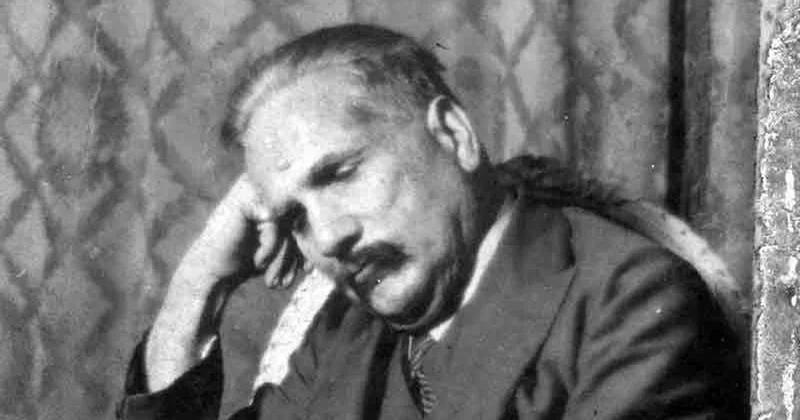
Raza Mir’s introduction to Mohammad Iqbal’s poetry and philosophical work, along with some biographical reflection in Iqbal: Poet of the East, provides extensive knowledge to the beginner who wants to read Iqbal’s philosophical work regarding the concepts of Khudhi, Shaheen and Socialism. The introductory book also familiarises readers with the intricate threads of Iqbal’s engagement with socialist thinkers such as Karl Marx and Vladimir Lenin. Yet, beyond a limited intellectual circle, many continue to reduce Iqbal to selective ideological readings, overlooking his poetic invocations of Hindu deities and civilisational hymns.
Mohammad Iqbal has been almost imprisoned in the image of a flamboyant poet of Saare Jahaan Se Acha or as an ideologue of Pakistan, conceiving him as a political and religious figure while ignoring his body of philosophical work. However, he participated actively in the pre-independent Indian politics, offered his opinion on partition, and wrote several patriotic pieces in Urdu, including Tarana-e-Hindi. Ironically, Iqbal is one of the most quoted and least read figures of the subcontinent, which has created a fragmented image of the poet-philosopher. Nationalists invoke him selectively, Islamists claim him exclusively, while secular critics often dismiss him. Such selective appropriations have reduced a restless intellectual to an ideological emblem.
Iqbal, born on November 9, 1877, in Sialkot, was first schooled at a local madrasa before being transferred to Scotch Mission College, where he “continued his study of Arabic and philosophy.” Iqbal earned a degree from Cambridge, a doctorate from Munich (Germany) and a law degree from London. This testified to Iqbal’s intellectual brilliance, for he “exhibited a philosophical bent from an early age.”
The inquiries
He was deeply interested in scholars such as Ibn-e-Arabi and Jalaluddin Rumi, while having “already been working on the intersection between traditional Arabic textual Islam and Farsi-influenced Sufism.” In 1907, he wrote his doctoral thesis titled The Development of Metaphysics in Persia. However, his sojourn to Europe in 1905, on the advice of Sir Thomas Arnold, would “turn out to be momentous.” It led Iqbal to become critical “of what he saw as its singular focus on materialism shorn of any spirituality.” Mir, therefore, distinguishes between two phases of Iqbal’s intellectual evolution: the “pre-Europe Iqbal” and the “post-Europe Iqbal.”
Upon his return to India, he began practising law and editing a legal journal. He was developing his own nation of colonialism and he believed that the partition of Bengal in 1905 made “Indian Hindus and Muslims … think of themselves as separate nations.” These preoccupied his mind and he’d go on to question the Almighty through his poetry. In 1909, amid widespread political and civilisational turmoil, he wrote the long poem called “Shikhwa” – a controversial work that signalled the making of a great poet. The opening stanza of the Shikwa reads,
Kyon ziyaankaar banoon, sood faraamosh rahoon?
Fikr-e farda na karoon, mahv-e dosh rahoon?
Nalee bulbul ke sunoon, aur hamatan gosh rahoon?
Hamnava, mai bhi koi gul hoon ke khaamosh rahoon?(Should I forego all profit, and plow a losing furrow?
Wallow in today's quagmire, not think about tomorrow?
Listen to birdsongs and yet stay quiet in my burrow?
Am I an insensitive rose to ignore my sorrow?)
However, in 1912, he imagined god’s response to “Shikwa” in “Jawab-e-Shikwa” as
Dil se jo baat nikalti hai asar rakhti hai
Par nahin, taaqat-e parvaaz magar rakhti hai
Qudsi-ul asl hai, rif’at pe nazar rakhti hai
Khaak se uthti hai, gardoon pe guzar rakhti hai(A cry that arises from the heart carries great might
It may not have wings, but possesses powers of flight
Chaste and pure, it has the high firmament in its sight
Rises from the earth, but reaches a heavenly height)
In 1929, Iqbal travelled to southern India, where the lectures he delivered were later compiled as the foundational texts for readers wanting to engage with Iqbal’s philosophical thought. The compilation, titled The Reconstruction of Religious Thought in Islam, sought to reinterpret Islamic thought in conversation with modern philosophy, science, and reason. The very title of the compilation, however, had the opposite effect: Iqbal was primarily thought of as a religious thinker.
The compilation and Iqbal’s post-Europe intellectual phase have often been framed as being concerned solely with religious subjects. Yet the great Indian poet, Sarojni Naidu, remarked: “The poems of Iqbal have freed my soul from the narrow confines of nationalism and have enabled me to love entire humanity.” Iqbal was not writing merely to address a religion or a region, but humanity as a whole, while possessing a crystal-clear understanding of British colonial cruelty, along with capitalism and fascism.
Iqbal’s Tarana-e-Hindi, written in 1904, expresses profound affection for one’s motherland.
Saere jahaan se achcha hindostaan hamaara
Hum bulbule hain iski, ye gulsitaan hamaara(Of all the lands of the world, our India is the best
With this verdant garden we joyous songbirds were blest)
During hus sojourn to Europe, Iqbal studied the descent of liberal democracies into autocracy, which further drew him towards Lenin, for in him he found “a thinker whose feeling mirrored his own.”
In his poem, “Lenin Khuda ke Hazor Mein”, he wrote, addressing god as Lenin,
Ai anfus-o aafaaq mein paida tere aayaat
Haq ye hai ke hai zinda-o paainda teri zaat(Your signs pervade all life and space
It’s true your being is eternal, immortal)
This was followed by Lenin replying in the voice of angels (“Farman-e Khuda”) as:
Utho meri duniya ke ghareebon ko jaga do
Kaakh-e umara ke dar-o deevaar hila do(Go bid the wretched of my earth to awake
Foundations of elite palaces should quake)
Iqbal was bestowed the title Allama, meaning “learned,” an honorific reserved for great scholars. His work encompasses a remarkable variety of themes and literary forms. One of his most celebrated poems is a dialogue between Jibreel (the angel who conveyed god’s revelations to the prophet) and Iblees (Lucifer, who defied god to prostrate before Adam). The poem is a “good example of the sense of drama found in many of Iqbal’s poems.” It begins with Jibreel asking the Iblees of his experience in “the land of colour and smell,” and the conversation unfolds as follows:
Jibreel:
Hamdam-e-dereena kaisa hai jahaan-e-rang-o-boo?Iblees:
Soz-o saaz-o dard-o daagh-o justujoo-o aarzoo!Gabriel:
How is life in the world of colour and scent, dear friend?Lucifer:
Plaintive singing, pain and scars, and longing without end!
The difficult answers
Whether he speaks through a believer questioning god, through Lenin addressing the heavens, or through Iblees reflecting upon the moral conditions of humanity, Iqbal reflects through his dramatic personae rather than speaking in his own voice. The poems thus become profoundly woven threads of philosophical conversations.
Although across the various forms of Iqbal’s work, particularly in “Shikwa” and “Jawab-e-Shikwa”, in the poetic persona of Lenin, and in the dialogue between Iblees and Jibreel, he repeatedly returns to questions of civilisational decline, human morality, injustice, and the many cruelties embedded within social and political life. Moreover, reading Iqbal remains relevant in the contemporary moment amid the rise of chauvinism, deepening religious polarisation, widening economic inequalities and the expansion of capitalism.
To read Iqbal today is neither to endorse every political position he held nor to enlist him with contemporary ideological camps. He transformed poetry into a forum of civilisational inquiry, where god, humanity, revolution, religion and power converse with one another. The question, therefore, is whether we are willing to read him as a philosopher whose concerns extended beyond borders and nationalism, rather than simply a religious ideologue.
Iqbal: Poet of the East, Raza Mir, Penguin Random House India.
We welcome your comments at letters@scroll.in.