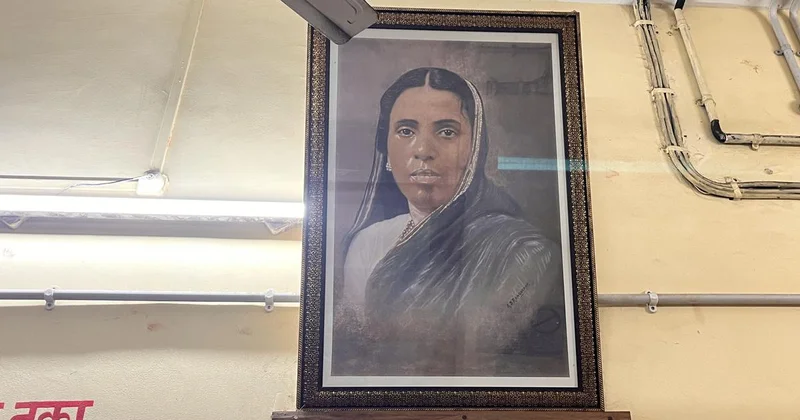
In South Mumbai’s Mandvi Koliwada sits a terracotta-colored building bearing the name Janabai and Madhavrao Rokade Municipal School.
As is the case with public buildings in many Indian cities, the names of the personalities that adorn them are often unfamiliar. Some of them are linked to relatively recent politicians and cultural figures. A few of them have a deeper historical connection. The Rokade municipal school falls in the second category.
The school was established in 1879, making it one of Mumbai’s earliest modern schools. It was started by Madhavrao Rokade.
For anyone interested in Mumbai’s socio-political history from this period, Madhavrao Rokade is remembered as a key member and writer associated with the Satyashodhak movement. This was a movement started by Jotirao and Savitribai Phule in Pune in 1873 to confront the upper-caste dominance in everyday life and to work toward inculcating a sense of collective consciousness among Bahujan communities, especially through education.
Rokade contributed to this movement by starting and running this school for many years with limited support. He was also known for his periodic writings in the late 19th century in newspapers such as Dinbandhu (Brother of the Oppressed) and Shetkaryacha Kaivari (Protector of Farmers).
Along with his role in education, Rokade had garnered immense respect for his engagement with workers’ problems at the Bombay Mill Hands Association and for his role as a mediator in pacifying communal tensions during the Bombay riots in 1893.
But who was Janabai?
Most of the scholarly works on social reform movements in colonial India are marked by copious profiles of men and their contributions. Due to a severe paucity of vernacular archives about lesser-known Marathi women writers and reformers and the haphazard cataloguing of the others, coupled with limited vernacular language skills among scholars to explore the social milieu, our understanding of social reform in colonial India remains limited.
Women, especially if they had Bahujan backgrounds, tend to get only a cursory mention as the wives, sisters or daughters of male reformers.
In this story, too, we know that Janabai Rokade was the daughter of Madhavrao. However, Janabai’s story is not entirely lost to obscurity, thanks to a Marathi biography written of her by Krishnarao Arjun Keluskar in 1929.
Keluskar was one of the most prolific Marathi writers in this period, who was known for his penchant for writing biographies. He wrote popular biographies of historical characters such as the Buddha, the medieval bhakti saint Tukaram, and the Maratha warrior Chhatrapati Shivaji.
Remarkably, for someone who also had an abiding scholarly interest in global topics ranging from ancient Stoic philosophers such as Seneca and Epictetus to the modern political history of France, Keluskar chose to write a biography on a Marathi-speaking Bahujan woman from Mumbai.
At a time when there were innumerable logistical and financial hurdles involved in documenting the social works of figures, a short biography like this one provides valuable insights on less-privileged women in colonial India.
As a family friend of the Rokades, Keluskar eulogised Madhavrao’s social work. At the same time, he had also been privy to how Janabai had steadily managed to amplify her own public presence. Instead of treating her as merely a supporter of the movement, Keluskar’s biography explores her individual contributions, spanning from educational achievements to public service.
In this account, Janabai emerges as one of the most respected public figures in colonial Bombay.
Janabai was born in 1888 in Mandvi Koliwada. A plaque in the school says the building was constructed on the site of the tomb of a spiritual leader named Raghunath Maharaj.
Madhavrao passed away in 1896 when Janabai was merely eight so she was raised by her uncle, Dharmajirao.
Devastated by the loss of her father, Janabai was only able to study to the fourth standard. In the time between her abrupt end to education and her marriage at the age of 14, she taught school children.
Unfortunately for Janabai, her misery continued as her marriage was a disaster. Seeing that her husband was a spendthrift who wasted his ancestral holdings, Dharmajirao called Janabai back home. As he was aware of Janabai’s intellect and her predilection for social service, Dharmjirao realised that she was destined to play a role beyond her current school teaching.
Dharmajirao helped Janabai join Mumbai’s Cama Hospital, which is still reputed for its care of women and children. Janabai’s nursing and midwife skills blossomed here. She performed these roles for women from all strata of society, including for British expectant mothers and women from royal families such as the Queen of Bhuj.
Because Janabai could speak Urdu and Gujarati in addition to Marathi, she was a coveted nurse and midwife beyond her immediate social circle. Soon, she started working independently and became one known as of Mumbai’s most efficient midwives.
Janabai’s public stature helped her uncle Dharmajirao raise funds to run the school. She contacted organisations such as the Wadia Trust to help her with the school as more children moved to the low-cost housing chawls in Mandvi built by the government-run Bombay Improvement Trust.
SM Edwardes, the city’s police commissioner, encouraged the Wadia Trust to increase their annual contribution to the school from Rs 50 to Rs 100. Janabai continued supporting this school even after Dharmjirao died in 1918.
Mindful of the support she had received from Dharmajirao and his family in her early life, Janabai had a profound desire to pay back her debt by running this school, Keluskar said.
For close to 15 years, Dharmajirao had run the school free of cost. This was a time when only a few schools in Mumbai catered to poor students. Understandably, the more pragmatic emphasis was on industrial education.
In a little while, Janabai ventured into other domains. She opened the Ahilyabai Maternity Hospital for poor women, named after Dharmajirao’s daughter. To honor Dharmajirao’s social service, she opened a free reading room in his memory.
Along with her pioneering role in the education sector and providing maternity care for poor women, Janabai also participated in influential social and cultural organisations. She was invited to be a member of the Maratha Aikechyu Sabha, became a partner of the Maratha Provident Fund and accepted the role of the president of the Student’s Brotherhood in Pune.
The Maratha Aikeychu Sabha worked towards spreading awareness about education and inculcating a feeling of brotherhood among people from different caste communities. Established in 1887, it supported students with scholarships.
The Maratha Provident Fund, established in 1894, sought to spread awareness among poor Marathi people about the importance of saving a percentage of their monthly income. Both these organizations had a capacious definition of the word “Maratha”, which was meant to include all non-Brahmin communities.
The Students’ Brotherhood, established in 1911, worked toward helping students in need of financial support by buying books and organising lecture series.
She also engaged in public service alongside the editor of Jagruti.
Jagruti was an important Satyashodhak newspaper that wrote about widow remarriage, education, untouchability and the problems of farmers and workers. It was first published between 1917 and ran until 1949.Even though these organisations were male-dominated, Janabai’s indefatigable persona compelled them to solicit her membership.
For her contributions to the field of education and public service, she was awarded the bronze badge of the Kaisar-i-Hind medal, which was awarded by the British emperor for distinguished service in the advancement of public service in India. Janabai was most probably the first Bahujan woman to receive this award.
Surajkumar Thube is a visiting professor at the political science department at Ashoka University.
We welcome your comments at letters@scroll.in.