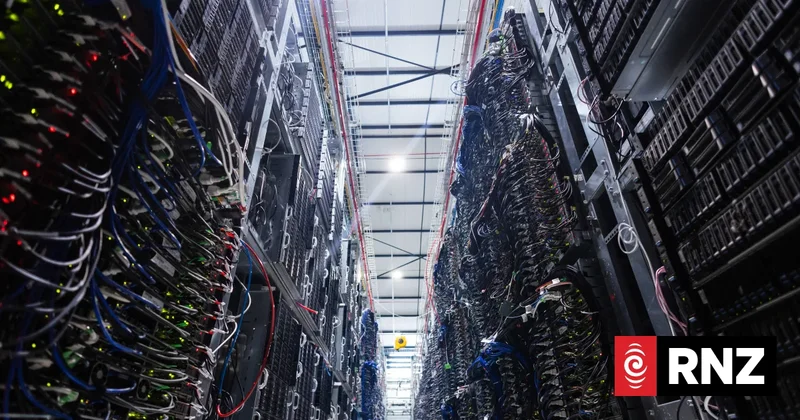
Concerns are growing about the proliferation of data centres, and could curtail New Zealand's potential to become a regional hub serving Australia and the Pacific.
A paper by Fitch Solutions company BMI focuses on New Zealand's small but rapidly expanding growth due to strong cloud adoption, data sovereignty requirements and growing international connectivity.
"New Zealand's regulatory and policy environment remains one of its key competitive advantages, underpinned by political stability and a highly renewable power system," it says.
"That said, this supportive backdrop is increasingly being balanced by rising scrutiny of the sector's impact on the grid.
"Tighter scrutiny of grid usage, power contribution requirements and local opposition to large-scale projects may slow execution timelines for the biggest developments."
The cost of development
The BMI report notes there was concern the current framework did not require data centre operators to contribute proportionately to the grid infrastructure, though it was happening in practice.
"The coexistence of active investment promotion and emerging grid-contribution requirements highlights the tension between attracting globally mobile digital infrastructure investment and maintaining social licence domestically," the BMI report says.
However, information provided to RNZ from the National Grid operator Transpower on the Transmission Pricing Methodology (TPM) did set out a number of requirements.
"Under the TPM the beneficiary pays the cost of connecting to the grid - this ensures that costs are allocated to parties benefiting from those assets rather than spreading them across all consumers," Transpower said in response to RNZ questions.
"So any new large loads (like data centres) pay their own costs of connection to the grid, and they should also bring new generation with them to cover their own demand.
"Before any new large load connects to the grid, our priority is to ensure the system remains stable and has the capacity to safely manage the new connection so large projects like data centres need careful assessment before they can connect."
Still, the Green Party was calling for a moratorium on data centre development, despite the existence of the TPM as well as standard practice.
By the numbers
New Zealand had 62 data centres at the start of the third quarter ending September, with most located in Auckland, though Wellington, Christchurch, and Hamilton were gaining importance, according to the BMI report.
It says local cloud spending was forecast to rise to $3.11b, with long-term growth supported by government "cloud first" policies, as well as AWS and Microsoft's hyperscale data centres, which delivered regional services.
"Growth is increasingly driven by co-location providers such as CDC, Datacom, NEXTDC, and TenPeaks, and New Zealand's renewable-heavy power mix, and submarine cable investments strengthen its appeal, despite rising scrutiny over grid impacts."
Historical context
Data centres have been a central feature of the New Zealand technology landscape since 1967, when the country adopted the decimal currency system, which initiated the roll-out of computer banking systems and established Databank, a shared electronic data processing service for major banks.
Databank managing director Gordon Hogg pitched New Zealand as a "data fortress" at the second annual meeting of the Nuclear Free Zone conference, in 1985, which was revisited by the New Zealand Nuclear-Free Peacemaking Association in 1987.
The demand for data centres had since continued at pace, along with the technology built into them, including closed-loop water-cooling systems, introduced by CDC, and powered by 100 percent renewable energy, which were a standard feature of modern developments.
"New Zealand's data centre market will remain Auckland-centric in the near term, but regional diversification is likely to accelerate as Christchurch, Wellington, Hamilton and Southland attract incremental enterprise, government and hyperscale-related demand," the BMI report says.
Growth was seen as favouring co-location operators over self-build hyperscaler campuses, especially as AWS and Microsoft leaned more toward leased capacity.
Expansion outlook
The BMI report suggests New Zealand's renewable-heavy grid, efficient facilities and expanding submarine cable network should strengthen its position as a regional digital infrastructure node and support efforts to capture Australian-based demand.
"Our Power team expects the country's electricity sector to continue decarbonising, with thermal generation falling to 0 percent from 2031 onward," it says.
"This transition will be driven primarily by hydropower, which we forecast will account for 51 percent of the total generation mix by 2035."
New Zealand's power network was already considered to be among the most energy-efficient in the world, according to BMI.
"This energy transition will be further supported by an expected $24b of investment in the electricity system over the next 30 years, with a strong focus on renewable generation."
It says the development of Southland's Datagrid campus was central to the government's ambition to position New Zealand as a regional digital infrastructure hub.
"A key enabler is improving international connectivity through new submarine cable projects, including Tasman Ring and Hawaiki, which would support New Zealand's ability to capture offshored Australian demand."