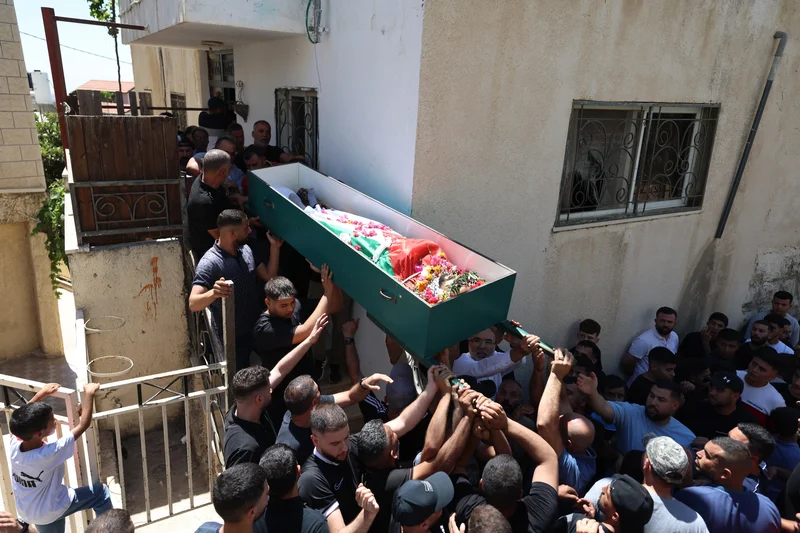
The Israeli-occupied Palestinian West Bank is under siege as Israeli settlers continue their days-long rampage, attacking mosques, cars, homes, agricultural fields and Palestinians while the Israel Defense Forces (IDF) close off villages and carry out mass arrests and home demolitions in a wide-scale military operation.
âThis is Israeli state violence, not just settler violence,â Israeli peace activist Ofer Neiman told Daily Maverick. âThat term is misleading. This is violence coming from the entire state of Israel. The Palestinians in the West Bank need international protection⦠There are things the world has to do to hold Israel accountable,â he said.
The latest violence started on Friday, 24 July, when a group of armed Israeli settlers invaded the Palestinian village of Tal and several other neighbouring villages in the northern Israeli-occupied West Bank.
âThey were confronted by some young men who tried to prevent them from entering their homes. The settlers opened fire when one of the Palestinians managed to disarm one of them, with a Palestinian shooting back,â said Saqer*, from the village of Kafr Qaddoum.
During the subsequent confrontation, two Israeli soldiers and four Palestinians were killed. Another four Palestinians were severely injured. Some of them were arrested by Israeli soldiers who raided a hospital where they were being treated, a move condemned by Doctors Without Borders.
Israeli settlers again attacked Palestinian villages in the occupied West Bank early on Saturday and Sunday, setting fire to two mosques and scrawling graffiti on buildings.
âAbout 12 Palestinians were injured after more settlers raided nearby villages and attacked people and property over the weekend. And the attacks have continued since then,â said Saqer.
The IDF said there was shooting from both sides. Israeli Army Radio reported that settler attacks on Palestinians surged 63% in the first six months of 2026 compared with the same period in 2025.
This was just the latest outbreak of Israeli military attacks and settler violence against Palestinian communities in the occupied territory as demolitions and attacks continue to affect Palestinian homes, water systems, schools and livelihood assets, further undermining access to essential services and community resilience.
Deaths linked to settler attacks this year have already surpassed last yearâs total, with 18 Palestinians killed by settlers as of 20 July compared with 17 throughout 2025. More than 70 Palestinians have been killed in the West Bank in 2026, the UN Office for the Coordination of Humanitarian Affairs (OCHA) reported.
Since October 2023, nearly 1,200 Palestinians have been killed in the West Bank. Nearly 40 of them were killed by Israeli settlers and 670 were civilians, including children, not belonging to any armed group.
More than 2,600 Palestinian structures have been demolished and over 5,500 Palestinians displaced in the West Bank since 2009 as the Israeli authorities prevent Palestinians from living in Area C of the West Bank, which compromises more than 60% of the territory.
Occupation extended
Simultaneously, the Israeli cabinet has just approved $434-million for establishing 34 new settlements in the West Bank, despite international condemnation. More than 750,000 Israeli settlers live in 147 settlements across the territory. All Israeli settlements are illegal under international law.
Israeli rights group Bâtselem argued in a report, State Business, published in November 2021, that âcontinuous, systemic violence meted out by settlers is part of Israelâs official policy, driving massive takeover of Palestinian farmland and pasturelandâ.
Daily settler attacks on Palestinians have become a way of life. But the deaths of two members of the IDF have stood out for Israeli Prime Minister BenÂjamin Netanyahu and his extremist cabinet.
Netanyahu ordered a major security operation, sending more military battalions into the West Bank to fight âterrorismâ. Mass arrests and military raids have been carried out, homes have been demolished, villages placed under curfew and numerous roadblocks erected.
âWe have been unable to travel on the main roads to Nablus because there are new roadblocks everywhere,â Saqer said.
Permanent roadblocks were already restricting movement in the occupied territory after Israel closed off many villages with dirt mounds, military checkpoints and permanent gate closures. As of March, there were 925 restrictions on movement in the West Bank, representing a 43% increase over the average of 647 recorded annually during the previous two decades, according to the OCHA.
âWe have been unable to approach our olive groves and other agricultural land for several years now as land is confiscated for the security and benefit of the settlers and this has decimated our villageâs economy,â Saqer said.
Ayman*, who runs a restaurant in the middle of Ramallah, said the restrictions were so bad his staff took hours to get home to nearby villages, which would normally take 20 minutes to reach by car.
âOne of my workers leaves at 5pm and only gets home four hours later to his village just over 10km away as he navigates side roads and military checkpoints. This affects his ability to spend time with his family and work productively,â he said.
Palestinian journalists are also facing increasing difficulties in moving around and getting to the story in order to tell it from the ground.
As this powder keg situation lurches towards immolation, Jordanian Foreign Minister Ayman Safadi warned that the Israeli government was pushing the West Bank to explosion.
Netanyahuâs hardline approach has been encouraged by his continuing corruption trials, which could end in prison, and his falling popularity at home as Israeli elections approach in several months. His popularity has often risen during security escalations when he has played tough.
âNetanyahu canât win thisâ
Neiman, meanwhile, said Israelâs real security problem was self-inflicted. âThereâs an ongoing security problem, the problem being Israeli genocide, war crimes and wars of aggression. Netanyahu canât win this. It seems he will not restrain the settlers.
âThe settlers are not going to go back to the old status quo, which was still very violent and racist. They sense overall they are losing the war, while Israeli decision-makers are sensing they are losing the strategic fight to maintain the West Bank.â
The continuing violence has prompted a number of European countries to sanction products produced in West Bank settlements. Eighty British parliamentarians have also demanded a full arms embargo on ÂIsrael and 104 US Congressmen and women voted to block the $3.8-billion military and security package Washington sends to the state annually.
Furthermore, for the first time, the popularity of Israel among Americans across the political divide has plummeted, with more expressing sympathy for the Palestinians than for Israelis.
But as the international media focuses on the US-Israel war on Iran, they have hitherto been ignoring the West Bank violence. This has enabled Israeli extremism to escalate and flourish away from global headlines.
âThe international media is now temporarily reporting on a situation that has been ignored for a long time but itâs also important that the ongoing destruction and death in Gaza be reported on again,â Neiman told Daily Maverick. DM
*Full names redacted for security reasons.
This story first appeared in our weekly DM168 newspaper, available countrywide for R35.