Member-only story
The architecture of watching work
For a century we designed the office around a single question — how do we see work? AI is quietly changing the question.
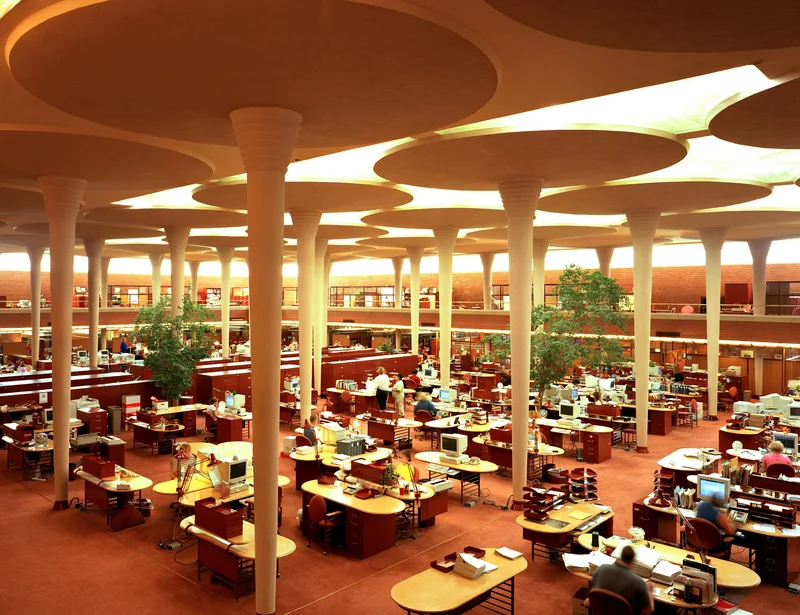
You reach the Great Workroom the way Frank Lloyd Wright meant you to. The approach is a low, dark passage of bare concrete, the ceiling pressed close over your head, the daylight draining out of the walk. Then the ceiling lifts, the walls fall away, and the room opens all at once — and you are standing in something that does not feel like an office. It feels like a forest that has agreed to hold still. It is a classic example of Wright’s compression-and-release: he built the dark, low corridor on purpose, so that the room would detonate when you stepped into it. He finished the whole thing in 1939, and eighty-seven years later the ceiling still does the thing he built it to do. Nearly sixty slender columns rise twenty-one feet from bases barely nine inches wide, spreading at the top into pads so broad they touch and become the roof. Wright called them dendriform — tree-shaped. Everyone else calls them lily pads. Light falls through forty-three miles of Pyrex tubing where the walls should be. There are no internal walls at all — half an acre of open floor, and once, a room full of clerks.