Quick facts
What it is: Andromeda galaxy (M31)
Where it is: 2.5 million light-years away, in the constellation Andromeda
When it was shared: July 27, 2026
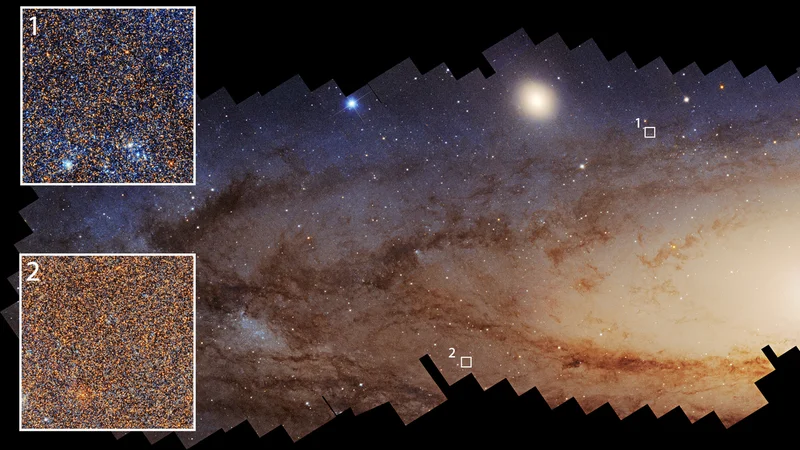
Andromeda is the only major galaxy in the universe that is speeding closer to the Milky Way as all the others rush away. Now, a new analysis of Hubble Space Telescope data hints that our galactic next-door neighbor may be winding down from a big burst of activity as it draws toward a possible collision with our galaxy.
The new study found that the Andromeda galaxy (M31) has been steadily slowing its production of new stars over the past 500 million years. The findings suggest that the galaxy is naturally winding down after a more active period, offering astronomers valuable clues about how large spiral galaxies evolve.
Andromeda is a giant spiral galaxy similar to the Milky Way, but with around twice its mass. As the nearest large spiral galaxy to Earth, it provides an ideal laboratory for studying galaxy formation and evolution. An understanding of when and where stars form is essential for explaining how galaxies develop and change over time.
The new research, published July 27 in The Astrophysical Journal, combines two major Hubble surveys that mapped roughly two-thirds of Andromeda's disk, including around 200 million stars. It's already known that Andromeda experienced a dramatic burst of star formation about 2 billion years ago, which is thought to have formed about a fifth of all the stars in the galaxy. That starburst is thought to be the result of a merger with another galaxy, probably the compact elliptical galaxy M32, which now orbits Andromeda.
The new study found that Andromeda formed stars at a rate of around one solar mass per year 500 million years ago. By 40 million years ago, that rate had halved, while today the rate has fallen to just one-fifth of a solar mass each year. Researchers found that most recent star formation in Andromeda has been concentrated within a ring about 32,000 light-years from the galaxy's center and that the decreasing activity within this region is largely responsible for the overall decline. That suggests the galaxy is gradually winding down from its previous burst of star formation rather than suddenly running out of material.
Related stories
- Every major galaxy is speeding away from the Milky Way, except one — and we finally know why
- Listen to the Andromeda galaxy's stars played as musical notes in eerie NASA video
- 'This doesn't appear in computer simulations': Hubble maps chaotic history of Andromeda galaxy, and it's nothing like scientists expected
Scientists also investigated whether M32 may have contributed to the slowdown. Regions closest to M32 show a more recent decline in star formation, making the companion galaxy a possible influence, although the evidence remains inconclusive.
"We need to measure the individual stars because they are the fossil record of the galaxy's formation," study co-author Ben Williams, an astronomer at the University of Washington, said in a NASA statement. "Hubble is the only telescope that can give you high enough spatial resolution over a large enough area to be able to do that in Andromeda."Although the team will continue studying Hubble's archive, they will also target observations from NASA's Nancy Grace Roman Space Telescope, which will launch on a SpaceX Falcon Heavy rocket as soon as Aug. 30. With a field of view at least 100 times larger than Hubble's, Roman will survey the entire Andromeda galaxy and its surrounding halo in unprecedented detail.
Get the world’s most fascinating discoveries delivered straight to your inbox.
Andromeda is best observed in November and is visible to the naked eye, even from locations with moderate light pollution. The galaxy may collide with the Milky Way about 5 billion years from now, though__ its ultimate trajectory is still uncertain__.
Jamie Carter is a Cardiff, U.K.-based freelance science journalist and a regular contributor to Live Science. He is the author of A Stargazing Program For Beginners and co-author of The Eclipse Effect, and leads international stargazing and eclipse-chasing tours. His work appears regularly in Space.com, Forbes, New Scientist, BBC Sky at Night, Sky & Telescope, and other major science and astronomy publications. He is also the editor of WhenIsTheNextEclipse.com.