The R3 million grant will help us generate the evidence needed to move this platform closer to clinical translation. The goal is to build a credible pathway towards more precise, patient-centred cancer care.
How does this approach work?
In essence, the project links diagnostic imaging and potential therapy around the same Trop2 target, using fluorine-18 for PET/CT imaging and actinium-225 for targeted alpha-therapy development.
For imaging, fluorine-18 is attached to a Trop2-targeting nanobody — not directly to Trop2 itself. After injection, the nanobody seeks out Trop2 on cancer cells. A PET/CT scan then detects the fluorine-18 signal and creates a whole-body map of where the Trop2 is found.
Positron emission tomography, or PET, is an advanced imaging method that uses a small amount of radioactive tracer to show biological activity in the body. When combined with CT, it can show both the location of disease and the molecular features that may be relevant to treatment. This can complement biopsy results across lesions that may be difficult or unsafe to sample repeatedly.
Fluorine-18 is widely used in PET because it has favourable imaging properties, a practical half-life and established production methods. Where imaging confirms sufficient Trop2 expression, a matched Trop2-targeting treatment can be explored using actinium-225. Actinium-225 is an alpha-emitting isotope with a physical half-life of about 10 days. Its alpha particles travel only a short distance in tissue, giving it the potential to concentrate a powerful radiation effect in targeted tumour cells while limiting exposure to nearby healthy tissue.
Reliable access to actinium-225 is essential for the future of targeted alpha therapy. Global production is expanding but supply remains constrained. Strengthening South Africa’s radiopharmaceutical capability, global partnerships and workforce is therefore an important part of making future therapies more sustainable and accessible.
Oncology, including nuclear medicine, can be resource-intensive. Yet the cost of cancer care must be considered across the entire patient pathway: delayed diagnosis, unnecessary treatment, repeated hospital visits and loss of opportunity for effective intervention also carry a heavy human and economic burden. Technologies that improve treatment selection may ultimately help make care more efficient, but this must be demonstrated through rigorous clinical and health-economic research.
The lesson from other major health challenges is that progress comes when scientific innovation is matched by testing, treatment, strong health systems and equitable access. For cancer, that means investing in prevention, earlier diagnosis, accurate staging, evidence-based treatment, survivorship care and research that can make those interventions more precise.
We should be ambitious but also careful. Many breast cancers can be cured, especially when diagnosed early and treated promptly. For advanced disease, the aim is to extend and improve life through better treatment choices. Theranostics may become one important part of that future but it must be tested rigorously and introduced responsibly.
South Africa can help lead this next chapter. We need well-designed clinical studies, sustained philanthropic and public investment, responsible partnerships with industry and a commitment to ensuring that innovation is relevant to patients in the public health system as well as the private sector.
We have important infrastructure on which to build. The Nuclear Medicine Research Infrastructure, hosted by the University of Pretoria and Steve Biko Academic Hospital, is a national research facility, which brings together radiopharmacy with a cyclotron, hotcells and quality control labs capability, molecular imaging, medical physics and radiobiology, translational research, preclinical imaging and clinical expertise. The ecosystem makes it possible to develop, evaluate and translate new radiopharmaceutical approaches in South Africa.
Bringing together patients, academic and commercial stakeholders will create a win-win situation and create a more coordinated response to breast cancer. The prize is not simply a new technology. It will benefit the world by generating a scalable theranostic model for Trop2-positive cancers. For these reasons, this project is scientifically compelling, clinically urgent, nationally strategic and globally relevant.
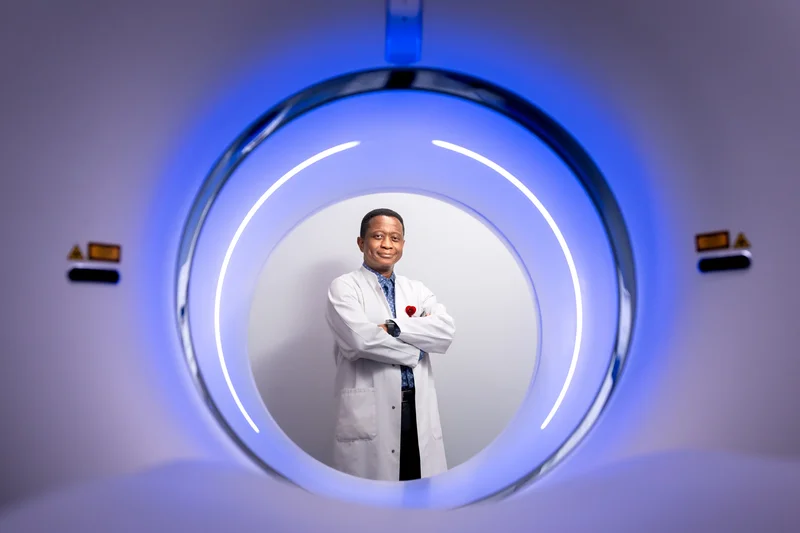
Professor Mike Sathekge is a global leader in nuclear medicine. A Fellow of the Society of Nuclear Medicine and Molecular Imaging and a member of the Academy of Science South Africa, he is head of the Department of Nuclear Medicine at the University of Pretoria and Steve Biko Academic Hospital, and president and CEO of the South African Nuclear Medicine Research Infrastructure. He is also editor-in-chief of the Seminars of Nuclear Medicine Journal and associate editor of the European Journal of Nuclear Medicine and Molecular Imaging, the Journal of Nuclear Medicine and the World Journal of Nuclear Medicine; he is chair of the Africa Health Research Institute and director of the International Atomic Energy Agency’s Anchor Centre for Rays of Hope for Cancer Care; and in South Africa, he is chair of the National Cancer Research and Innovation Strategy, and of the Academy of Science South Africa’s panel on research, development and innovation of peaceful uses of nuclear technologies