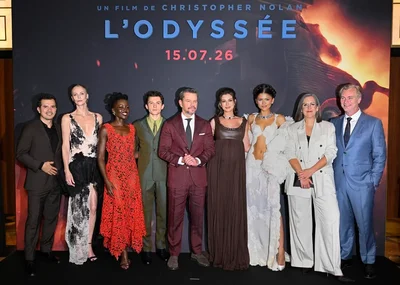
PARIS, FRANCE - JULY 08: (L-R) John Leguizamo, Charlize Theron, Lupita Nyong'o, Tom Holland, Matt Damon, Anne Hathaway, Zendaya, Emma Thomas and Christopher Nolan attend Universal Pictures "The Odyssey" Paris Premiere at Le Grand Rex on July 08, 2026 in Paris, France. (Photo by Kristy Sparow/Getty Images for Universal Pictures)
Getty Images for Universal Pictures
Christopher Nolan's "The Odyssey" opened July 17 with the biggest domestic launch of his career, an estimated $124 million three day domestic total and a global start north of $260 million, alongside an A CinemaScore and critic and audience approval scores in the mid to high 90s on Rotten Tomatoes. For a distributor that fronted a reported $250 million production budget and roughly $125 million in marketing spend, that is the outcome every studio marketing chief hopes for and few actually get. But the campaign that got Universal Pictures there is worth studying beyond the opening weekend numbers, because it broke from convention in ways that other studios will be tempted to copy, and it also left some obvious growth levers unpulled.
What worked: scarcity as the core strategy
The defining choice of this rollout was treating footage as a reward for theatrical attendance rather than as content built for maximum online reach. Universal debuted the film's first teaser exclusively in theaters alongside "Jurassic World Rebirth" in July 2025, and rather than posting the footage online, let it circulate only through leaked, shakily filmed clips that were repeatedly taken down. A six minute prologue then played only ahead of 70mm rereleases of "Sinners" and "One Battle After Another" in December, an event so tightly held that audiences at a London BFI Imax screening did not know it was coming. By the time a conventional trailer arrived online, the studio had already trained its most engaged audience to treat a trip to a specific format of theater as the only way to see new "Odyssey" footage first.
The approach paid off in the metric studios watch most closely for trailer performance. When the countdown trailer finally went wide, it pulled in more than 121.4 million views across social platforms in its first 24 hours, the studio's biggest 24 hour trailer launch on record and enough to top the previous benchmark set by "Wicked: For Good" at 113 million.
Universal extended the same logic to advance screenings, and this is the piece of the campaign most likely to be studied in marketing case studies for years. The studio scrapped the now standard practice of word of mouth advance screenings for social media influencers, choosing instead to screen the film only for critics following its London premiere. That is a real risk in an era when influencer reaction clips routinely function as a film's second trailer. But it also protected the brand from the kind of premature, take heavy discourse that can flatten a mystery box campaign before release, and it reinforced the message that this was a film meant to be experienced cold, on a big screen, one time.
The distribution calendar backed up that positioning. Universal confirmed an extended theatrical window for several of its 2026 releases, including "The Odyssey," keeping the film exclusively in cinemas for a minimum of five weekends before any move to home entertainment, a marked departure from the roughly three weekend windows common during the pandemic era. Paired with a three week exclusive IMAX booking window, the studio built genuine scarcity into both the marketing and the release pattern rather than manufacturing hype it could not sustain past opening weekend.
The premium format bet itself was foundational rather than cosmetic. The film is believed to be the first major commercial feature shot entirely on IMAX's 70mm cameras, and Universal built ticketing around that fact well before any marketing materials existed. IMAX 70mm tickets went on sale a full year ahead of the release date, an unprecedented move that theater chains attributed to the box office performance of "Oppenheimer," which drew more than $190 million of its global gross from IMAX screens alone. Advance shows sold out overnight in markets including Melbourne and London, with one IMAX general manager telling press the demand felt almost embarrassing given how far out it landed.
A star-studded cast adds to the allure, not makes it
The press run leaned heavily on the size of its ensemble to generate a steady drumbeat of coverage in the weeks before release. The cast, led by Matt Damon as Odysseus alongside Tom Holland, Anne Hathaway, Zendaya, Robert Pattinson, Charlize Theron and Lupita Nyong'o, gave the film a red carpet at its London premiere that functioned as its own marketing event, with outlets covering the arrivals as closely as the movie itself. The actors' commentary added a layer of credibility to the campaign that paid trailers cannot buy on their own. Holland called the film a masterpiece, and Damon, who prioritized location shooting and practical effects over a stage-bound production, described it as the hardest job of his career. That kind of unscripted, repeated praise from a cast this recognizable gave journalists a steady supply of quotable material and kept the film in entertainment coverage even during the weeks when Universal was deliberately withholding new footage.
The controversy variable
No account of this rollout is complete without acknowledging that a meaningful share of the film’s pre release attention came from casting backlash rather than trailer craft. The final trailer drew an estimated 542,000 dislikes tied to reaction over the casting of Lupita Nyong'o as Helen of Troy and Elliot Page as Sinon, and Elon Musk repeatedly targeted the film ahead of release, accusing Nolan of bias against Greek audiences over the casting. Universal did not fuel the controversy directly, but it also did not move aggressively to contain it.
What could have been added
The gap in this campaign is not creative, it is structural. A rollout built almost entirely on theatrical exclusivity and premium format scarcity is a strategy tailored to an older, already converted moviegoing audience. It does very little to build a bridge to viewers under 25 who discover films primarily through short form video rather than trailers attached to other theatrical releases. A campaign this disciplined about withholding footage could have paired that restraint with a parallel, lower stakes content stream, behind the scenes production diaries from the Morocco, Greece, and Iceland shoots, cast interviews about adapting Emily Wilson's translation, or creator partnerships built around the film's mythology rather than its plot. None of that requires showing a single frame of footage, and it would have given the campaign a second audience acquisition channel independent of the controversy cycle that ended up doing a lot of that work by accident.
There was also an opening around Ludwig Goransson's score and Travis Scott's role as an in-film bard that went largely unused. Music marketing tie ins, a score preview campaign, a Scott led promotional moment, are a natural extension for a studio sitting on this much cultural attention, and they would have given the film a presence in music and culture press that ran alongside, rather than in reaction to, the casting story.
None of this changes the headline result. Universal ran a disciplined, format first campaign that trusted scarcity over saturation, and the box office validated that bet. The lesson for other studios is not to copy the withholding strategy wholesale, but to recognize that a single powerful mechanic, in this case protecting the theatrical experience, can carry a campaign further than a wide but shallow content calendar. The next studio to try this playbook should keep the discipline and add the audience development layer this one skipped.