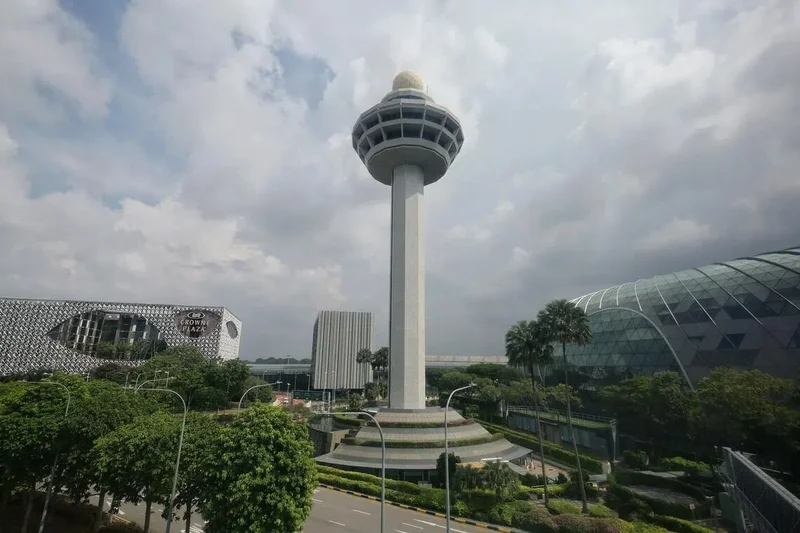
SINGAPORE – Some $4 billion will be invested over the next 15 years to overhaul Singapore’s air navigation services, including air traffic control systems, with the renovation of Changi Airport’s iconic control tower forming part of the upgrade.
The investment is aimed at meeting growing demand for air travel and strengthening Singapore’s position as a global aviation hub, Civil Aviation Authority of Singapore (CAAS) director-general Han Kok Juan said on July 22.
The International Civil Aviation Organization projects that global air passenger traffic will nearly triple over the next 25 years, with the Asia-Pacific region accounting for about half of that growth.
CAAS will refurbish the iconic Changi Control Tower and upgrade the Singapore Air Traffic Control Centre (SATCC) to accommodate new systems that will support future growth.
As Singapore builds capacity on the ground to handle rising passenger traffic, “it is important that we also build capacity in the skies, so that we are able to provide smoother, safer and more sustainable air services to travellers”, said Han at a press conference at the airport.
He added that this would strengthen Singapore’s position to capture the opportunities that aviation brings to the country and the companies based here.
While the tower, at about 80m tall, is the airport’s most recognisable landmark, not all air traffic controllers work there. Some are based at the SATCC near Changi Village, managing aircraft during the climb, cruise and descent phases of flight.
The Changi tower will be renovated to house new systems, with works including a new facade and the construction of an annex between the tower and Jewel Changi Airport.
Work will begin in November and be completed by the end of 2028. During this time, the tower will be covered with scaffolding and an aesthetic mesh.
Han said the tower was last upgraded in 1997, when its exterior was reclad. Recladding is a process that replaces a building’s facade.
There have been issues with parts of the facade dropping off and posing safety concerns, Han said, when explaining why it had to be refurbished.
Meanwhile, CAAS is building a new SATCC complex at its current site to house next-generation air navigation systems, while ensuring uninterrupted 24/7 operations.
The project is being done in phases. The first phase, comprising new electrical substations and a multi-storey carpark, has been completed. The second phase, which started in 2026 and is due to be completed by end-2028, will add new operations, equipment and maintenance rooms, as well as improved staff facilities.
The upgrades will support Changi Airport’s transition to three-runway operations by the end of the decade, when the third runway opens for civil aircraft use. This will increase the airport’s flight-handling capacity, and improve the safety and efficiency of air traffic in the region, Han said.
Expanding the workforce, upgrading systems
The opening of Changi Airport Terminal 5 (T5) in the mid-2030s, together with the wider Changi East development, will nearly double the airport’s size and increase its annual passenger-handling capacity from 90 million to 140 million.
To support this growth, CAAS will increase its workforce of about 500 air traffic controllers by around 40 per cent to about 700 by the mid-2030s.
Today, air traffic controllers manage about 2,000 flights a day, including around 1,000 arriving at and departing from Changi Airport.
The airport recorded 374,000 aircraft movements in 2025 – or an average of one take-off or landing every 84 seconds.
To attract and develop more Singaporeans for the profession, CAAS will introduce several initiatives, including an air traffic control specialisation with a local university and a management associate programme for fresh graduates.
Today, air traffic controllers manage about 2,000 flights a day, including around 1,000 arriving at and departing from Changi Airport.
ST PHOTO: KEVIN LIM
To help air traffic controllers manage the rise in air traffic volumes, CAAS will progressively replace or upgrade more than 30 air navigation systems over the next 15 years, incorporating technologies such as AI to help controllers make faster and better decisions.
Air traffic controllers, Han said, need to be supported by better systems and infrastructure.
“The use of data… will give our (controllers) an edge to be able to manage the rising demand for air travel,” he added.
One of the key upgrades is the next-generation air traffic management system, which will replace the current system used to manage aircraft operating at Changi and Seletar airports, as well as flights passing through Singapore-controlled airspace.
The existing system, which has been in use for about a decade, is nearing the end of its operational life.
The new system will be able to handle up to one million aircraft movements a year and track up to 4,000 aircraft simultaneously in real time – double the current capacity.
Work has already begun and is expected to be completed by 2030.
CAAS is building a new Singapore Air Traffic Control Centre complex at its current site to house next-generation air navigation systems, while ensuring uninterrupted 24/7 operations.
PHOTO: CAAS
Another major upgrade is an integrated digital tower system.
Using high-resolution cameras and sensors, it will give controllers a real-time digital view of the airfield, with critical operational information displayed on a single integrated platform.
This will improve situational awareness and decision-making, while allowing controllers to operate beyond the physical constraints of the airport’s control towers.
CAAS will also introduce an info-centric air traffic management tool, which uses data and predictive analytics to identify and manage potential traffic bottlenecks before they occur.
It will also enable the digital exchange of flight plans and aeronautical information with airlines and air navigation service providers across the region, improving traffic flow and better matching demand with available airspace capacity. Work will begin in 2027 and is expected to be completed by 2030.
The fourth major initiative is an open platform for air navigation services, which provides the digital infrastructure that will enable the seamless sharing of air navigation data, including flight plans and aeronautical information, within CAAS and with its external partners.
The platform will support closer regional collaboration and pave the way for more advanced air traffic management. Work has already started and is expected to be completed by 2028.
Of the $4 billion investment, $3.2 billion will go towards new air traffic systems and infrastructure, as well as maintaining them over the next 15 years, Han said.
Some $500 million will be used to hire, train and pay 200 more air traffic controllers. It will also fund initiatives, such as scholarships and the management associate programme.
The remaining $300 million will be spent on developing and introducing new technologies with industry partners and other air navigation service providers, as well as exploring new ways to manage air traffic.
Leveraging AI
Beyond upgrading its systems, CAAS is also investing in new technologies to make air travel safer and more efficient as the number of flights continues to grow.
One key focus is using AI to support air traffic controllers.
AI, Han said, could act as a “digital assistant”, helping controllers anticipate developing traffic and weather situations, recommend how aircraft should be sequenced and spaced, and reduce the mental workload involved in managing a busy airspace.
Later in 2026, CAAS will begin live trials of another AI-powered tool that automatically detects communication errors between pilots and air traffic controllers.
The system is designed to catch potential misunderstandings before they lead to incidents, such as runway incursions or aircraft coming too close to one another.
CAAS is also stepping up cooperation with its regional counterparts to improve the flow of air traffic across the region.
It is developing an AI-powered traffic management tool that can forecast congestion and suggest ways for neighbouring countries to better coordinate flights.
Since September 2025, Singapore, China and Hong Kong have held daily operational calls to coordinate cross-border air traffic.
South Korea, Thailand and Vietnam have since joined the initiative, allowing air navigation authorities to share information and better manage traffic across the region.