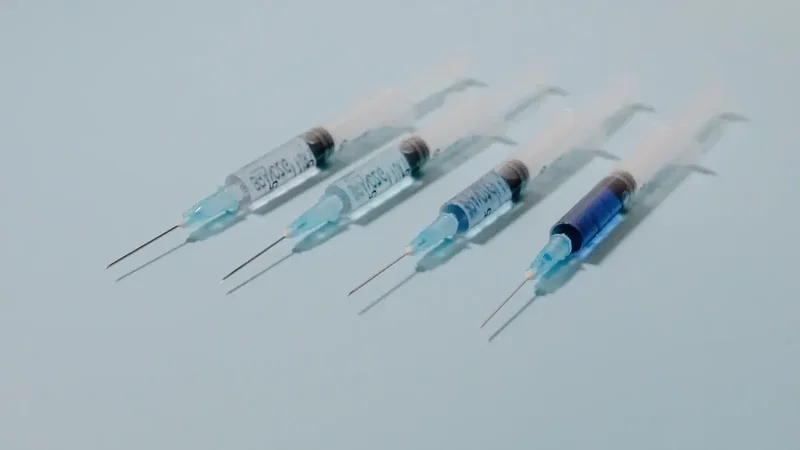
Just over half of everyone in Africa using the once-every-six-month HIV prevention injection, lenacapavir (LEN), through national roll-out programmes lives in South Africa. Health department data presented at South Africa's exhibition booth at the International Aids Conference in Rio de Janeiro on Tuesday shows 31 297 of the continent's roughly 60 000 LEN users are in South Africa.
The health department started rolling out the jab at 360 government clinics — about 8% of South Africa's public clinics — across six provinces on 5 June. Since then, 98.5% of HIV-negative people offered a choice between a daily HIV prevention pill and LEN have chosen the twice-yearly injection.
Just over two-thirds of South Africa's LEN users are in Gauteng and KwaZulu-Natal, the two provinces with the most clinics offering the injection (129 in Gauteng and 94 in KwaZulu-Natal). Together, the provinces are home to almost half of South Africa's population.
Health Minister Aaron Motsoaledi told Bhekisisa his department had worried that people might be reluctant to use the injection because some associate jabs with Covid vaccines.
"After the Covid pandemic, there was vaccine hesitancy and some people confuse LEN with a vaccine," he says. "But our data tells us South Africans are realising lenacapavir's value."
LEN is not a vaccine. It's a medicine for HIV-negative people that prevents HIV by stopping the virus from entering the body's cells. One injection protects someone for six months, after which they need a follow-up jab to stay protected.
Ten African countries are rolling out the jab with funding from the Global Fund to Fight Aids, Tuberculosis and Malaria and the United States government. Some, including Zambia and Eswatini, started as early as November and are seeing up to 85% of users returning on time for their second injection, country representatives reported at a conference session.
People need to return for their follow-up injection within two weeks from the date of their six-month appointment. If they miss that window, they have to take four lenacapavir tablets — two on the day of the injection and two the next day — alongside the jab, just as first-time users do. The tablets make sure there is enough medicine in the body to protect against HIV within three days.
Studies have shown that LEN provided complete protection against HIV for young women in clinical trials and near-perfect protection for other groups, including gay and bisexual men and transgender people, who have a higher chance of getting HIV than the general population.
Because South Africa started rolling out LEN only on 5 June, the first users will be due for their second injections on 6 December. The health department therefore doesn't yet know how many people will return for their follow-up shots.
But early results from LEN4PrEP, an implementation study led by Wits RHI that started in November, show that, of the relatively small number of participants who should have returned for their second injection, 85% have come back on time for their follow-up dose. The study is being conducted at two Tshwane government clinics and a mobile clinic that serves the surrounding communities.
South Africa had an estimated 134 000 new HIV infections in 2025 — about 381 a day. Modelling by Wits University researchers shows that if between one million and two million HIV-negative people receive LEN at least once a year between now and 2043, South Africa could reduce new annual infections to about 65 000 — low enough to end Aids as a public health threat by 2043.
But scaling up to that level will require far more doses than are available. Large supplies are expected once generic versions of LEN enter the market in 2027.
Bhekisisa analysed the health department's first six weeks of LEN roll-out data to find out who's using the injection, whether it has increased the overall use of HIV prevention medicine and whether South Africa could run out of the branded doses, made by Gilead Sciences, that the Global Fund is supplying to the country at an undisclosed price.
The health department tracks LEN uptake through its SyNCH (Synchronised National Communication in Health) system. SyNCH creates mini electronic patient records that allow nurses' data entries to be displayed on a real-time dashboard, which sends daily summaries to the department.
The system is used to dispense chronic medicine through the health department's CCMDD (Central Chronic Medicines Dispensing and Distribution) programme. Because patients' records can be accessed at any clinic using SyNCH, LEN users can receive their follow-up injections at any of the 360 roll-out sites.
**Who uses LEN in SA? **
People who use government clinics in South Africa can choose between two types of HIV prevention medicine: a daily pill or the twice-yearly injection, LEN.
By 19 July — six weeks after LEN was introduced — health department data showed that 98.5% of people offered a choice had opted for LEN. The true figure might be slightly lower, however, if nurses were more diligent about recording LEN users than pill users in the department's SyNCH system.
The results are similar to those from LEN4PrEP, an implementation study that has been running for eight months and is fully enrolled with 1 544 participants. There, 88% of participants have chosen LEN over the pill. "The number has steadily increased over the course of the study — we started off with 80%," says the study's chief researcher, Saiqa Mullick.
Similarly high uptake has also been reported in countries such as Zambia.
Mullick says people aren't choosing LEN because it works better than the pill — they're choosing it because it's easier to use. Studies show LEN is more effective than the daily pill but largely because people find a twice-yearly injection easier to stick with than taking a pill every day.
"Participants in our implementation study say they like the idea of fewer clinic visits [pills are collected every three months versus LEN every six months], the reduced risk of forgetting to take daily doses and long-acting protection," says Mullick.
Almost three-quarters (72%) of LEN users in South Africa's roll-out are women. That's at least partly because women generally visit clinics more often than men, especially during pregnancy or when taking their children for vaccinations.
Mullick says the fact that 28% of users are men — a similar proportion to the LEN4PrEP study — is encouraging.
"About 20% of our participants are men. With previous HIV prevention products, we've had around a 10% male participation rate," she says. "Our study also shows that men are especially keen to use LEN: 93.6% of men who were offered a choice between the pill and LEN chose the injection."
A quarter of LEN users in the health department's roll-out are between 15 and 24 years old. More than 70% of them are female, suggesting that many are likely to be teen girls and young women — one of the government's priority groups for HIV prevention. Around 40% of new HIV infections in South Africa are projected to occur in this group.
The largest share of users (39%) are between 25 and 34 years old, while about three in 10 are aged 35 to 49. Together, the two age groups are projected to account for 64 250 (48%) of South Africa's estimated 134 000 new HIV infections in 2025.
Pregnant and breastfeeding women make up just over a quarter of LEN users. Motsoaledi says that's mainly because they regularly visit antenatal and child vaccination clinics, giving nurses more opportunities to offer them the injection.
"Nurses are therefore in direct contact with them and can explain the benefits of LEN," he says. "We can also easily reach pregnant women and new mothers through the health department's MomConnect app, which has six million users."
Previous modelling showed that allocating about a quarter of the Global Fund's donated doses to pregnant and breastfeeding women — together with a similar proportion for adolescent girls and young women — could prevent more HIV infections over the next five years than many other distribution strategies. The early roll-out data suggests LEN is reaching many people in the two priority groups.
Uptake has, however, been much lower among some priority groups, including sex workers (705 people), gay and bisexual men (419), transgender people (31) and people who inject drugs (33). The groups have a higher chance of getting HIV than the general population and are therefore a key focus of HIV prevention programmes.
One possible explanation is that many clinics designed to serve these communities closed after NGOs running them lost US government funding when the Trump administration terminated grants. Another is that some people may not have felt comfortable disclosing their occupation (in the case of sex workers), sexual orientation or gender identity to clinic staff.
**Has LEN led to more people using prevention medication overall? **
In 2025, before LEN became available, an average of about 2 670 people a week started taking the daily HIV prevention pill at just over 4 500 public health facilities.
Since LEN was introduced, an average of about 4 200 people a week have started using the injection at 360 clinics across six provinces.
The comparison is not like for like — the 360 clinics were selected because they were ready to introduce LEN and might not reflect all public health facilities. But the early figures suggest that offering people another HIV prevention option could substantially increase demand.
The health department’s data shows that around a third of LEN users had never used HIV prevention medication before, suggesting that LEN has, at least so far, brought new prevention medicine users into the health system. The LEN4PrEP study has an even higher number: around 58% of LEN users had never used prevention medication before.
**Will SA run out of Global Fund doses? **
Since LEN was introduced, clinics have given an average of almost 4 200 injections a week. Of the 115 320 doses that had arrived — or were due to arrive — in South Africa by mid-June, 43 813 had been distributed to clinics.
By 19 July, clinics had used 25 730 of the doses, leaving 18 083 in stock. At the current rate of uptake, the stock would last until about mid-August. By then, it's reasonable to expect that more doses would have been distributed to clinics.
The remaining 71 507 doses that had arrived in the country but had not yet been sent to clinics would, at current uptake, last until about mid-December once they enter the supply chain.
The Global Fund has pledged a total of 974 450 doses over two years. With only 115 320 delivered so far, just under 860 000 doses are still to come — enough to sustain the current rate of uptake for about another 200 weeks.
It's therefore unlikely that South Africa will run out of Global Fund-donated LEN before phase 2 of the government's roll-out begins in April next year. By then, the health department also hopes to start buying generic versions of the drug, provided they have been approved by the South African Health Products Regulatory Authority.
According to Sahpra CEO Boitumelo Semete-Makokotlela, at least one of the six companies licensed to make generic LEN — India's Hetero — has applied to register its product in South Africa. She says Sahpra expects to complete its review by March.
Hetero has committed to selling generic LEN to South Africa for no more than $20 (about R334) per injection and $15 to $17 (R250 to R284) for the four starter tablets.
But Mitchell Warren, the executive director of the international HIV advocacy organisation Avac, says supply is just the first step.
"The bigger challenge with a growing LEN programme won't be supply," he says. "It will be infrastructure. How to ensure South Africa's health system can support 500 000 people needing an HIV test and an injection every six months. What if it's a million or more? Will the health system hold?"