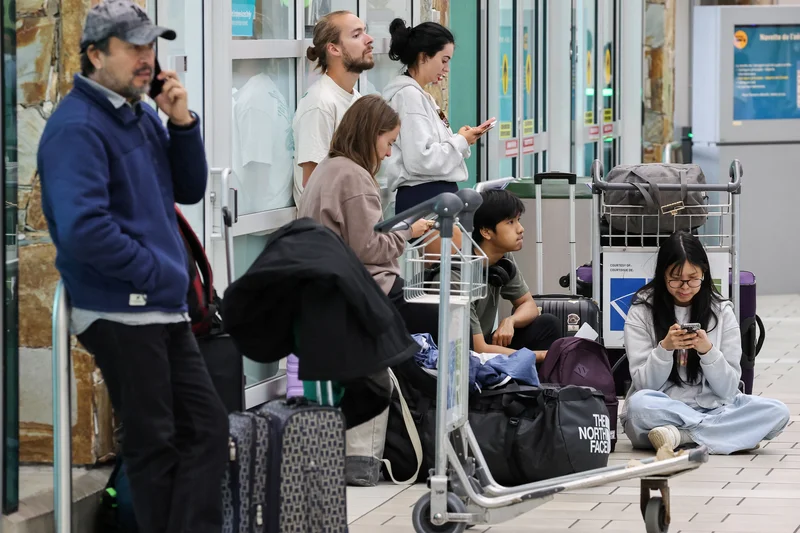
At Toronto Pearson International Airport on Sunday, Nikita Joseph tried to calm her crying toddler. She rocked a stroller with one hand and checked her phone with her other for updates on her cancelled flight.
The Windsor resident was supposed to fly to Antigua and Barbuda for vacation to meet her three other children, who travelled there with Ms. Joseph’s sister last month. “I don’t even know how to tell my five-year-old that I’m not coming today,” Ms. Joseph said. “She has been anticipating my arrival, and I can’t even tell her when I’m coming.”
Around her, prospective travellers found themselves in similar situations – sitting on suitcases and frantically refreshing webpages on their phones in hopes of finding an alternative flight to avoid the disruptions caused by the first day of WestJet’s flight attendant strike.
At 2:01 a.m. EST on Sunday, the airline and Canadian Union of Public Employees 8125, the local that represents WestJet’s 4,400 flight attendants, announced the labour action after the strike deadline passed.
A total of 600 flights were cancelled as of midday Sunday as workers walked off the job, creating chaos and frustration at airports across the country.
Talks between the airline and the union broke down late Saturday over the issue of wages and ground pay, which is the amount flight attendants are paid for the work they perform before a plane departs and after it lands. CUPE says WestJet flight attendants work up to 35 hours a month for free because they do not earn ground pay.
After the strike notice, WestJet released the details of its latest contract proposal, which offered flight attendants a new “duty pay premium” (a salary increase of 12 per cent), designed to address the union’s claim of unpaid work, as well as annual wage hikes. CUPE 8125 president Alia Hussain said in a news release that the airline’s offer did not go far enough.
At a Sunday morning news conference, CUPE recording secretary Cameron Jones said talks had resumed.
“The bargaining committee is trying to close that gap to get a deal that we believe is fair that we can bring back to the membership so we can go back to the work that we love,” he said at the picket line outside Calgary International Airport.
Last summer, Air Canada flight attendants went on strike over the same issue, resulting in hundreds of cancelled flights and days of delays. The flight attendants, also represented by CUPE, defied a back-to-work order issued by the government shortly after the strike began, and chose to strike unlawfully in order to compel Air Canada to come back to the bargaining table. The strike ended after three days, and a tentative agreement that includes four years of wage increases and partial ground pay provisions was later rejected by union members, but enforced by an arbitrator.
In a scene that may cause déjà vu, 200 union members walked picket lines outside Terminal 3 at Toronto Pearson International Airport on Sunday. Striking workers shouted demands for better wages through megaphones as rain poured. Passing drivers honked their horns in support while dropping off travellers.
Meshach Baba, 25, slept on the airport floor after he arrived from Taipei Saturday night and learned his flight to Orlando, Fla., had been cancelled because of the labour dispute. The cancellation was for the last leg of his flight home after he spent three weeks in the Philippines for a wedding, his first solo international trip.
“The trip was still pretty fun, but I’m definitely going to be more cautious about who I’m booking with,” he said.
While WestJet rebooked his flight for Sunday afternoon, that trip was also cancelled because of the strike. His next flight, on Delta Air Lines, was scheduled for the next day.
Domestically, Canada’s other major airlines are absorbing the surge in demand as travellers attempt to salvage their summer vacation plans.
In an e-mail, Porter Airlines confirmed that bookings have recently increased across its network.
“While flights are already extremely busy, seats are available on many existing flights and we are assessing whether we can add more flights,” Porter communications director Brad Cicero said.
Air Canada said most seats on its flights are sold out and it currently has minimal ability to increase capacity.
“Our teams are making every effort to support WestJet passengers and provide available travel options. However, travellers need to be aware that we are in the peak summer period and the August long weekend, representing the busiest weekend of the year,” the airline said in an e-mailed statement.
The strike, said John Gradek, a faculty lecturer in supply networks and aviation management at McGill University, reflects a broader reckoning with the relationship flight attendants have with their employer, sparked by significant layoffs at the beginning of the pandemic.
Currently, WestJet’s “credit hour” compensation system links cabin crew pay to the length of the flights they work, but is used to pay them for a full range of duties, not just time spent in the air, the company says on its website. The “credit hour” combines flight times, ground duties, delays and other labour into a “single, higher rate of pay” that is then credited across the workday, according to WestJet.
The pay rate ranges between $28.88 and $53.61 per credit hour. At 80 credit hours a month – considered full-time work – that adds up to between $27,700 and $51,500 a year.
While many airlines maintain this type of compensation structure, Delta Air Lines spearheaded reforms in 2022 when it became the first carrier in North America to pay flight attendants specifically for work done on the ground. American Airlines and Alaska Airlines followed suit with boarding pay of 50 per cent of regular rates.
Mr. Gradek said the “credit hour” structure disproportionately benefits senior employees, while leaving junior ones struggling to make ends meet.
“The junior flight attendants who work three or four flights a day don’t get any benefits in that at all. They’re in trouble,” he said.
On what the dispute will cost WestJet, a private company, Mr. Gradek made the “conservative estimate” that the airline will be out between $8-million to $10-million dollars each day of the strike, as it must absorb the costs of rebooking passengers on competitor flights at premium prices. Still, he noted the airline turned down a loan offer from the federal government of up to $150-million in June to offset surging fuel costs, suggesting its financial health is stable.
As for the potential of the federal government ordering WestJet cabin crew back to work by invoking Section 107 of the Canada Labour Code, Mr. Gradek said that provision has lost its utility.
“That horse has left the barn a long time ago,” he said, referring to Air Canada flight attendants’ decision to defy the Section 107 order from Jobs Minister Patty Hajdu last summer that directed the Canada Industrial Relations Board to end the work stoppage and order binding arbitration between the airline and the union.
In a statement early Sunday, Ms. Hadju said she was disappointed that no deal could be reached to avoid a disruption at WestJet, but did not say whether the government planned to intervene.
Mr. Gradek suggested the trend of frequent airline labour disputes signals the need for industry to shift.
“They disrupt people’s lives. They disrupt the economy, and it’s time for us to come up and say, ‘Okay, let’s come up with a different way of doing business.’ ”
*With reports from Vanmala Subramaniam and The Canadian Press *