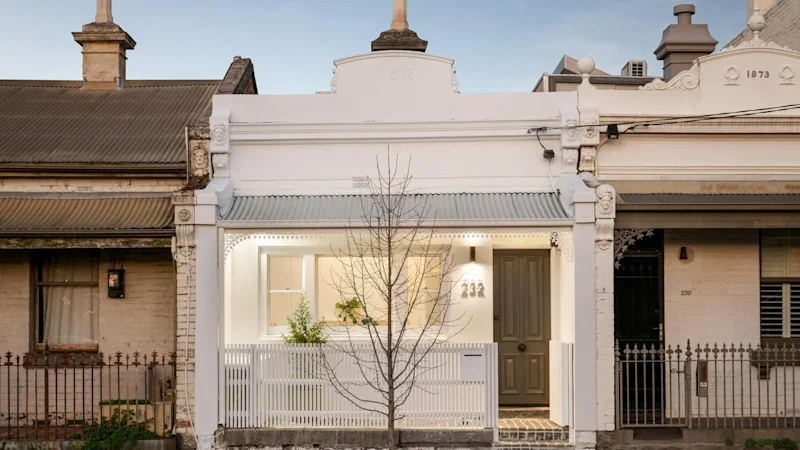
A Carlton North terrace with a soaring renovation is still available with price hopes of $1.75 million after passing in on a vendor bid at auction on Saturday.
The two-bedroom home at 232 Canning Street dates to 1872 but has been transformed, with high vaulted ceilings and floor-to-ceiling glass at the rear alongside a streamlined kitchen.
The property was one of 570 scheduled to go to auction in Melbourne last week. By Saturday evening, Domain Group recorded a preliminary auction clearance rate of 60 per cent from 367 reported results throughout the week, while 65 auctions were withdrawn. Withdrawn auctions are counted as unsold properties when calculating the clearance rate.
The period home on one of the inner north’s sought-after streets was listed with a price guide of $1.7 million to $1.75 million.
At auction, a vendor bid was placed at $1.68 million, below the bottom of the guide price range.
But with no genuine bids forthcoming, the home was passed in. It was later listed for private sale at $1.75 million, which had been the reserve.
Nelson Alexander selling agent Charlie Barham noted that the home had been recently renovated. Older photos show the living space has been opened up to let in light.
“Being newly renovated, it is a turnkey house; it appealed over the campaign to young professionals and downsizers - being one level,” he said, adding that it is close to Rathdowne village shops and cafes.
But in a tale of two markets, he highlighted his colleague’s sale in Fitzroy North which attracted four owner-occupier bidders and sold above reserve even though the house needed work and some interested parties took advice from structural engineers.
The liveable five-bedroom house at 151 Miller Street was listed with a guide of $2.1 million to $2.3 million.
At auction, bidding began at the bottom of the guide and rose in $20,000 increments, then passed the top of the guide, which was also the reserve price. The stride shortened to $10,000 and $1000 offers.
It sold for $2,566,000 to an upsizing couple who plan to live there.
“It is a bit of a standout in the current market,” Nelson Alexander selling agent Janine Ballantyne said, noting the large block. “I think people were prepared to [bid] after doing the due diligence.”
Elsewhere, another period home in Richmond sold for $2.37 million to a young couple who beat a downsizing family for the keys.
The three-bedroom house at 128 Lennox Street had a price guide of $2.1 million to $2.3 million.
Proceedings began with a vendor bid of $2 million, then there was competition up to $2.2 million, where the price stalled. Although the owners were there to sell, their hopes were a little higher, BigginScott Richmond selling agent Edward Hobbs said.
Further bidding pushed the price to its reserve of $2.25 million, and then bidding dragged on with offers as low as $5000 until it reached $2.37 million, at which point it was sold.
“We felt a real shift [on Saturday] in particular. I don’t know if that is off the back of some [forecast] RBA stability,” Hobbs said, referring to the better-than-feared inflation figures released last week.
“That house was obviously a bit of a one-off. It was iconic - it had a striking facade, built circa 1900.”
He thought the market overall had rebalanced a bit, but was a little patchy, with different price segments attracting different levels of interest.
In Coburg, a three-bedroom townhouse in a block converted from a squash court sold in post-auction negotiations for $810,000 to a first-home buyer.
The home at 7/1 Kaye Court had been asking $750,000 to $800,000, with a reserve price at the top of the range. It drew a genuine offer at auction of $750,000 but soon passed in.
“A lot of first home buyers walked through that one. The vendor was quite realistic, she presented it immaculately,” Ray White Coburg selling agent Jake Popalis said.
“There are a lot of buyers around that are first home buyers. They are the ones that are still moving within a timely manner.”
He said the market in general has softened.
“Pricing has been affected but not as much as people are expecting or making out to be,” he said.
“The biggest change is days on market creeping up… it is taking maybe an extra campaign or two instead of a four-week campaign.”