Even by the brutal standards of militant settler violence in the West Bank, the raid on Deir Jarir late on Sunday night that killed two Palestinians and left another in hospital with a gunshot wound was extreme.
Palestinians in the town said settlers from a nearby outpost arrived after 9pm on Sunday claiming that they were searching for stolen livestock. Israeli soldiers and police soon joined them, protecting them as they sought to take several villagers’ sheep by force.
But when villagers raised the alarm and a crowd gathered, soldiers shot two men, beginning a night of three successive raids by settlers from nearby outposts and Israeli soldiers that lasted until after 2am, according to Palestinian residents of Deir Jarir.
Saber Ajaj, a relative of one of the victims, 53-year-old Odeh Farajna, said he found him moments after he had been shot through the chest. Farajna, a member of the village council, owned a flower shop and helped with the stonework at the local graveyard.
“The moment I put him in the car I knew that he was dead,” Ajaj said in an interview during a reception held after the funeral. “This shooting was meant to kill.”
In interviews as they buried the two victims on Monday, family and friends of the dead Palestinian men described several attacks each month where they said settlers, backed by security forces, arrived in houses on the outskirts of the village and then stole livestock.
“It’s a partnership between the army and the settlers,” said Adel Rashid, the father of the younger victim, Abdul Adel Rashid Abu Mukh, 26.
Rashid said local settlers on Sunday had stolen 21 of his sheep, while 50 more had been taken from another member of the village. Video of Sunday’s incident showed a settler protected by four IDF soldiers in green camouflage leading a sheep out of a local house.
The raids are part of a picture of worsening settler violence in the region as Benjamin Netanyahu’s far-right allies have accelerated a land grab in the occupied West Bank.
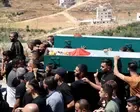
The funeral of Awda Abulrahim Farahneh and Ahmed Adil Abu Muhu on Monday. Photograph: Anadolu/Getty
Arbitrary checkpoints and other restrictions to cut off towns like Deir Jarir after the 7 October 2023 attacks by Hamas have been bolstered by plans for the government to endorse new settlements in the West Bank before national elections that could challenge the Netanyahu government’s mandate.
On the hill above the village is a settlement built last year that appears to share water infrastructure with an Israeli military base, according to Dror Etkes, an Israeli who founded Kerem Navot, an organisation which monitors Israeli land policy in occupied Palestine. Residents said the settlers and military appeared to have coordinated the raid.
Seven people have been killed in the village since 7 October 2023. Their portraits have been spray-painted on the walls of the town, along with the date they died.
“The killing in Deir Jarir is one example of how Israel promotes ethnic cleansing in the West Bank: settlers invade and steal, while the military and police accompany them and shoot Palestinians who try to protect their homes and property,” said Yuli Novak, the executive director of B’Tselem, a human rights organisation based in Israel that catalogues violations by the security forces.
A Guardian analysis has shown that Israel has not prosecuted its citizens for killing Palestinian civilians in the occupied West Bank since the start of this decade, creating impunity for a campaign of violence.
The West Bank attacks are intensifying. Fadi Hamdallah al-Naasan, a 17-year-old from the town of al-Mughayyir, northeast of Ramallah, died on Saturday after succumbing to a gunshot wound to his leg during a raid on his house by the Israeli military and settlers on 11 July.
Nearly a thousand mourners, mostly men, gathered in Deir Jarir on Monday shortly after noon for the burial. They marched from the mosque in the centre of the town, carrying the two bodies down to the old graveyard.
On the road entering the area stands a new set of gates at a checkpoint established after 7 October that security forces are said to open or close arbitrarily, effectively cutting off the villages from the outside world.
“Every time they come to attack us they are trying to make life here unlivable,” said Iyad Odah, 56, a member of the village council who knew Farakhna. Since 7 October, he said, the town’s farmland, which once occupied thousands of hectares, was inaccessible as local settlers beat back farmers, attempting to access their orchards and grazing land.
The Israeli military on Monday saidthey had gone to Deir Jarir to escort Israeli settlers, who claimed their livestock had been stolen and wanted to take it back. The military said they opened fire after Palestinians threw rocks and concrete blocks at the security forces. They did not respond to questions clarifying why they did not use non-lethal crowd control instead of live ammunition.
Responding to the IDF’s claim that they had been attacked by “terrorists” in the village, Odah, of the town’s village council, said: “They are the real terrorists.”