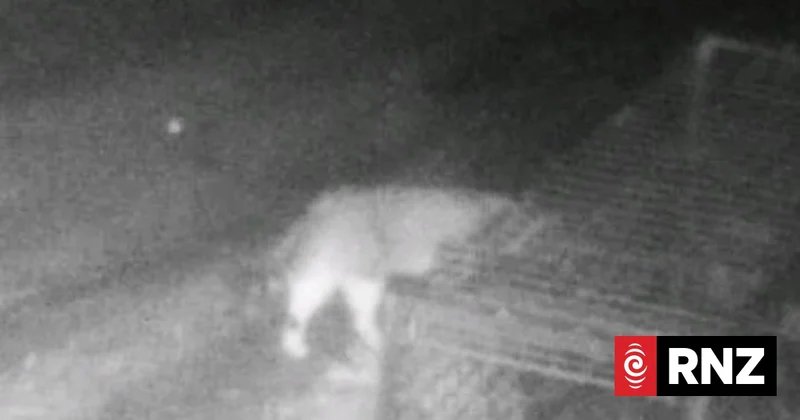
A wildlife-devouring feral cat so elusive it was nicknamed 'Nine Lives' has been caught after a massive three-year effort.
Nine Lives was thought to have killed around three-quarters of the rare pāteke, or brown teal, released on the Purerua Peninsula in the northern Bay of Islands.
Pest-free Purerua-Mataroa coordinator Andrew Mentor said those 20 pāteke made up about 1 percent of the world population of the flightless native duck.
It was likely Nine Lives had also made meals out of many a kiwi chick.
Mentor said possums had all but been eliminated from the peninsula and rat and stoat numbers had been dramatically reduced, but Nine Lives had proved incredibly hard to catch.
Such was the cat's notoriety, a CNN crew travelled to New Zealand earlier this year to make a documentary about the quest to find Nine Lives. The elusive cat had also featured in the podcast Our Changing World.
Mentor said the large grey tabby first came to attention in 2023 after a release of captive-reared pāteke.
"From that point on, it became obvious he was decimating our wildlife, particularly our pāteke-brown teal," he said.
"So we started an intensive camera network to try and figure out his patterns. And he was so erratic and so highly averse to human contact, that he was very difficult to predict or track."
Over the next three years, Pest-free Purerua trappers worked out where the cat liked to go, experimented with many different kinds of lure, and kept expanding their camera network.
Finally, last Thursday, Nine Lives returned to the same spot for the third night in a row - something the cat had never done before.
"It was a needle in a haystack to go out and spend hours and hours waiting in the hope that he would turn up. It depended on weather conditions, the moon, light, all those different factors, to have him in the right place at the right time, which is very, very difficult. But eventually we located him at a feeding spot where we were able to take him out by shooting him," Mentor said.
"Why he was so unpredictable, we just don't know. But it shows that cats, being the apex predator that they are, are very difficult to remove from the environment they know so well. And feral cats just don't want anything to do with humans."
Mentor said most feral cats in New Zealand were derived from the North African hunting cat, so hunting was in their nature.
"We love our companion cats and we don't want to harm them. But when it comes to feral cats and the species we hold so dear, we just need to keep working on removing them because there are so many in the environment."
Once the threat from Nine Lives became clear, further releases of pāteke on the peninsula were halted.
Mentor said at the time the group believed they had the feral cat population under control.
"But when we introduced an enticing species like this into the environment, which is very easy for a cat to predate on, in hindsight it showed we weren't ready. And it highlighted the extra work that we needed to do to make that area safe for pāteke to come back, and for kiwi to survive from chicks through to adulthood."
The demise of Nine Lives meant Pest-free Purerua's five paid workers could now re-focus their efforts on a more normal strategy of "detect and respond".
That meant stopping possums and feral cats re-invading the peninsula via a two-kilometre-wide neck of land that joined it to the mainland north of Kerikeri.
While the pāteke deaths had been a setback there had also been notable successes on the peninsula, Mentor said.
The local kiwi population was now estimated to be around 3000, one of the highest - if not the highest - densities of the national icon anywhere in the country.
The peninsula's mix of coastal, wetland and farm environments was also home to kororā (little blue penguins), oi (grey-faced petrels), multiple species of gecko, marsh crake, spoonbills, fernbirds, New Zealand pipit, dotterel and Australasian bitten.
Mentor said he would be taking the trappers and their partners out for a meal to thank them for many nights spent camping out in the bush looking for Nine Lives.
"It's to acknowledge their dedication. Without that, we wouldn't have had this outcome."
Mentor said pet cats were not the group's target.
"Companion cats are important to many, many people. It's the feral ones that we're after. They just don't belong in the New Zealand ngahere (forest)."
Mentor said pāteke once numbered in the hundreds of thousands and were found in every corner of New Zealand.
However, they were extremely vulnerable to introduced predators, and their numbers plummeted to just 700 by the 1990s.
Most of those lived on Aotea Great Barrier Island and along Northland's east coast.
Their small size - just half that of the introduced mallard duck - and nocturnal habits made them easy prey for cats, stoats and weasels, as well as pūkeko and hawks.
Since the national Pāteke Recovery Programme started more than 20 years ago, their numbers had increased to about 2000.
However, it remained one of New Zealand's rarest waterfowl, roughly on par with the whio or blue duck.
It was also the world's fourth-rarest dabbling duck, a type of duck that feeds by tipping up instead of diving.
Pest-free Purerua-Mataroa is led by Northland conservation trust Kiwi Coast and covers an area of 7600ha.