TEHRAN – The curtain fell on the 2026 FIFA World Cup in the United States with an ending that few in Washington had hoped to witness. Instead of Argentina lifting the trophy at MetLife Stadium in New Jersey, Spain emerged victorious after defeating the defending champions 1-0 in extra time, turning what many expected to be a political celebration into a night of disappointment for President Donald Trump and his closest international allies.
The tournament, jointly hosted by the United States, Canada, and Mexico, concluded with its most important matches—the semifinals and the final—played on American soil. Yet the image that ultimately defined the competition was not one of political triumph for the host nation but of Spain celebrating its second World Cup title, 16 years after its first.
Ferran Torres etched his name into Spanish football history with the decisive goal in extra time, ending Argentina's reign as world champions and silencing tens of thousands inside MetLife Stadium. For Lionel Messi and his teammates, who had dreamed of defending the title they captured four years earlier, it was a heartbreaking finale. Their quest to cement one of football's greatest dynasties ended with tears instead of triumph, leaving an unforgettable image of a champion forced to surrender its crown just one step from history.
Yet beyond football, the outcome carried unmistakable political symbolism.
Spain's victory represented far more than sporting success. Madrid has emerged as one of Europe's strongest critics of Israel's military campaign in Gaza and has openly opposed the US-Israeli military offensive against Iran. The government of Prime Minister Pedro Sánchez recognized the State of Palestine, repeatedly condemned Israeli actions in Gaza, and has sought to strengthen restrictions on arms exports to Israel.
Trump, by contrast, had repeatedly criticized Spain's foreign policy, accusing Madrid of undermining Western unity through its positions on Gaza and Iran. During recent remarks, the US president criticized Spain's refusal to align fully with Washington's Middle East strategy, portraying the Spanish government as an unreliable partner whose positions benefited America's adversaries.
Against that backdrop, Spain's triumph acquired political significance that extended well beyond the football pitch.
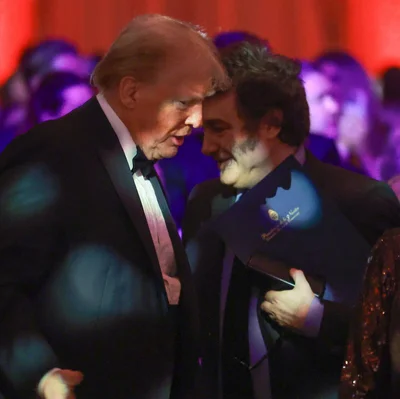
Throughout the tournament, Trump made no secret of his admiration for Argentina and its President Javier Milei, one of Washington's closest ideological allies. An Argentine victory on American soil would have provided a symbolic gift to Milei while reinforcing the political alignment among Buenos Aires, Washington and Israel.
Victory for Lionel Messi's side could also have been celebrated by Israeli Prime Minister Benjamin Netanyahu and President Trump as a symbolic success for a network of political allies whose partnership has deepened during recent regional conflicts.
Instead, that narrative collapsed with Ferran Torres' extra-time winner.
The disappointment was compounded by the United States' own underwhelming campaign, which ended well before the decisive stages despite hosting the tournament's showcase matches.
In Tehran, however, Spain's victory prompted an entirely different reaction.
Iranian President Masoud Pezeshkian congratulated Spain on what he described as a "well-deserved" World Cup triumph.
"The joy of the friendly nation and government of Spain is the joy of the Iranian nation and government," Pezeshkian wrote on X.
Parliament Speaker Mohammad Baqer Qalibaf also praised Spain, saying the country's support for the Palestinian people and its backing for Iran during the US-Israeli war reflected "the spirit of freedom and resistance to domination."
Iran's Football Federation President Mehdi Taj likewise congratulated Spain, describing the championship as a victory achieved by a nation that had stood against "the crimes and occupation of the Zionist regime."
The celebrations extended beyond Iran. Across the Gaza Strip, hundreds of Palestinians gathered around large public screens to watch the final before erupting in celebration after Spain secured the title. For many Palestinians, Spain's victory represented not only footballing excellence but also recognition of Madrid's outspoken diplomatic support for their cause.
In the end, the 2026 FIFA World Cup concluded with a storyline few political strategists could have scripted. The tournament that offered Trump an unparalleled global stage ultimately crowned a nation whose foreign policy has frequently challenged Washington's approach to the Middle East.
For Argentina, it was the agony of coming within a single goal of retaining the world's greatest football prize. For Trump and Netanyahu, the defeat of Messi's team meant the loss of what could have become a powerful symbolic victory for their closest political partners.
Instead, the World Cup closed with Spain lifting the trophy, while congratulations poured in from Tehran and celebrations echoed through Gaza—a finale that transformed football's grandest stage into an unexpected moment of geopolitical symbolism.