July 22, 2026 — 7:30pm
Save
You have reached your maximum number of saved items.
Remove items from your saved list to add more.
AAA
For me, the 70 finalists of the 2026 Young Archie competition on display at the Art Gallery of NSW are the sleeper success of this year’s exhibitions so far – for the overwhelming message of love in the accompanying texts. So many of them are portraits of some of the most important people in the entrants’ lives.
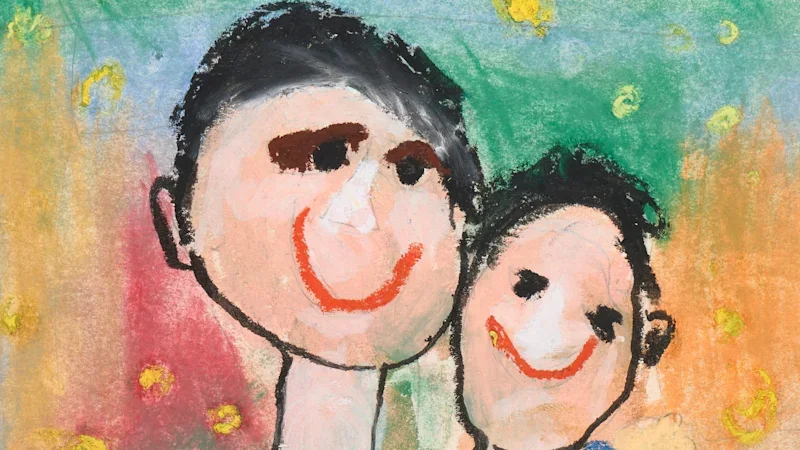
Young Archie 2026 finalist, 5–8 years, Caden Bi, “Forever her little one”, oil pastel and pastel on paper. Art Gallery of New South Wales
And so, I thought, it would be absolutely fascinating to see who was chosen.
While both the Archies and the Archibald have some self-portraits, the Archibald entries are mainly of people who’ve made their mark on our society. And it’s certainly interesting to see how they are interpreted by their artists.
But the Young Archies – oh my! They are, in both their portrayals and their accompanying words, such a glimpse into the hearts of so many young lives. Most reveal key members of their families, but some portray valued friends or mentors. With my longstanding focus on ageing in our society, what blew me away were the powerful intergenerational bridges demonstrated by so many entries depicting beloved grandparents, great-grandparents and other valued older people.
So, of course, I could not resist doing the numbers on the 70 finalists and the additional 20 honorary mentions displayed on the gallery’s walls, even though they may not be a representative sample of the full range of entries. As a researcher, I would, of course, love to get my hands on the 4350-plus entries into the 2026 Young Archies competition. But that did not take away from the joy of reading and seeing how the winners depicted their chosen subjects.
And homing in on those who have portrayed grandparents, and even a couple of great-grandparents, as well as other significant older people in their lives has been an eye-opener. And in these troubled times when Pauline Hanson is calling for a “monoculture”, what shines through is that most of the children who expressed respect and love for the elders in their lives were from non-English-speaking backgrounds.
I’ve written a book about ageing and often give talks about it. When I speak about ageism, I’m usually asked how we compare with other cultures, especially those which venerate their elders, such as Asian ones.
What is clear from these artistic entries is that we’re importing the best of those cultures when it comes to giving us insights into intergenerational relationships. A quick breakdown of the 22 entries portraying older people showed that 17 were from non-English-speaking backgrounds. Nine had Chinese-sounding surnames. The remaining five had Anglo-Celtic names.
Caden Bi, at six years old, is perhaps my favourite artist, with grandmother and grandchild embracing each other, and the simple text saying that “This is a happy picture of me and my grandma. We are smiling big and hugging each other. We feel warm and love.”
But perhaps the most profound one, in some ways, comes from Alexander Hsieh: “My English tutor is an 80-year-old man with kind eyes and a gentle smile. He used to be an English teacher at a private school for many years ... [and] to me, he is more than a tutor, he is a true friend. When I practise my writing, I share my thoughts and feelings with him and he shares his life experiences with me … I hope he will keep teaching me for many years.”
Then there is the deep understanding by some of what their grandparents have gone through to ensure a better life for their families. Writing about her Nonna, 15-year-old Inez Deckker knows that “life hasn’t been easy for my Nonna … Her trials and tribulations have shaped her outlook on life and made her the strongest person I know. To me, she’s skilful and careful and always willing to put effort in to help me whenever she can.”
While one has to pay to see the Archibald exhibition, the Young Archies are free, and well worth a spirit-lifting visit for these and other insights into some of the beautiful young people who will be shaping Australia’s future.
Dr Anne Ring is a health sociologist, freelance writer and author of Engaging with Ageing: What Matters as we Grow Older
Save
You have reached your maximum number of saved items.
Remove items from your saved list to add more.
Dr Anne Ring is a health sociologist, freelance writer, and the author of Engaging with Ageing: What matters as we grow older.