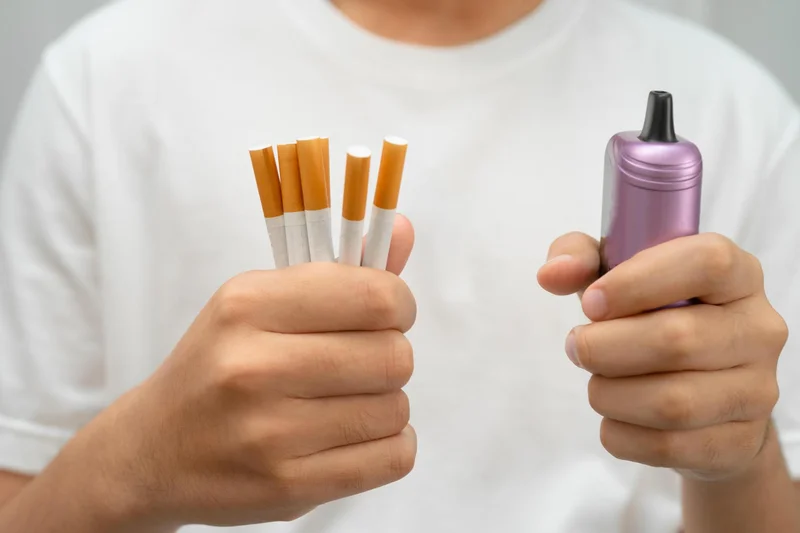
Smoking and drinking among Korean adolescents rose sharply from sixth grade through the final year of high school, according to new government data highlighting a steady decline in healthy habits as students grow older.
The Korea Disease Control and Prevention Agency released findings Monday from its Korean Youth Health Behavior Panel Survey, which has tracked a panel of 5,051 students who were sixth graders in 2019 for a 10-year period through 2028 to study behavioral changes and their contributing factors.
Monday's release, covering the 2019-2025 period, drew on 3,756 students and compiled cumulative statistics on smoking, drinking and eating habits.
The data showed a sharp rise in tobacco product use as students advanced through school. The share of students who had ever used a tobacco product rose to 11.93 percent by their final year of high school from 0.35 percent in sixth grade, up 11.58 percentage points over six years.
The increase was steeper among male students, up 15.47 percentage points to 16.02 percent, than among female students, up 7.5 percentage points to 7.64 percent.
The share of students who had smoked on at least one day in the previous 30 days rose to 5.3 percent by their final year of high school from 0.01 percent in sixth grade, reaching 7.49 percent among male students and 3 percent among female students.
Drinking showed a similar pattern, intensifying as students advanced through school. The survey found that nearly seven in 10 students, or 68 percent, had at least sipped alcohol by their final year of high school, up from 36.4 percent in sixth grade, while 43.2 percent had drunk at least a glass, up from 7.5 percent over the same period.
The rate of first-time drinkers was highest among students entering their final year of high school, at 18.1 percent.
Eating habits worsened as well. Students skipping breakfast five or more days a week rose to 32.8 percent from 17.9 percent, while those eating fruit at least once a day fell to 16.3 percent from 35.4 percent.
Students drinking sugary beverages three or more times a week rose to 60.9 percent from 50.9 percent, while those eating fast food that often rose to 31.4 percent from 20.9 percent.
The findings come as some countries move to phase out smoking entirely for future generations. The British Parliament passed a bill in April banning tobacco sales for life to anyone born in 2009 or later, starting 2027, an approach designed to preserve current smokers' rights while eliminating the habit among younger generations.
Meanwhile, the Maldives became the first country in the world to implement such a law when it banned tobacco sales to anyone born in 2007 or later — applying the rule equally to citizens and tourists — starting Nov. 1, 2025.
New Zealand took a similar approach in December 2022, legally enacting a generational smoking ban, but after a change in government in late 2023, the incoming administration repealed the law in February 2024, citing black market concerns and decline of tax revenue.