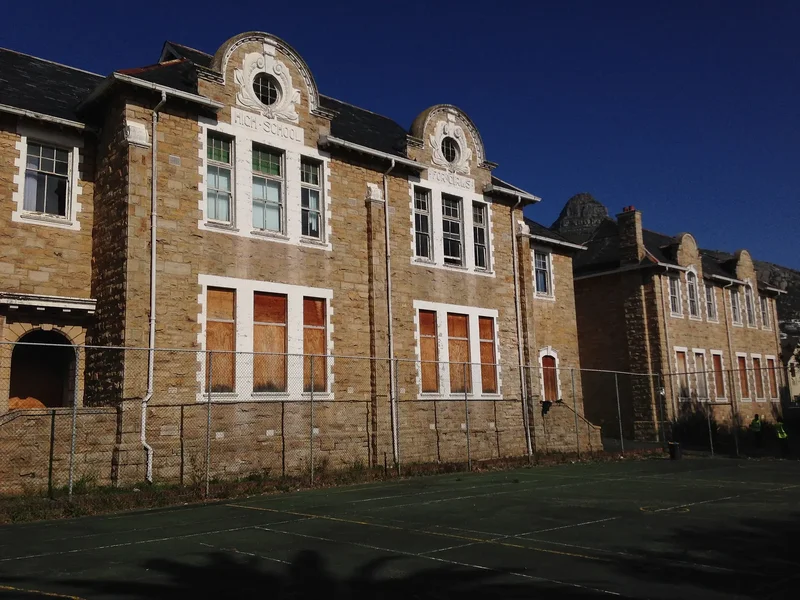
After 10 years, four courts and a battle over an expensive piece of land in Sea Point, we finally have an answer.Recently, the Constitutional Court ruled that the 2015 sale of the old Tafelberg School site was illegal.
If you have not been following the saga, don't worry, I am about to walk you through it and then explain why you should care, even if you'll never set foot on the site.
The site sits at 353 Main Road, on land owned by the Western Cape provincial government.It used to house the Tafelberg Remedial School.Back in 2013, the province started considering selling it off and by 2015 it had a buyer: the Phyllis Jowell Jewish Day School, for R135 million.
In 2016, activist groups Reclaim the City and Ndifuna Ukwazi interdicted the sale and forced the province to reopen the public participation process.More than 5 000 Capetonians wrote in to support social housing on the site rather than a straight sale.
The province considered this and in early 2017, then-premier Helen Zille announced that the cabinet was going ahead with the sale, promising social housing elsewhere.That answer did not sit well with the activists, who took the fight to the Cape Town High Court in May 2017.
It took two years for the case to be fully argued.In 2020 the high court agreed with the activists, setting aside the sale and finding that the province and the City had failed to redress the legacy of apartheid spatial planning in the city centre.The province appealed.
In 2021 it lost that argument but won the right to appeal other parts of the judgment.
By 2023, the whole thing had escalated to the Supreme Court of Appeal, which, in 2024, sided with the province and found the sale legal.Reclaim the City and Ndifuna Ukwazi were not done.In February 2025, they took the matter to the highest court.
Which brings us to today.The Constitutional Court, in a unanimous judgment written by Justice Nonkosi Mhlantla, overturned the Supreme Court of Appeal and declared the sale illegal.The court found two separate problems.First, the province had wrongly classified the property as surplus to its needs without properly weighing its potential for affordable housing.Second—and this is the part that should worry every government department sitting on unused land—the public participation process that led to the sale happened after the decision had been made.
Mhlantla is reported to have described it as a tick-box exercise rather than a real consultation.
The court also found that the province failed to inform or consult the national minister of human settlements before deciding to sell, thereby breaching the basic rules governing how different spheres of government are supposed to work together.
The order is fairly specific.The Western Cape government now has three months to report back to the high court with a sworn account of what it is doing to deliver affordable housing in the inner city and how many units have been built since the litigation began in 2017.
What does this mean for citizens of the city?A few things.I want to keep this balanced because there are real arguments on more than one side.
For housing activists, this is close to a total win after a decade of fighting.The judgment does not just deal with one plot of land in Sea Point.It sets a broader principle that well-located public land close to jobs, schools and transport cannot be sold to the highest bidder without government first properly considering whether it should be used for affordable housing.
Reclaim the City's Brett Herron has said the ruling makes plain that land value cannot be used as an excuse to deny people access to housing and that building affordable homes only on cheap land at the edge of the city does nothing to undo apartheid spatial planning.It just moves the problem further out of town.
On the other side, the Western Cape government has said it respects the ruling, while pointing to what it has built, including mixed-use developments at Conradie Park, Prestwich and Leeuloop.The City of Cape Town has made a similar point, noting that around 4 000 affordable units are under construction in the inner city this year and that the original case record is eight years old and does not reflect current reality.
A lot can change in government housing delivery over eight years.The court seemed to acknowledge this by asking for an updated report rather than punishing the province based on old facts.
The province had classified it as surplus to its needs without properly weighing its potential for affordable housing
There is also a more practical worry worth mentioning, one that comes from voices in the property sector rather than from activists or the government.
Debbie Wall-Smith of Core Property Group has pointed out that budget constraints will limit what any province can do and that the ruling does not let the government off the hook for one housing obligation just because it is struggling to fund another.
There is also a broader concern in the property industry that municipalities and provinces, worried about facing the same fate as the Western Cape, might become too cautious about selling or developing public land, leaving valuable sites sitting empty rather than being used for anything, including affordable housing.
For Capetonians, especially for the thousands of people who commute long distances into the city each day because they cannot afford to live near where they work, the stakes go well beyond the courtroom.
The judgment confirms that the Constitution does not just protect a right to housing anywhere; it protects a right to housing in the right place, close to opportunity.Whether that translates into flats on Main Road in Sea Point any time soon is a separate question.Given how long this case has taken, I would not hold your breath for a ribbon cutting next year.
But the principle has been settled by the country's highest court.Every provincial and municipal government sitting on well-located land will have to think much harder before deciding to sell it off to the highest bidder.
We will know more in a few weeks when the province files its report.I will be watching and so, it turns out, will most of Cape Town.