For the First Time in 27 Years, a Man Set a New World Record for Fastest Mile. People Have Chased the Goal for Centuries
British runners in particular have long tried to cross the finish line in less than 4 minutes, records show, sometimes running in the nude or trying to win a bet
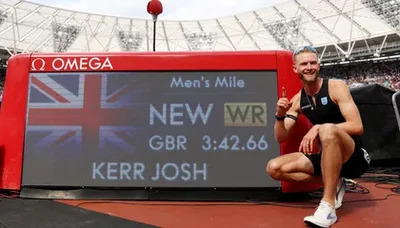
Josh Kerr celebrates after setting the new 1-mile world record, shattering the previous mark, which had stood for 27 years.
Michael Steele / Getty Images
Surrounded by a roaring crowd anticipating history, last weekend Scottish runner Josh Kerr delivered on their hopes and set a new world record for fastest mile, running the distance in a blistering 3 minutes and 42.66 seconds.
The effort shattered the previous mark of 3 minutes, 43.14 seconds, which was set in 1999 by Moroccan runner Hicham El Guerrouj.
The record-breaking run, held at London Stadium, was the culmination of an eight-month initiative that Kerr, an Olympic medalist in the 1500-meter run and one of the most accomplished modern middle-distance runners, called Project 222. The title derived from the number of seconds in a 3:42 mile—the time he needed to rewrite history—and gave a catchy name to the ambitious achievement that British runners in particular have long chased.
“I’m following the footsteps of the giants,” Kerr told reporters following the event, the Athletic’s Liam Tharme and George Edwards report, referencing the long legacy of Britons attempting to set a new standard for the mile.
Once the time is certified, Kerr will become the seventh British man since 1913, when official records began, to hold the 1-mile world title, according to World Athletics, the international governing body of the sport of athletics, which includes track and field and cross country.
The immensity of Kerr’s achievement this week is being compared to that of Roger Bannister, who in 1954 became the first man credited with beating the 4-minute mile. The feat was described at the time by the Daily Telegraph as “sport’s greatest goal … as elusive and seemingly unattainable as Everest.” Some people thought such a run was impossible, and that anyone who tried risked death.
But Bannister proved doubters wrong. Despite windy conditions on the day of his attempt, the Oxford University medical student broke the world record with a time of 3 minutes, 59.4 seconds.
“The earth seemed to move with me,” Bannister said after the race, according to Guinness World Records. “I found a new source of power and beauty, a source I never knew existed.”
Fun fact: Calling the race
Norris McWhirter, who later went on to co-publish and co-edit the Guinness Book of World Records, was the stadium announcer for Bannister’s fateful race. His suspenseful announcement, writes Rex Cleaver for British Online Archives, was nearly as memorable as Bannister’s run.
“Ladies and gentlemen, here is the result of event nine, the 1 mile: first, number 41, R. G. Bannister, Amateur Athletic Association and formerly of Exeter and Merton Colleges, Oxford, with a time which is a new meeting and track record, and which—subject to ratification—will be a new English Native, British National, All-Comers, European, British Empire, and World Record. The time was 3—” he said, and then the crowd went wild.
Bannister’s mark was beaten soon after by Australian John Landy. A competitive span between 1979 and 1981 saw British men Sebastian Coe and Steve Ovett exchange new records several times. Before Kerr, Steve Cram was the last British man to officially be the world’s fastest miler, a title that he won in 1985 and held until Noureddine Morceli of Algeria eclipsed it in 1993.
1954: Roger BANNISTER runs the first ever 4 MINUTE MILE \| Newsreel \| Classic BBC Sport \| BBC Archive
But historical records are also filled with unofficial race times that shed further light on the British mile fixation. One such instance is street vendor James Parrott’s possibly sub-4-minute mile through the streets of London in the late 18th century, which he ran to try to win a wager of 15 guineas.
“1770 May 9th, James Parrott, a coster-monger, ran the length of Old St, viz. from the Charterhouse-wall in Goswell Street, to Shoreditch Church gates, (which is a measured mile) in 4 minutes,” Sporting Magazine reported in 1794, according to BBC News’ James Fletcher.
Roger Bannister, photographed in 1954, was the first man to officially run a mile in under 4 minutes.
Public domain via Wikimedia Commons

Other public wagers combined challenges of swiftness with risqué antics. In 1787, the Oxford Journal reported that a man from Birmingham named Powell had been offered 1,000 guineas if he could run a mile in under 4 minutes. Records of the official run did not survive, but an observation of his time trial—4:03—asserts that “he ran entirely naked, and it is universally believed that he will win the wager.”
In 1796, a man named Weller, running for three guineas, reportedly finished a mile in 3:58. Such race challenges were popular in Britain in the 18th and 19th centuries.
“Women did it, men did it, young men did it, old men did it, fat men did it,” Peter Radford, a former Olympic runner and sports science professor, told BBC News in 2014. “Sometimes for a wager someone would say, ‘I can run two miles in XYZ time while eating a chicken.’”
Kerr’s record was much more scientific than these bygone runs. He wore custom-made shoes, an aerodynamic speed suit, trained at elevation in New Mexico and used two pacers during the run.
“Out there, I am just the body, but there is an incredible amount of work behind the scenes,” Kerr said after the race, writes Jess Whittington forWorld Athletics. “Today is a result of all that hard work. The last lap was incredible. I was deaf in the last 110 meters.”