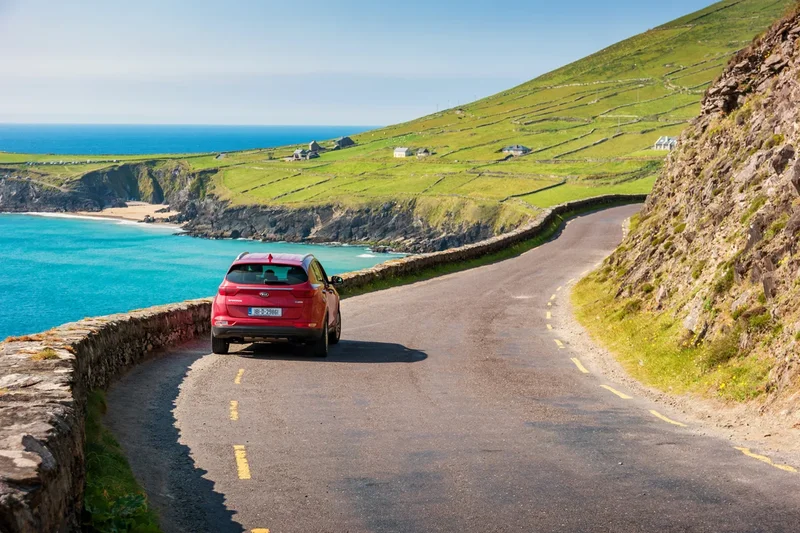
The island of Ireland, split into the separate Republic and Northern Ireland, has so much to discover that it requires several trips – from rugged natural beauty to charming villages and miles of coast and countryside.
One of the best ways to see some of the most magnificent spots, as well as tick off world-famous landmarks in cities and exchange tales with locals in rural villages, is to fuel up your car and hit some of Ireland’s best road routes. Road trips mean you can more easily access those hard-to-reach places where public transport is sparse.
One of Ireland’s most famous road trip routes, the Wild Atlantic Way, is popular for a reason – it spans more than 1,500 miles touring the country’s seaside destinations, which makes it the longest coastal road trip in the world.
While it certainly is a bucket list experience, there are so many other routes that take visitors through the island, including crossing the heartland of the country, passing through the capitals of Dublin and Belfast, and exploring striking spots such as the Giant’s Causeway.
So, whether you prefer the rolling hills of the Irish countryside, the plunging cliffs on the coast or the vibrant atmosphere of the cities, there’s an Irish road trip to suit. Below, we’ve rounded up a list of some of the best.
The best road trips in Ireland 2026
1. Wild Atlantic Way
This 1,600-mile route is Ireland’s most famous road trip, taking in coastal scenery, natural landmarks and cities and towns including Galway and Donegal. It starts in the Inishowen Peninsula in the north, running south until it finishes in Kinsale, a quaint, southern coastal town with colourful streets. It is divided into 14 stages, which last anywhere from roughly 90 miles to almost 150.
Highlights along the Way include the Slieve League cliffs and the Cliffs of Moher, the rock formations of Downpatrick Head and towns including the seaside heritage town of Westport. You’ll come across dozens of stunning beaches, from Keem’s Bay to Dunmoran, while also seeing miles of coastline and sections of cliffs including the stretch along the Atlantic Drive.
Find out more here.
Read more: I travelled to Ireland’s remote islands for a wild weekend away
2. The Ring of Kerry
This loop is located on the Iveragh Peninsula and starts and ends in Killarney. It takes in some of Ireland’s most beautiful mountainous and countryside scenery, as well as lakes such as Lough Leane. Natural sites such as the Gap of Dunloe, Moll’s Gap and the island of Skellig Michael await you on the 111-mile tour, as well as the Killarney National Park.
Unmissable highlights include the Kerry Cliffs and Carrauntoohil, the highest mountain in Ireland (standing at 1,038m). This part of County Kerry also has some impressively white sandy beaches: Derrynane, Rossbeigh and St Finian’s Beach to name a few. Be sure to stop at the “Ladies View” over the Lakes of Killarney, which got its name due to being a favourite of Queen Victoria’s ladies-in-waiting who took in the sights while on a tour of the Ring with the monarch.
Find out more here.
Read more: The family-friendly oasis that is just an hour’s flight away
3. The Copper Coast (extended)
While most variations of this route only cover the 25 miles between Tramore and Dungarvan, it can be extended further into Kilmore Quay before finally arriving at Wexford, making it roughly 100 miles long. Starting in Dungarvan, the first leg of the route takes in the entirety of the Copper Coast European GeoPark, a Unesco-listed area of international geological significance. Spanning across the County Waterford coastline, the area is named after the 19th-century copper mining that took place here, but has many splendid highlights such as Neolithic dolmens, Iron Age forts and ruined medieval churches on the seafront and further inland.
However, the coast is arguably the main attraction here, with stretches of rugged cliffs, rocky coves, sandy bays and blue waters interrupted by picturesque villages and structures ranging from abbeys and castles to lighthouses. Arriving in Wexford, you’ll be greeted with medieval walls, winding lanes and sites such as the Wexford Town heritage trail and Irish National Heritage Park.
Find out more here.
Read more: Ireland’s smallest county is its most beautiful
4. Belfast to Derry
Moving into Northern Ireland, this route starts in the capital before heading north to the coast, near Ballycastle (and its excellent beach) and eventually moving to Derry via the Causeway Coast. From Belfast, you’ll head northwest to Antrim and then north through Ballymena until you reach Ballintoy Harbour and the Carrick-a-Rede rope bridge on the coast. From there, drive west to Whitepark Bay Beach and then near Dunseverick Castle (with the option of a slight detour to visit the Giant’s Causeway).
After potentially enjoying one of the isle’s main tourist sites, you carry on southwest to Coleraine, followed by Limavady, through part of the Binevenagh Area of Outstanding Natural Beauty, before finally reaching Derry. Having covered just over 100 miles, you can take time to enjoy the second-largest city in Northern Ireland; sites including the Peace Bridge, St Columbs’ Cathedral and the city’s 400-year-old walls.
Read more: How a trip to rural West Cork helped me reconnect with my teenage daughter
5. The Burren Loop
A 93-mile figure-of-eight loop, the Burren Loop is short enough to complete in a day, though with plenty to see and trails to walk, you may want to stay for an evening in Ballyvaughan or the colourful town of Lisdoonvarna. The rocky Burren region is a barren limestone area that is itself a Unesco World Heritage Site, noted for its karst (soluble rock) landscape covering almost 100 square miles. This drive leads you through narrow roads onto scenic coast including the Cliffs of Moher Unesco GeoPark, famed for its mix of Atlantic, Alpine and Mediterranean plants.
The main attraction on this road trip is the Cliffs of Moher themselves; almost nine miles of towering limestone cliffs that are also home to a cliff walk. For another great view, take a boat from Doolin to see them from the water below.
Find out more here*. *
Read more: Why Dublin is the surprising city to delve into Picasso’s troubling relationship with women
6. The Causeway Coast
A 130-mile route between Belfast and Derry-Londonderry, this route takes in more of the coast (and its great sights) than the shorter journey from the Northern Irish capital mentioned above. As you come to the coast, you’ll see the Carrick-a-Rede bridge, the Glens of Antrim and the Cushendun Caves, before arriving at the Giant’s Causeway. After visiting the famous 60-million-year-old basalt columns, you’ll eventually come to Derry and its medieval walls.
Other notable stops on the route include some of Ireland’s best beaches (Benone and Portrush Whiterocks), national landmarks (including Mussenden Temple and Magilligan Point) and towns such as Portstewart and Limavady. Stop at the scenic seaside town of Ballycastle to embark on its folk heritage trail before taking the ferry across to Rathlin Island, Northern Ireland’s only inhabited offshore island, for a spot of sea birdwatching and taking a walk to its three lighthouses.
Find out more here.
Read more: The little-known island off the coast of Ireland that’s filled with puffins and wildflowers
7. Ireland’s Four Peaks
Covering the highest peaks in each province of Ireland and Northern Ireland, this route is usually driven as part of the isle’s “Four Peaks Challenge” but can be enjoyed equally as a 540-mile scenic road trip (whether or not you want to attempt climbing all four peaks). This ‘H-shape’ route crosses the central length of the island; there’s no set starting point, though if coming from the UK mainland it may make sense to start at Slieve Donard or Lugnaquilla. From Lugnaquilla, you head north past Dublin to Slieve Donard before turning back on yourself and beginning the five-hour journey to Mweelrea.
The final leg of the route takes you back on yourself down to Galway, before heading south, first to Limerick and then finally to Carrauntoohill. While the peaks offer sweeping views of the surrounding areas, even if you don’t take on the climbs you’ll still be able to enjoy some of the finest Irish countryside and cities, from the bays and mountains of the Connemara National Park to the limestone landscape of the Burren and the charming cobbled centre of Galway.
Read more: The UK and Ireland’s best pilgrimage routes to walk this year
8. Irish City Tour
While not an official route, the layout of cities across the isle lends itself to a longer route exploring the best of both countries. The looping route can start from Belfast or Dublin (likely depending on which ferry port or airport you arrive into) and is anywhere from 600 miles long; extra stops can be added, for example extending onto Bangor after Belfast. If starting in Belfast, head to Derry – a portion of the Causeway Coast is optional – before crossing into the Republic of Ireland via Letterkenny and heading southwest to Donegal Town. Continue south, first to Galway and then to Limerick and Cork (days or nights spent in each are optional), before starting the final leg of the loop and driving on to Dublin. You can also drive straight to Belfast or stop in Lisburn or Bangor before the end of your all-encompassing route.
Read more: Best luxury hotels in Dublin, from celebrity favourites to Michelin-starred dining
9. The Dingle Peninsula
If you want to sample just one spectacular section of Ireland’s Wild Atlantic Way, a good choice is to drive around the Dingle Peninsula – or, as it is also known, Corca Dhuibhne. Stretching 30 miles (48 kilometres) into the Atlantic Ocean, dramatic mountain ranges serve as the spine of the peninsula, including Ireland’s second highest peak, Mount Brandon. Along its coastline, visitors will pass craggy headlands such as Slea Head and sandy beaches, including the unique Maharees tombolo.
For a condensed journey along the peninsula, the Slea Head Drive along the dramatic sea cliffs is one of Ireland’s most scenic routes, beginning and ending in Dingle. The road passes points of interest such as the Dunberg Iron Age Fort, has views of the Blasket Islands, and can include stop-offs in Gaelic-speaking villages, such as Ballyferriter, with pubs and restaurants.
Find out more here.
Read more: The North is in ascendancy – here are the places to visit this summer
10. Boyne Valley
The Boyne Valley is just 20 minutes north of Dublin airport and one and a half hours south of Belfast. The valley straddles both County Meath and County Louth and is situated at the hub of four major motorways, the M1, M2, M3 and M4, making its more rural landmarks easily accessible. The bow-tie-shaped route pinches in the middle at the town of Navan, and sprawls into the countryside to some spectacular spots like the ancient ceremonial site Hill of Tara, the Cistercian monastery Old Millifont Abbey and the site of the Battle of the Boyne, one of the most major battles in British and Irish history that secured Protestant power in both countries.
The countryside landscape makes for some picturesque places to park up and go on walks or hikes, including Baltrath Wood, the 25-kilometre Boyne Valley Camino and the Trim Porchfield and River Walk around the Norman Trim Castle.
Find out more here.
Read more: The best beaches in the UK for summer, recommended by travel experts