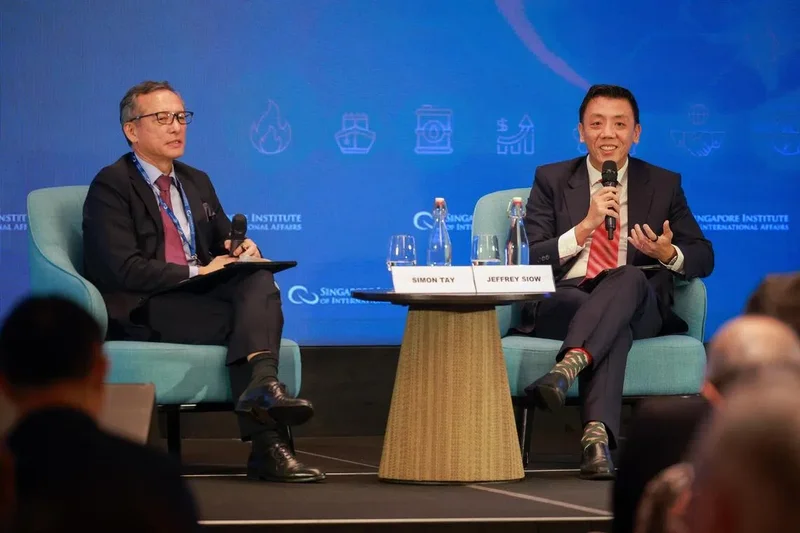
Singapore needs to redouble resources on reskilling to overcome smaller population: Jeffrey Siow
SINGAPORE – Singapore needs to redouble the resources it is putting into reskilling efforts to ensure that workers are able to adapt quickly to a changing economy, said Transport Minister Jeffrey Siow.
This is how the country can turn its smaller population from a constraint into an asset, said Siow at a dialogue on Aug 3.
A smaller Singaporean population base means there are more resources available to invest in each person, said Siow, who is also Second Minister for Finance.
“I can invest more per person, train them more, train them more intensively and build a structure to enable them to get access to reskilling resources more quickly,” he said at the dialogue titled Keeping Singapore Competitive in a Disrupted World.
It was held at the Parkroyal Collection at Marina Bay and organised by the Singapore Institute of International Affairs (SIIA).
Singapore already has a head start on reskilling through SkillsFuture, said Siow, speaking to moderator and SIIA chairman Simon Tay and an audience of about 300 including policymakers, academics and business leaders.
The Government started SkillsFuture Singapore, a statutory board administrating upskilling and reskilling, in 2015. On July 1, it merged with Workforce Singapore to form a new statutory board – the Skills and Workforce Development Agency – to create a more integrated ecosystem for jobs and skills.
Siow said: “If we can do more in that respect, we can help overcome that constraint.”
He was responding to a question from the audience on the trade-offs Singapore has to make as it moves to transform its economy for the future.
Singapore faces several constraints including an ageing population and an “abysmal” total fertility rate, and needs to do better on integrating newcomers to the country, said Siow.
But its biggest constraint is energy, he said.
It faces challenges generating renewable energy, and traditional energy sources have also been disrupted due to conflict in the Middle East, he said.
The city-state must diversify and look for new energy sources – including studying the feasibility of nuclear energy, he added.
This, as well as reskilling, is what the country needs to focus its attention on, he said.
Singapore has not been standing still as the global system of free trade breaks down, said Siow, in response to a question on how the country is dealing with changes to the world economy.
Trade today is not just about moving physical goods around, but also about being at the centre of data flows, said Siow. It is also about being able to control where these goods and services are moved around.
He raised the example of how the PSA has a large network of ports around the world – allowing it to orchestrate the movement of ships and containers to other ports when some face disruption.
PSA operates 70 deep-sea, rail, and inland terminals in over 180 locations.
“We want to do more of that. I’m encouraging them to do it,” Siow said. There is also opportunity for Singapore to do the same with air cargo, he added.
This is one of the key recommendations from a review of Singapore’s economic strategy which he co-chaired, he said.
The committee released a report in June with 32 recommendations across eight thrusts meant to prepare Singapore’s economy for the future.
“We want to move from just being a hub for goods, services and trade to being a hub where these flows are orchestrating onto Singapore, and so we’ll continue to do that,” Siow said.
The SIIA released its own report on Aug 3 on advancing Singapore’s competitiveness with ASEAN.
It said Singapore is weathering the current global turmoil, and gave some recommendations for how it can strengthen its competitiveness in the region.
This includes asking Singapore-based investors to better understand national policies in the region, and deepening Singapore’s links to nearby areas like Johor and Sumatra.
In a panel session after the dialogue, PSA vice-president for port ecosystem development Foo Cexiang said trade within ASEAN has stagnated for some years, despite trade within Asia rising.
Singapore has to think about which goods and services the region is actually able to trade, he said, adding that the country is well positioned to be a regional food hub for ASEAN.
Foo, who is also MP for Tanjong Pagar GRC, said Singapore’s food manufacturing capabilities are advanced, and the country can be ASEAN’s gateway to the world.
“That will certainly increase the amount of intra-ASEAN trade,” said Foo, who will join the Ministry of Trade and Industry as a minister of state on Sept 1. He will also be Minister of State for Manpower.
Foo also raised the need for Singaporeans to develop multicultural skills to build networks across the region.
“That cross-cultural component is at the root of how ASEAN can progress even more,” he said.