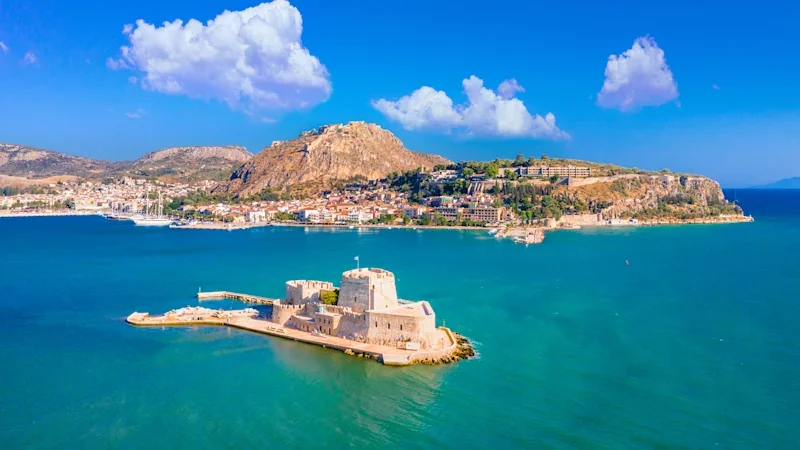
This little town was briefly the capital of Greece, but never mind the politics: this is one of the nation’s most delightful mainland towns.
Who goes there
Most ships are sailing itineraries around the Greek islands and Turkish coast, or across the eastern Mediterranean, and either start or finish in Piraeus (Athens), Istanbul or Civitavecchia (Rome). Others pass through on wider Mediterranean cruises. You have plenty of choice, from expedition companies such as Ponant to luxury lines such as Seabourn and Silversea, and to larger ships operated by the likes of Celebrity, Holland America and Viking.
Sail on in
Nafplion sits deep in the Argolic Gulf between two of the descending peninsulas that make up the hand-shaped, very rugged Peloponnese peninsula. In short, the scenery is splendid, with blue and brown mountains to both sides. Nafplion itself is one of Greece’s most agreeable small towns, with remnants of Byzantine, Frankish, Venetian and Ottoman occupation apparent as you sail in.
Get exclusive travel deals delivered straight to your inbox. Sign up now.
Berth rites
Small ships dock in the inner harbour right by the old town, and you step off straight onto the quay. You’ll be tendered ashore from larger ships. Either way, you have no need of transportation, as everything is within walking distance.
Going ashore
In the early 19th century Nafplion was the capital of newly independent Greece. Its brief moment of fame has resulted in a fine neoclassical town centre of shady, bougainvillea-draped streets, marble-paved cafe squares filled with commemorative statues, and seaside promenades. You’ll come across little churches and mosques and pretty squares. Both the Archaeological Museum and (particularly if you have an interest in textiles) Peloponnesian Folklore Foundation Museum are worth a look. In the harbour, the tiny island of Bourdzi is just big enough for a picturesque castle.
Don’t miss
A rocky crag looms over Nafplion, fortified by the tireless Venetians. Palamidi Fortress is approached by a flight of hundreds of steps that zigzag up the rock face. The ascent is heart-banging, but so is the view over Nafplion’s red-tiled rooftops and blue bay. This almost impregnable complex of eight bastions encloses wandering paths, secret passages, corridors and stairways, towers and ruined walls, and is the perfect place to while away an hour or two.
Get active
The hoof up to Palamidi Fortress will certainly give your lungs a workout. The more languid can walk or jog the promenade that leads around the little rocky peninsula which sticks out into the bay to the west of the old town, and has lovely views over limpid waters and a few inviting (if rocky) swimming spots. You can hire sailboats and kayaks for a trip out into the bay.
Best bites
The waterfront has a row of seafood restaurants serving fresh fish and octopus. However, artichokes, roast pork, grilled chicken and slow-cooked lamb from an earthenware pot are typical dishes of this part of the Peloponnese. Nafplion has a reputation in Greece for its oranges, used in liqueurs and marmalades and in a must-try orange pie. The ice cream is also renowned; some people claim Antica Gelateria di Roma serves the best in all Greece.
Further afield
Nafplion’s laid-back good looks are reason to linger, but a side trip to Epidauros takes you back two millennia to a wellness centre of the ancient Greeks. It has the world’s best-preserved Greek theatre, which can still seat 17,000 spectators on 55 tiers and has such good acoustics that anyone speaking from the centre of the stage can be easily heard from any of its seats. The other great nearby sight is the archaeological ruins of Mycenae, a World Heritage site dating back to the Bronze Age.