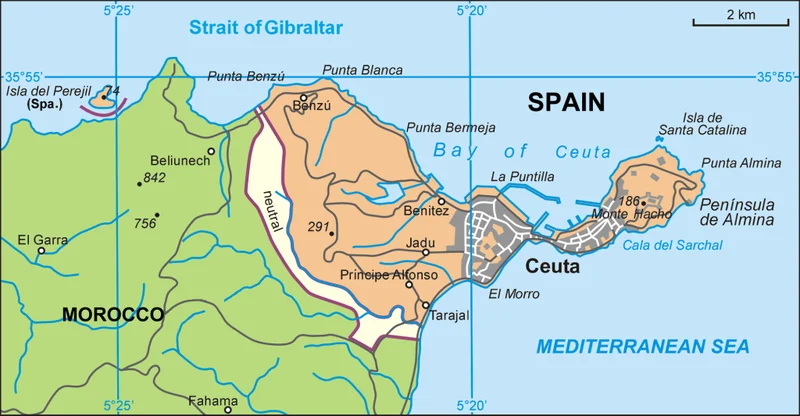
Conor here: As expected, the sudden arrival of tens of thousands of migrants from Morocco into Spain is putting pressure on the current government and boosting the prospects of Spanish parties more internationally aligned with Washington and Tel Aviv.
The question remains: was it coordinated? El Espanol is now reporting the involvement of Moroccan spooks:
BREAKING: According to El Español, citing senior Spanish Civil Guard and intelligence sources, authorities allegedly identified individuals linked to Moroccan intelligence services among the crowds that entered Ceuta during the recent mass migration crisis.
The report states… pic.twitter.com/yL1s6LJQAI
— GeoInsider (@InsiderGeo) August 2, 2026
It is certainly suspicious that 60,000 people suddenly decided to make a swim for it. Suspicious also that many reportedly returned to Morocco immediately afterwards:
I crossed the Sahara Desert with migrants about a decade ago. Those in the video who crossed into Ceuta from Morocco neither looked like migrants (no luggage) nor did they behave like migrants (went back home with no protest). They looked like a rent-a-mob from Morocco’s… pic.twitter.com/0XkOfUqHyc
— Vijay Prashad (@vijayprashad) August 1, 2026
In 2021, about 8,000 migrants headed to the Spanish enclave, but that was likely triggered by a diplomatic spat between the two countries, and Moroccan border guards reportedly stood by and watched.
Notably during that incident Spanish PM Pedro Sánchez received support from EU officials, with European Council President Charles Michel tweeting: “Spain’s borders are the European Union’s borders.” Not this time as Brussels and other bloc nations abandon Madrid. That makes it less likely that Morocco could capitalize on the incident the way other nations in North Africa and Middle East have by extracting payments from Brussels in exchange for keeping migrants bottled up. It also points to a coordinated effort to damage the Sanchez government.
Meanwhile, Israel and the US, Morocco allies, would be thrilled if the Ceuta crisis helped topple the current government. The Sanchez government is one of the few sources of steady European opposition to the insanity of NATO nations spending 5% of GDP on defense and it has walled itself off from any involvement in Trump’s war against Iran. Its opposition to genocide in Palestine isn’t just talk; Madrid has cut off military shipments to Israel. So if we’re asking cui bono, a few obvious answers are in Washington and Tel Aviv, which have been quick to crow about the incident:
Spain, which never misses an opportunity to lecture Israel, has declared a state of emergency in Ceuta following the crisis over its immigration policy.
Maybe before it continues lecturing us, it’s time it explained to the world why it still maintains colonial enclaves in…
— Danny Danon 🇮🇱 דני דנון (@dannydanon) July 30, 2026
Now comes news that the US is attempting to get Spanish enclaves for Morocco:
BREAKING: The Trump Administration told Congress that Spanish enclaves “Ceuta and Melilla are located in Moroccan territory”, Thomas Massie revealed earlier today.
It also pledged US$40 million of US taxpayer cash for military purposes in Morocco.
“Two weeks ago the House… pic.twitter.com/cp75n716Nz
— Nury Vittachi (@NuryVittachi) August 2, 2026
As with all Trump moves, there is almost surely some personal enrichment scheme at work here. Morocco would likely reward such efforts with some sort of investment in a Trump clan venture. It could also be a way to punish Spain for its disobedience. Here’s one potential other reason:
Why would Israel want its ally Morocco to control Ceuta as opposed to its critic Spain? One reason may be that Ceuta is the closest point in Africa to Europe, sitting astride the Strait of Gibraltar, meaning that Spain currently controls both sides of the strait. The Strait of…
— Kenneth Roth (@KenRoth) August 1, 2026
Regardless of any of the facts, the media ball is already rolling and Sanchez’s opponents are looking to capitalize on the incident.
By Deniz Torcu, adjunct Professor of Globalization, Business and Media at IE University. Originally published at The Conversation.
It is estimated that more than 50,000 migrants crossed entered the small Spanish enclave of Ceuta in the course of a single day after the border effectively collapsed. Ceuta, an autonomous city, sits on Morocco’s northern coast. The Spanish government has said almost all of the migrants have since returned to Morocco, and at least 57 have died.
Faced with doubts as to how and why this was able to happen, the public was left with only footage and photographs: people swimming and climbing onto Ceuta’s Tarajal beach, tens of thousands in a single day and night, scores dead.
With no facts or explanations to back them up, scenes like these land in the imagination first. And the imagination is where a country’s attitude to migration is built.
The Ceuta border crossing undermines one of Spain’s more flattering ideas about itself. After the long years of fascist dictatorship the country has spent recent years recasting itself as a place that embraces migration and diversity while much of Europe talks about walls and defence.
Migrants broke through fences and swam into Spain’s North African enclave of Ceuta from Morocco, overwhelming the police and prompting Madrid to deploy the military as tens and thousands of migrants were estimated to have crossed illegally https://t.co/bX4Fas0v2i pic.twitter.com/TQVUL8Owh8
— Reuters (@Reuters) July 31, 2026
This is a story Spain tells with real conviction – a nation at the crossroads of Europe and Africa, shaped by centuries of cultural mixing. And it often puts these ideals into action – only six months ago, it opened a route to legal residence for hundreds of thousands of immigrants already living and working in the country.
But national self-image and public opinion are a cultural achievement more than a legal one. They run on emotions, which makes them far more delicate – and far more vulnerable to misinformation and exploitation – than any law.
Images, Words, Opinions
We can watch opinions change in real time by seeing what happens to the words people use. A day earlier, the public language of migration was ordinary and neutral. It mostly concerned integration, work permits, the ordinary paperwork of settled lives.
The images emerging from Ceuta have shoved that aside, instilling a harder register. Words like “invasion”, “war”, “flood” and “control” now predominate across public statements and social media.
For ordinary people, this means the migrant who could be a neighbour, a colleague or a classmate’s parent becomes a faceless figure, a number crossing a beach. A number is far harder to grieve than a person, and language that deals in numbers can be as cold as it likes without sounding cruel.
Meanwhile, an image – like those now looping on TV screens and social media – argues without making an argument. Rhetoric has to persuade, to say something a listener can answer, but images offer a shortcut to the feeling beneath it. They move the starting point of any conversation on the subject.
Spanish Prime Minister condemns ‘violation of territorial integrity’ of Ceuta. pic.twitter.com/KtVrI10Clt
— euronews (@euronews) July 31, 2026
The images circulating from Ceuta mean that the Spanish government is forced into a position of explaining itself, while punitive ideas are waved through as common sense. Sentences that would have sounded ugly on Wednesday sounded almost like sober description by Friday. The moderate ends up looking naive, and the burden of proof changes hands without anyone announcing it.
The optics are a gift for Europe’s far right, and they know precisely what to do with it. They can lose every argument about the real numbers and still come out ahead, because their aim is to make the story of a welcoming Spain look foolish. In the absence of any other information, videos and images do a lot of that work for free.
Normalising Extreme Language
The leader of Spain’s right-wing opposition party, the Partido Popular (PP), has already linked the border crossing to the Spanish government’s policy of mass regularisation, introduced in February – making the unfounded claim that it created a “pull factor”.
The leader of Spain’s far-right Vox party went further, immediately branding the arrivals an “invasion” of military-age men. US businessman Elon Musk has made the same argument, and compared the images to a scene from the 2013 zombie film World War Z.
But for the far right, this reaches past a single news cycle. The moment their vocabulary stops sounding extreme, the mainstream right has to answer in the same terms or risk looking weak. Once the conversation shifts, anyone defending Spain’s self-image as an open, welcoming country is already on the back foot, apologising before they have said a word.
In the aftermath of the Ceuta incident, this is what Spain stands to lose: the ability to tell its story of welcoming immigration and embracing diversity without having to first apologise for it.