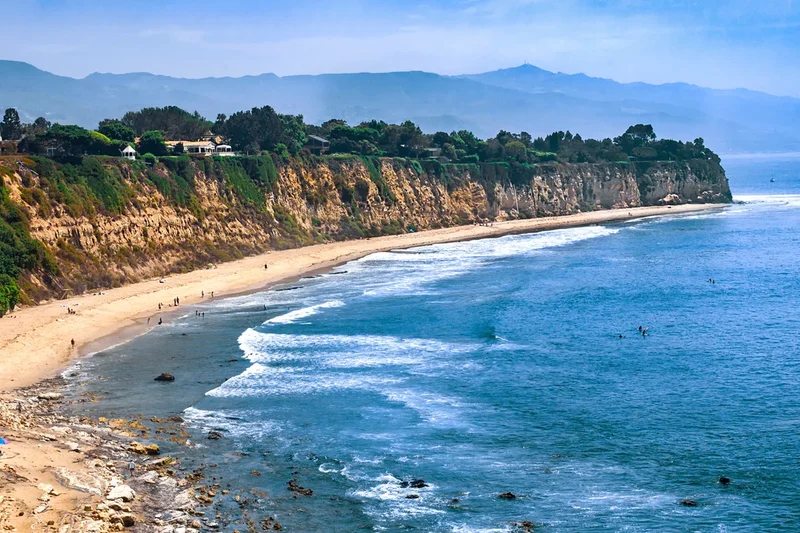
Malibu's Point Dume Beach has been closed indefinitely after severe coastal erosion damaged access roads, parking areas and utilities, with officials warning the unstable bluffs pose a serious safety risk.
The Los Angeles County Department of Beaches and Harbors said Westward Beach Road beyond the pay gate and the Point Dume Beach parking lot are closed with "no estimated reopening date."
Restrooms 1, 2 and 3 also remain closed after erosion damaged underground water lines, though temporary toilets and hand-washing stations have been installed.
Officials urged visitors not to ignore barriers, warning the bluff edge has become dangerously unstable.
"Visitors are reminded not to cross safety cones, caution tape, or barriers," the department said. "The bluff edge is unstable, with erosion creating drop-offs of up to 8 feet in some locations. Entering closed areas could result in serious injury."
The California Highway Patrol has also closed Westward Beach Road at Birdview Avenue, although Pacific Coast Highway remains open.
City officials said the latest damage follows days of high tides and heavy surf, which accelerated erosion in areas already weakened after the January 2025 Palisades Fire destroyed several oceanfront homes.
"Recent high tides and high surf have accelerated coastal erosion in the burn area where seawalls from the homes no longer provide any protection from the surf," the city said. "In several locations, the erosion has advanced close to the roadway."
The closure highlights California's growing struggle with coastal erosion, which scientists say is being intensified by stronger storms and rising sea levels.
Homeowner Alan Ashavi said he constantly monitors the cliff below his Malibu property after storms triggered landslides nearby.
"It is nerve-wracking because you deal with it on a daily basis," he told Reuters. "You come in here and check every day or every hour sometimes."
Scientists warn powerful atmospheric rivers and increasingly intense winter storms are accelerating erosion along California's coastline, threatening homes, roads and other infrastructure.
Kathleen Treseder, a climate scientist at the University of California, Irvine, said experts expect some sea cliffs to retreat by as much as 100 yards in the coming decades, putting coastal homes and businesses increasingly at risk.
"We have these atmospheric rivers coming off the oceans, drops the rain here on these hills and then the hills start eroding as well," Treseder said. "Not only do we have this erosion from the waves, but we also have erosion inland caused by the rainfall."
The impacts are already being felt across Southern California, where landslides have damaged roads, forced rail closures and left multimillion-dollar homes perched precariously above collapsing cliffs.
"It's just so sad to see the destruction that is happening," San Clemente resident Susan Pope said. "I hope the future planning is better for that."