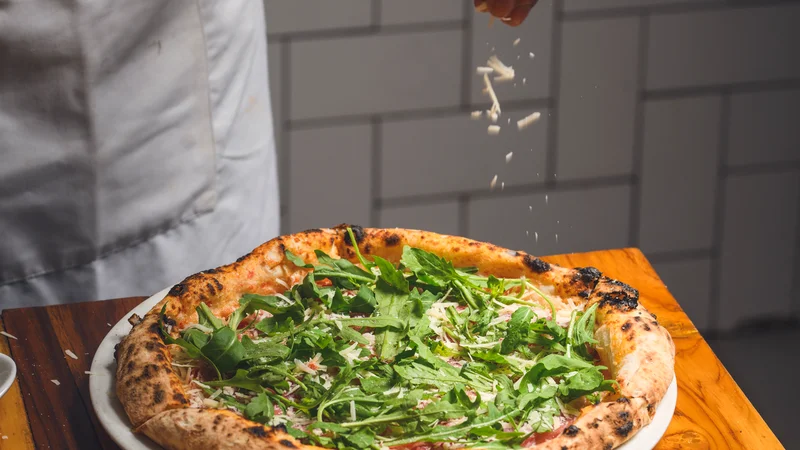
Statistically, only about 15 to 20% of independent restaurants survive a decade; a survival rate that has shrunk further in recent years. When Amol Kumar launched Leo’s Pizzeria in a quiet by-lane off Delhi’s MG Road in December 2016, he was not looking to build a long-term legacy. He was only trying to survive.
“I wasn’t even sure if we’d make it to year one,” Amol recalls, sitting at their spacious Vasant Vihar outlet. “I was making every pizza at the time. I thought if I could just do this for a year, I’d be proud of myself.” Ten years later, the neighbourhood pizzeria has rewritten Delhi’s artisanal pizza narrative. Today, Amol is orchestrating a massive regional expansion, preparing a new Gurugram outpost for a mid-August 2026 launch and has debuted NYNY, a New York-style slice shop in Hauz Khas, even as he eyes other cities. The growth comes on the heels of a major international validation. Leo’s was recently named in “One To Follow” in the prestigious The Best Pizza – Milan 2026 list, alongside its fourth consecutive appearance on the 50 Top Pizza Asia-Pacific list, ranking at No. 41.
However, for someone who helped pioneer India’s authentic Neapolitan movement, Amol spent his youth as far away from the kitchen as possible. While studying Hospitality in Switzerland, he had teachers who told him that he didn’t belong in the kitchen. During a six-month internship, a prominent French chef told the 19-year-old, “No matter what you do in life, don’t work in a kitchen.” “It created a mental block,” Amol recalls. “I wanted to work in finance anyway, but as a young person to be told so strongly what not to do — it wasn’t very nice, and I didn’t step inside a kitchen for almost 10 years.”
It took a decade for him to find his way back to the stoves. The seeds, however, had been planted long before. There was a childhood trip to Germany in 1996 where a self-confessed picky eater who only wanted dal chawal fell in love with pizza. Later, in Switzerland, he watched a husband-and-wife team run a tiny pizzeria where the pizzas were so large they had to fold the edges just to close the box. “To me, it just meant love and generosity. I thought, that’s the dream. You find your person, you run a little place, and you share it with the world.”
When Leo’s first opened in December 2016, the challenges were monumental. Italian flour was a myth on local shelves, tomatoes lacked consistency, and finding premium charcuterie required a bit of espionage. “I didn’t know where to source decent salami or Parma ham,” Amol laughs, recalling his early supply chain tactics. “I’d go to fancy grocery stores and look at the display boxes. The staff wouldn’t tell me who the suppliers were, so I developed a strategy. I’d say, ‘Can I just see the label? I’m allergic to some ingredients.’ Then I’d quickly memorise or photograph the importer’s name on the back sticker and look them up later.”
Educating the diner was an even bigger challenge. With customers familiar with the pan-baked or thin crusts from fast-food giants, a soft, blistered Neapolitan slice was an alien concept. In fact, the first Leo’s menu included a graphic-heavy booklet teaching people how to fold and hold their pizza. “People would see the beautiful charring from the wood-fired oven and tell me to my face that the pizza was burnt and that it’s the worst pizza they’ve ever eaten. In the initial days, that one negative comment would ruin my entire week,” he says.
Despite overseeing the expansion and getting a prestigious nod from Milan, Amol remains a craftsman at heart. He is still hands-on with the dough, keeping his palate sharp with annual trips to Italy and Tokyo. And when the day is over, the globally-lauded pizzaiolo still retreats to the same comfort food that sustained him during the brutal first few years of Leo’s. “I still just want my dal chawal,” he smiles.
Published - August 03, 2026 03:02 pm IST