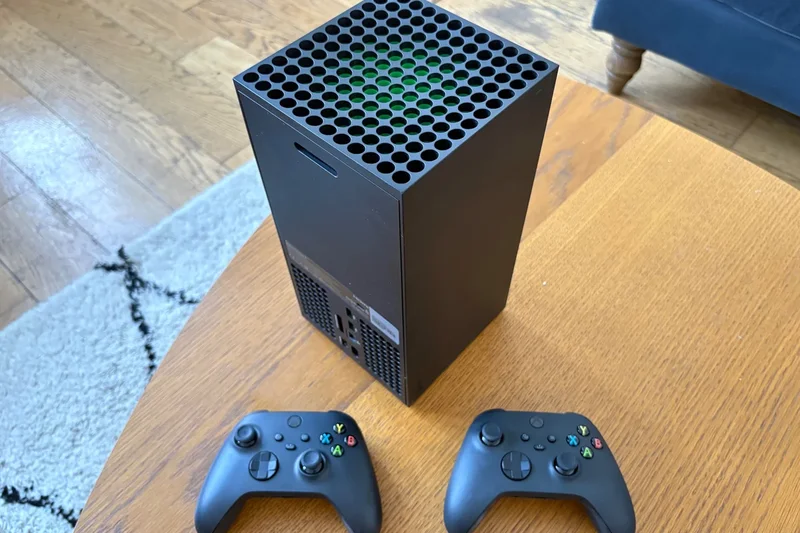
Gaming hardware is in such a precarious position right now. Component shortages caused by huge tech companies building AI data centres and eating up the supply of critical parts needed to make consoles and gaming PCs has resulted in hardware skyrocketing up in price, instead of decreasing over time.
The Xbox Series consoles have been hit particularly hard by this. Both the Xbox Series X and Xbox Series S have again gone up in price, following a global price hike in May 2025. Despite the increases, there are reports that Microsoft is selling each console at a significant loss, with the gaming giant hoping to recoup those costs through game sales and Game Pass subscriptions.
Now the Xbox Series X has gone up in price – yet again. The 1TB digital edition is £170 more expensive at £619.99, while the 1TB disc edition now costs an eye-watering £669.99. So, with the latest price hike, is the Xbox Series X still worth buying in 2026?
Read more: **Nintendo Switch 2 review **
- Why we love it- Still a strong console
- Slightly better specs than main competitor
- Great selection of games easily available through Game Pass
- Strong backwards compatibility
-
Best access to older games in home console space
-
Take note- More expensive than similar competitors
- First-party titles nowhere near as strong
- First-party titles playable on competitor hardware
Starting with the tech itself, the Xbox Series X is still a good home console. It runs games in 4K and up to 120fps on supported screens, and it’s really straightforward to set up.
In the box, you get an Xbox Series X console, a wireless controller, two AA batteries, a power cord and a high-speed HDMI cable – everything you need to plug in and get set up immediately. The controller does not come with a cable, but one can be purchased separately if you’d rather connect that way.
The onboarding process is really straightforward: connecting the console to wifi, signing in with your Microsoft account and updating the console software to the latest version is all a doddle. Everything is explained really clearly for you each step of the way.
Once you’re signed in and set up, some people might disagree with this, but I think the dashboard looks good, even if it is a little busy. Artwork appears when you hover over each game, and menus are straightforward to navigate. The overall experience of actually using the console and its UI is great.
Presentation and performance of games across the board is really good too. In quite a lot of cases, you’ll have the option to choose between Fidelity and Performance modes. Fidelity prioritises a higher resolution over frame rate, whereas Performance does the opposite.
Quick Resume is a great feature. It lets you suspend and switch between different games without loading screens, and even when running the most intensive games, the console remains quiet while keeping cool thanks to an impressive cooling system.
Now, onto the games.
The Xbox Series X has pretty much all the latest third-party games available at launch. If a big third-party game is releasing, it will be releasing on this hardware, as well as the Series S.
There are, of course, first-party titles too, but a lot of these games have either already been made available on competitors' hardware or are being remade or remastered with releases across different platforms. This has had a huge impact on the quality of Xbox-only titles available, as Xbox has prioritised Game Pass and making as many of its games as accessible as possible instead of focusing on hardware sales, and this aspect has hit the Series X hard.
New CEO Asha Sharma is working to change that, with Gears of War: E-Day releasing in October on Xbox Series X/S and PC. It’s understood this was planned for PS5 too, but was pulled late on to entice players to play the game on Xbox hardware. The upcoming Clockwork Revolution is an Xbox console exclusive too.
So there are changes coming to Xbox Series X/S console exclusives. Right now though, the fact that so many Xbox games are available on other hardware, while rival first-party titles aren't available on Xbox consoles, is still a big mark against Xbox hardware.
Where Xbox does shine over its competition in the game department is through Game Pass and backwards compatibility. Game Pass is a monthly subscription service where loads of games can be accessed for a rolling fee, and backwards compatibility gives you the ability to play older games designed for older consoles, such as Xbox 360, on newer hardware.
And Xbox is unmatched in these departments. Xbox really rewards players that have been in its ecosystem from the very beginning, as well as for those who want to go back and see what a lot of the classics are like.
Game Pass is also a superb option for players who might not have an extensive digital library yet. Although it doesn't always have every big release on day one, it does boast an extensive portfolio of Xbox games. It also includes back catalogues from partners such as EA and Ubisoft.
But another mark against the Series X is its price. The 1TB Disc Edition now costs £669.99, making it £100 more expensive than the PS5 Slim disc edition at £569.99.
The price hike hasn’t yet come into effect at every third-party retailer, including Argos, so it’s worth snapping up now if you want an Xbox Series X.
Taking everything else out of the equation for a moment, that's a huge blow. If you've got two consoles with similar specs but one costs £100 more, then naturally you'll gravitate towards the cheaper option.
But this is gaming hardware we're talking about, so it's not that straightforward. It comes down to what you want to experience and get out of your console.
Key specifications
- CPU:8-core Custom Zen 2 @ 3.8GHz (3.6GHz with SMT)
- GPU:Custom RDNA 2, 52 CUs @ 1.825GHz, 12 TFLOPS
- Memory:16GB GDDR6 (320-bit bus)
- Storage:1TB Custom NVMe SSD (expandable)
- Resolution:True 4K
- Performance:Up to 120fps
- Dimensions:15.1 × 15.1 × 30.1cm
- Weight:4.4kg