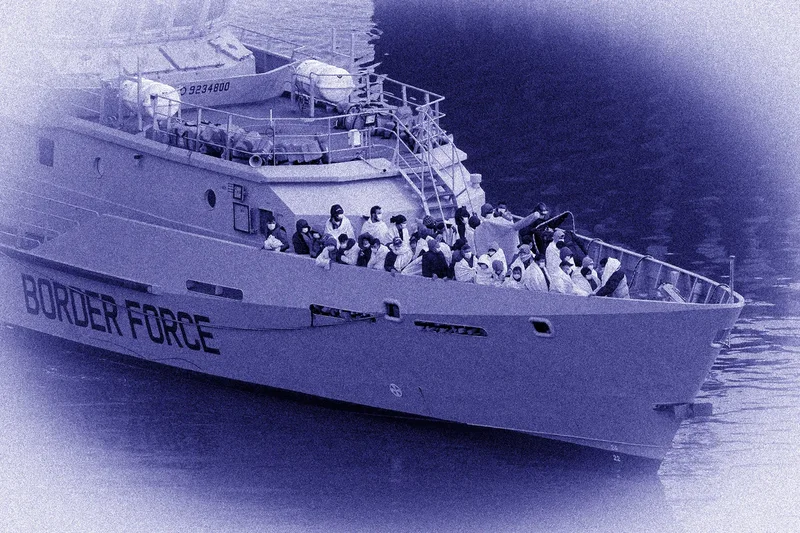
Reform UK has sparked further controversy over its latest pledge to launch “the largest military operation in the English Channel since World War Two” to stop small boat arrivals from France.
Dubbed “Operation Fortress” by Nigel Farage’s party, a Reform UK government would send the Royal Navy into the Channel to intercept all migrant boats there and return them to France or Belgium.
Though the party says the plan is in line with international law and that it will both halt small boat arrivals and act as a humanitarian response, Labour criticised the “reheated” announcement and said “anger and easy answers won’t bring crossings down”.
The party would pass emergency legislation “as necessary” to give the joint command any further required powers. But what does the law actually say about such a plan?
What does Reform have in mind?
The party proposes to set up a joint military command with units from the Royal Navy, Royal Marines, RAF and British Army as well as a surveillance command to track incoming boats.
The armed forces would intercept any unauthorised boats and detain their occupants, giving them water and food and a medical assessment before returning them to France or Belgium under escort on navy vessels.
Would it be legal to use the armed forces?
Yes and no. Yes, if it is just for logistics, placing the navy in command of Border Force and other resources (as was done between 2019 and 2023), intelligence gathering and surveillance. None of these is normally unlawful or even controversial. But more direct confrontations might be.
What does the law say?
Basically that it’s not possible for the Royal Navy to directly engage with the typical small boat in the Channel – either towing them away, pushing them back towards French waters, or towing them back to the French coast. There are at least four aspects to this.
First, if the navy caused someone to be injured or die, that is a common law offence, given that we are not literally at war and irregular migration is a civil matter.
Second, there is the absolute universal human right, under domestic and international law, to claim asylum, and the navy is not entitled to abrogate that.
Third, there are multiple international conventions codifying the traditional imperative to save lives at sea. These include the International Convention for the Safety of Life at Sea, 1974 and the UN Convention on the Law of the Sea, 1982.
Last, pushing people and vessels into French waters violates French sovereignty and invites retaliation and resistance. In a worst-case scenario, British and French ships could be engaged in brinkmanship, and things could escalate into a mini cold war between the UK and France/the EU. Trade and much else would be endangered.
What do these maritime laws state?
The UN convention creates an obligation on all seafarers, including navies, to rescue anyone in danger at sea. Article 98, for example, obliges states to require all masters of a ship to help anyone in danger at sea, so long as it does not also cause serious danger to the rescuing ship. It requires vessels to: assist anyone found in danger at sea; proceed to rescue people in distress, if informed of their need for help and if this may reasonably be expected of the vessel; assist and follow procedures in the event of a collision. It applies to all waters. That is why Border Force and the RNLI take the occupants to shore – it’s the law.
One crucial question is whether “pushback” by a large naval vessel against a dinghy would violate the convention. Practically, it would certainly be hazardous, and could easily endanger life.
What does the Royal Navy think?
They were involved in commanding Border Force a few years ago, didn’t like it, and say it made no difference. The spin that comes out is that they’ve got better things to do, lack the resources and will refuse to endanger the lives of civilians, let alone attack and drown them.
Didn’t the Australians use their navy?
Yes, with some success, but in very different circumstances. Australia is a long way from Indonesia, where many of these larger (safer) boats come from, so the Royal Australian Navy would be able to take or escort them back to international waters. There were also nations, such as Sri Lanka and Vietnam, willing to take back their citizens, and third countries that agreed to house and process them, such as Papua New Guinea. None of these sorts of options arise in the English Channel where there are no international waters (the closest being the hostile North Sea or Atlantic). Nor are there any nearby countries willing to accept the would-be refugees. Quite the opposite, in fact.
How could a government enforce such a policy?
If done logically and properly, it would require the UK to exit all the relevant international conventions, amending any domestic laws, and finding Royal Navy commanders actually willing to implement the policy, which would be difficult but probably not impossible. Similar strictures would apply to RAF or army non-lethal “strafing” of small boats. The damage to international relations would be considerable.