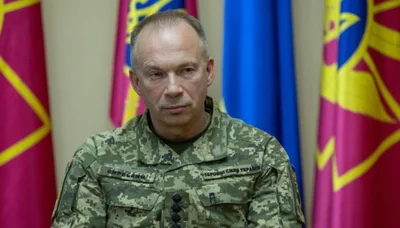
Commander-in-Chief of the Armed Forces Oleksandr Syrskyi stated that the General Staff will cooperate with any defense minister who is appointed, and that the primary task remains the defense of Ukraine.
He made these remarks in a column for *Military*, as reported by Ukrinform.
“It came as a surprise to me to learn that we had a conflict with the minister [Mykhailo Fedorov]. I viewed our relationship as a professional one: involving complex issues and differing positions. That is how it should be between two institutions during a major war,” Syrskyi said.
He emphasized that Ukraine will prevail in the war not because it has irreplaceable individuals, “but because it has an army, institutions, and millions of people who are doing their jobs.”
“Reducing this war to a confrontation between two individuals is the greatest favor we could do for the enemy… the war is won by real work, not by the public drama surrounding it,” Syrskyi noted.
The Commander-in-Chief emphasized that the Ministry of Defense is responsible for supplying the troops, procurement, policy development, and civilian oversight of the Armed Forces of Ukraine, while war strategy, operational planning, and the situation on the front lines fall under the responsibility of the General Staff.
“War strategy, operational planning, and the situation on the front lines—by law, these are my responsibilities to the Supreme Commander-in-Chief. Long-range strikes and the isolation of Crimea are carried out by the Armed Forces of Ukraine, the Security Service of Ukraine, the Main Intelligence Directorate, and the State Border Guard Service, and are coordinated by the Supreme Commander-in-Chief and me. This is not because I ‘prevent’ anyone from succeeding, but because this is how institutional processes are structured in all armies around the world,” Syrskyi emphasized.
He stressed that war strategy cannot be the subject of public debate.
“War strategy is not a public document or a social media post. It is reported to the Supreme Commander-in-Chief, and its results are evident on the front lines,” the Commander-in-Chief noted.
Regarding criticism of unmanned systems, Syrskyi noted that he himself initiated the creation of the Unmanned Systems Forces as a separate branch of the military and proposed appointing Major Robert Brovdi (Madyar) as its commander.
“A person who ‘doesn’t want to fight with drones’ would not create the world’s first separate branch of unmanned systems forces nor appoint a commander for it in defiance of all traditions of military hierarchy,” he stated.
At the same time, Syrskyi emphasized that drones cannot completely replace other means of conducting combat operations.
“Drones account for a large share of strikes today. That is a fact. But to prepare the battlefield for drones to operate effectively, we need artillery, mortars, engineering assets, air defense, electronic warfare, and dozens of other types of equipment,” he noted.
Commenting on personnel policy, the commander-in-chief rejected accusations that he appoints only loyal commanders, citing as examples a number of military personnel who were promoted based on their performance.
He also drew attention to the situation regarding new contracts for service members.
“The new contracts were presented over a month ago. As of today, about 2,000 service members out of a million-strong army have signed them,” Syrskyi noted, adding that he had received “a large number of demotivated soldiers and officers who expected one set of conditions but received another.”
“The same applies to mobilization reform—a task set by the President. The Ground Forces and the Territorial Defense Command fall under my authority, and we are ready for changes: we attend all sessions of the Verkhovna Rada, report all violations to the State Bureau of Investigation, and insist on involving the police. But the reform itself—the legislative and administrative work—is the ministry’s responsibility. I am waiting for it just as the whole country is,” he said.
The Commander-in-Chief also emphasized the need to ensure the timely payment of salaries to military personnel.
“The minister himself publicly stated that part of the funds from military salaries was allocated to the purchase of drones. Because of this, the issue of funding payments for the second half of the year arose… A soldier’s salary is not a reserve to be redistributed, but a state obligation to people who risk their lives every day,” he emphasized.
The Chief of the General Staff stated that, together with the government, they are continuing to seek a solution so that every service member “receives their pay on time and in full.”
In conclusion, Syrskyi stated that the General Staff will continue to cooperate with any defense minister who is appointed, as the primary goal remains the defense of Ukraine.
“I’m not at war with the ministry. I’m at war with Russia. The General Staff has never opposed the ministry: we have cooperated and will cooperate with any minister appointed by the state. Because in the army, you don’t choose who to serve with. In the army, you follow orders and do your job. But you do it well. My job is war—strategy, the front lines, and the people. That’s what I’m doing, and that’s what I’ll continue to do. Preferably without interviews or op-eds. Ukraine is greater than any individual’s name. And Ukraine will prevail if everyone does their part where they are,” the Commander-in-Chief emphasized.
As reported, protests have been ongoing in Ukraine in recent days, demanding the reinstatement of Mykhailo Fedorov as defense minister and the dismissal of Commander-in-Chief of the Armed Forces of Ukraine Oleksandr Syrskyi. Yesterday, people took to the streets in Kyiv, Dnipro, Kharkiv, Mykolaiv, Odesa, Khmelnytskyi, Vinnytsia, Kropyvnytskyi, Lutsk, Cherkasy, Ivano-Frankivsk, Mukachevo, Chernivtsi, Uzhhorod, and other cities.
President Volodymyr Zelensky stated that the reason for the dismissal of Defense Minister Mykhailo Fedorov was the lack of effective communication between the Defense Ministry and the army leadership. According to the President, such communication did not take place without him.
At a briefing on July 16, Mykhailo Fedorov criticized Commander-in-Chief of the Armed Forces of Ukraine Oleksandr Syrskyi for “blocking initiatives” and “unwillingness to discuss problems.”