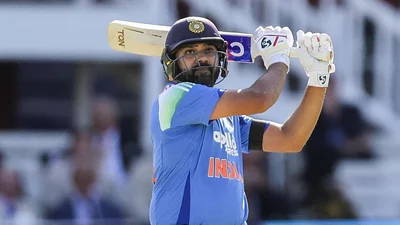
Rohit Sharma is not an angry man. Just as well, because anger doesn’t suit him.
Rohit Sharma is not a bitter man. Just as well, because bitterness doesn’t suit him, either.
These last few days, why, even months, must have been difficult for the stylist from Mumbai, one of the very few remaining batters in international cricket you’d travel miles to watch. In a rapidly changing world where aesthetics are fast being supplanted by raw power and where strength has superseded timing, Rohit is an anachronism. He doesn’t batter so much as caress the cricket ball, apologetic that he must dismiss it from his presence because that’s what his vocation demands, almost reverential in the manner in which he accumulates his runs, with an elegance and grace that come so naturally to him.
For reasons best known to us, or maybe not, we have decided that we ought to have a larger say in Rohit’s future than the protagonist himself. So, we have indulged in rumour-mongering and baseless speculation. We have thrown respect out the window, we have embraced insensitivity and continued to question his place in the limited-overs scheme of things. This, despite the fact that he continues to deliver, admittedly not with the same consistency of yore which is but an inevitable fallout of advancing years.
Flawless run
From the time he was summarily axed as captain just months after leading India to a flawless title run at the Champions Trophy in Dubai in March last year, Rohit has needlessly been catapulted to the crosshairs of motivated gunslingers. Everything that he has accomplished, and that is more than most of the very best can even dare to dream of, has been conveniently ignored, if not forgotten. He has been put on trial every time he has donned the India blue and walked out to bat in a One-Day International – the only format in which he represents the country these days. If Rohit entertained a sense of persecution and utter disrespect, he was perfectly justified in doing so.
But Rohit isn’t wired that way. Would he have been affected by the goings-on around him? Of course, because he also is all too human. He also bleeds when nicked, he also hurts like every one of us. But he isn’t the kind to sit back and mope at the unfairness of the world. He is old enough – 39, as we love to constantly keep reminding him – to understand how the world functions, how the cards are dealt, how the narrative can be twisted and manipulated so that by the end of the twisting and the manipulation, the original truth is couched in layers of misdirection.
Through all of this, Rohit has maintained a stoic, admirably restrained, silence. He has taken the blows on his chin with equanimity, plunging himself into the sustained pursuit of a craft that has been his unshakeable ally for more than two decades. He has committed himself to becoming the fittest version of himself, perhaps aware that the tenuous safety net of captaincy too has been snatched away and that there is no insurance anymore – not that he has needed it in the past – against a free fall.
These things happen in team sport, and especially in cricket in India, which has been dominated by strong personalities who are quickly brushed aside once we opt to move on to the ‘next big thing’. Social media has merely amplified this phenomenon; everyone with access to a keyboard has an opinion, and several of these opinions are vitriolic and venomous. It takes a thick hide, or a complete disassociation with social media, to carry on as if nothing is happening, which we all know is easier said than done.
Rohit and Kohli took India to a consolation win in the Sydney ODI last year.
\| Photo Credit:
FILE PHOTO: AFP
Since being divested of the captaincy last year, Rohit has played in all of India’s 15 ODIs – three each in Australia, at home against South Africa, New Zealand and Afghanistan, and now in England. Those 15 hits have netted him two hundreds and four half-centuries, which translates to a 50-plus knock every 2.5 innings. In his 19-year international career, he boasts 34 three-figure knocks and 62 other scores between 50 and 99 in 280 digs – a 50-plus effort every 2.92 outings. Surely, if there is a dip in returns, it stems from perception, not reality.
In six of these 15 innings, Rohit’s strike-rate has ranged from 100 to a period-high 125.45 which came during his delightful 138 against England in Sunday’s final ODI at Lord’s. Can we put away the knives we have been sharpening with unseemly glee, please?
An obsession
The 2027 50-over World Cup has been an obsession in several quarters, an obsession that has almost clouded our vision when it comes to other formats. In Test cricket, for instance, India have floundered badly in the last year and a half; home series routs at the hands of New Zealand and South Africa are more than just dampeners, they point to a systemic flaw which those in the thick of things seemed determined to ignore. The myth that India’s batters are the best players of the turning ball has been exploded emphatically by honest rather than massively skilled overseas tweakers like Mitchell Santner and Ajaz Patel and Simon Harmer, yet there seems to be a marked reluctance to move away from ‘lottery’ turners that effectively bridge the gap in quality between India’s spinners and those from outside the subcontinent.
India are currently in the bottom half of the World Test Championship table, and face a monumental task as they attempt to make it to the final for the third time in four editions. Ahead of them are daunting away tours of Sri Lanka and New Zealand between August and December, followed by a five-match skirmish at home against Australia early next year. India need at least a half-dozen wins from the remaining nine games to pitchfork themselves towards a top-two position at the end of the league stage, and that’s where the immediate focus must be. Instead, all the energies have been trained almost exclusively on Rohit and, to a lesser extent on Virat Kohli, and whether one or both should be in the mix for an event that is still some distance away.
Succession plans are inevitable in team sport because time doesn’t wait for anyone and it is important to make provisions for tomorrow. But it’s also equally vital not to lose sight of today. In a desperate urge to merely target the future, Indian cricket’s primary stakeholders are in serious danger of missing the wood for the trees. And by constantly subjecting a giant of Indian cricket to unforgiving scrutiny when there simply is no need, they aren’t just forgetting the present but also disregarding the glorious immediate past.
Rohit has expressed his desire to play in the next World Cup.
\| Photo Credit:
File photo: Getty Images
Mindful of the need to cover all bases in the lead-up to the World Cup, if head coach Gautam Gambhir and chief selector Ajit Agarkar are keen that Yashasvi Jaiswal gets enough opportunities to grow into his role as an opener-in-waiting, they are perfectly entitled to do so. Truth to tell, the left-hander has done nothing wrong; despite smacking centuries in two of his last three ODI innings, he wasn’t even on the plane to England, which is hardly ideal. But as they have shown with the 15-year-old Vaibhav Sooryavanshi, where there is a will, there is a way. Despite the grand success in the later stages of the T20 World Cup of Sanju Samson, India didn’t shy away from discarding him briefly to accommodate Sooryavanshi. There is still place for Jaiswal if that is the desperation, but why it should be at the expense of a still-delivering Rohit is the million-dollar question.
In so many ways, Rohit has been sought to be pushed into a corner to the extent that even the Board of Control for Cricket in India found it necessary to shoot down whispers that the Lord’s ODI would be his final game in the country’s colours. What started as a gentle breeze suddenly snowballed into a raging tornado. Retirement stories were planned in newspaper offices, to-be-published tributes started to stack up until Devajit Saikia, the BCCI secretary, doused raging fires with his proclamation on Friday that Lord’s wouldn’t be Rohit’s swansong. What powers we rumour-mongers wield.
As things stand, India don’t play an ODI until the end of September, when West Indies come calling for a three-match series with games scheduled in Thiruvananthapuram, Guwahati (fast paralleling Ahmedabad as a must-visit centre) and New Chandigarh. That’s more than two months away and there will – or at least in theory, there should – be a temporary lull in the Rohit dissection. Later this week, India will take on Zimbabwe in a three-match T20I series when Sooryavanshi will again be in the limelight.
In the middle of August, Shubman Gill’s side will make their first Test foray to Sri Lanka in nine years. Since losing 1-2 in 2008, India are unbeaten in the Emerald Isles, drawing 1-1 in 2010, rallying from the loss of the first Test to triumph 2-1 in 2015 and completing an unprecedented 3-0 sweep two years later. But Sri Lanka have come a long way since 2017 while India have positively regressed, and Gambhir can expect another torrid examination by spin of which Sri Lanka have plenty of resources to fall back on.
In his control
Rohit will use the next two months, one is sure, to keep fine-tuning his enormous skills and ensure that he is battle-ready when the Caribbeans come along. That’s all that is in his control, that’s the extent to which he can take things into his own hands. Already, he has quietly announced his intentions with his unwavering work ethics that have resulted in the fittest-looking Rohit in recent times. True, he picked up a hamstring injury during the IPL, but he bounced back with a brilliant 84 after a three-week layoff during which he missed five matches. Rohit isn’t the only player to have contracted a non-cricketing injury in recent times. Why, even Kohli missed the Afghanistan ODIs with a hamstring injury while Gill’s repeated neck spasms and a new, disturbing development in the form of cramps are gradually becoming a source of concern. Far younger and supposedly fitter individuals like Hardik Pandya, Nitish Kumar and Harshit Rana are spending more time rehabbing than plying their wares on the cricket field.
Let’s just leave Rohit to his devices. He knows not to overstay his welcome; let’s accord him that respect, because it isn’t a privilege but a right he has earned.