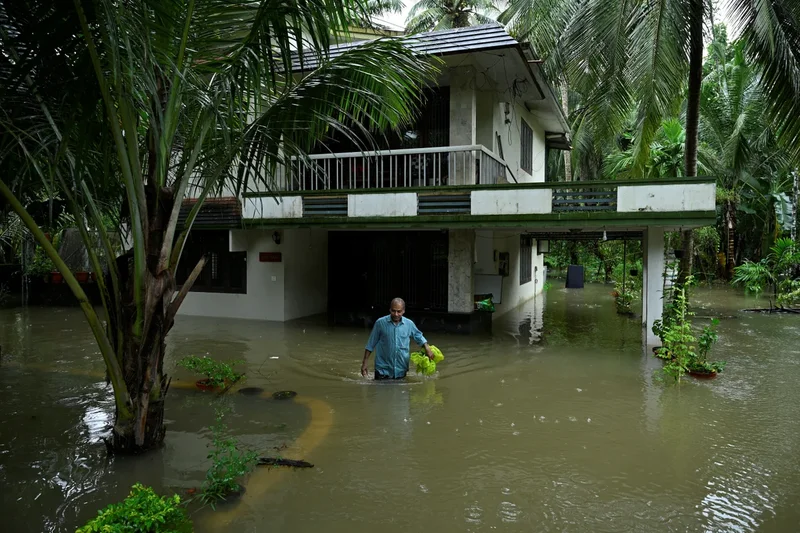
At least 15 people died and seven were missing in the southern Indian state of Kerala after days of torrential monsoon rain brought hillsides down onto homes and sent rivers over their banks.
Twenty seven houses were destroyed and around 200 damaged. Nearly 11,000 people were now sheltering in 316 relief camps, chief minister VD Satheesan said on Monday.
The death and devastation began in the hills of central Kerala, where the heaviest rain fell on Friday night and Saturday, and spread north towards the coast, with four people killed in Malappuram and three in Kottayam, among them a child who drowned in a water tank.
Rainfall in the worst-hit belt reached a level rarely recorded anywhere in a single day, with 302mm falling in under 24 hours on Vadasserikkara, a town in the hills about 60 miles inland from the coast, according to Sekhar Lukose Kuriakose, member secretary of the Kerala State Disaster Management Authority.
Britain's wettest day on record, at Martinstown in Dorset in 1955, brought 279mm of rainfall.
“This was an exceptionally heavy spell of rain," Mr Kuriakose told reporters on Saturday, adding that the worst of the damage ran through a belt of three hill districts.
The rain came from a depression over the Arabian Sea that combined with an offshore trough, a band of low pressure lying parallel to the coast, to draw in wet air and force it up against the Western Ghats, the mountain range running down India's southwestern edge and responsible for catching the monsoon.
A woman was killed when a landslide buried her house in the hill district of Idukki, while her husband and son were pulled from the debris injured.
Rescue crews spent the weekend digging at two other settlements in the district where families were thought to be trapped beneath the mud.
Lower down, where the rivers fanning out from the hills run through farmland and towns, the flooding did the damage, with the Pamba river bursting its banks and swamping the market town of Ranni, closing its main road and filling shops in the centre with water.
Landslides also cut the highway running west to Kochi, Kerala's largest city and its main port.
Engineers were forced to release water from filling reservoirs to stop dams overtopping, raising all five gates at Kallarkutty in Idukki and opening a sea outlet on the coast to drain two swollen rivers, pushing more water towards communities downstream and prompting warnings to residents to move.
Four fishermen went missing after two boats overturned in the sea off the capital Thiruvananthapuram on Friday evening. While two were later found alive, the families of the other two protested outside the local police station over what they claimed was a slow response, prompting the state to ask the navy for help with the search.
Schools and universities in the affected districts were closed and two state examinations postponed.
More heavy rain was forecast for Monday and Thursday, with winds of 40 to 50kmph. Fishermen were told to stay ashore, where gusts could reach 60kmph and waves run up to 3.5m high.
Kerala's monsoon disasters have grown deadlier as its slopes have been cut into for building, farming and quarrying, with landslides in Wayanad in the state’s north killing roughly 400 people in 2024 and floods killing about 480 in 2018.