Current Climate brings you the latest news about the business of sustainability every Monday. Sign up to get it in your inbox.
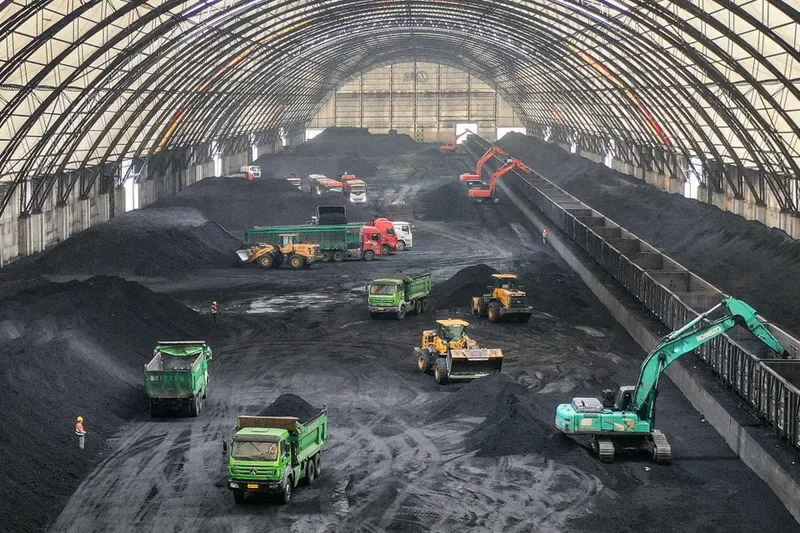
Welcome back to Current Climate. China may dominate global sales of clean energy technology, including solar panels, wind turbines, batteries and electric vehicles, but it’s also the planet’s top carbon emitter owing to a heavy reliance on coal. But that unhealthy addiction is starting to change.
With its head-spinning production and installation of renewable energy, coal’s supremacy in China is weakening. In the year’s first six months, coal produced 49.7% of the country’s power, falling below 50% for the first time in recent history, the government said last week. And at the current pace of installations, which could reach 4,300 gigawatts by the end of the year, solar power may pass coal to become China’s top source of electricity in the third quarter, according to the China Electricity Council.
That would be a major milestone, yet the country’s reliance on coal won’t fade rapidly. That’s because just like in the U.S., electricity demand is spiking, as the country builds more AI data centers and consumers keep switching to EVs. As a result, even with more solar and wind power being added to the grid, total coal use may still grow in the next few years, even as it’s outstripped by renewables. China’s target is for coal use to peak no later than 2030, and decline from that point onward.
While the growth in renewables is encouraging, environmental groups want to see it expand even faster. “Solar and wind play a central role in outcompeting and displacing coal. But solar and wind generation is still only at 25%,” said Gao Yuhe, Greenpeace East Asia’s Beijing-based project lead. “Stronger targets for solar and wind generation will have a knock-on effect to further undercut coal. China’s current 2030 target for wind and solar is 30%, but we can easily hit 33% by 2028. Without stronger targets, coal will linger in the interim.”
The Big Read
Americans Can’t Buy Chinese EVs. Waymo Is Importing Thousands
Chinese automakers are now the de facto global standard for electric vehicles. BYD is outselling Tesla with highly affordable models. Consumer electronics giant Xiaomi is rolling out stylish sedans and SUVs outfitted with dizzying in-cabin infotainment tech. But staggeringly high tariffs, hovering at 127.5% for Chinese-built EVs, have kept those cars largely out of American driveways.
But they have not kept them out of Waymo’s fast-growing U.S. robotaxi fleet.
In late May, Alphabet’s self-driving vehicle company began deploying small electric vans, built by China’s Zeekr brand–which it calls the Waymo Ojai–in cities including Los Angeles and San Francisco. At the time, Waymo would only say it had “more than 100” of the friendly-faced, periwinkle-colored minivans on the road. Most industry watchers assumed the Mountain View, California-based company would ultimately operate fewer than 1,000 owing to the excessive import fees. That’s not the case.
Since 2024, Zeekr has shipped more than 3,200 units of its CM1e, its Chinese market name, through the Port of Los Angeles, including over 2,600 so far this year, based on Bills of Lading data compiled by research firm ImportGenius. While Waymo isn’t identified as the recipient, Zeekr doesn’t have any other U.S. partner. If they were imported at the CM1e’s Chinese market price of $39,000, tariffs would drive the cost up to nearly $89,000, excluding the cost of Waymo’s autonomous driving hardware that likely exceeds $10,000.
Hot Topic
Daniel Weiss, cofounder of Angeleno Group, on the increasingly favorable outlook for cleantech investment
In a piece published with Laura Tyson*, you argue that a historic convergence is remaking the case for clean energy. How does your firm see things? *
Part of what is striking to us as investors who have been in clean energy and climate technologies now … September will be our 25th anniversary since I founded the firm with my partners in 2001. One of the things that's striking to us is this unusual convergence in historical terms of these three factors.
We cannot think of another time since Watt commercialized the steam engine in the 18th century and we began the modern energy markets and industrial revolution, where you've had the convergence of these three factors. One: the abundance of cheap green electrons at scale. Two: a massive inflection for load growth and demand for those electrons. And three: this renewed emphasis, in part because of the war in Iran, on the importance and centrality of energy security and energy dependence.
So, cheap electrons, massive demand driven by AI, data centers, Indians buying air conditioners, EVs, electrification of industrial manufacturing, a whole range of factors are driving this. I think the number is 10X compounded annual growth rates over the next 10 years versus the last 20 years, in terms of electricity demand. The convergence of those three factors is rather unique. And it has very little to do with climate. It has a lot to do with markets, technology, and economics. But it could set the stage, ironically, for one of the biggest super cycles of clean energy and renewables investing of the 21st century. And that it's going to happen potentially or is happening under this administration. It's rather remarkable.
We think the winners in the private sector, which drives somewhere in the vicinity of 80% of global GDP, are going to be those that recognize these global secular mega trends. Again, that doesn't have to do with ESG or whatever you want to call it, a climate agenda. It has to do with markets and economics.
Would an example of this be that on the data center side, it’s faster and cheaper to build large solar and battery systems than to use natural gas, since it takes years to get a new turbine?
Yes. Seven-plus years. I was talking to a board member of GE Renova who I think was telling me not long ago that it's actually closer to eight years. The cheapest, fastest electron in many places happens to be a green electron.
And the other thing that's interesting is that for most of the world, I think the number is somewhere in the vicinity of 70%, the population does not live in geographic jurisdictions that have a big endowment of hydrocarbons. So even if they wanted to drill baby drill, that's not an option for them. In places like the U.S., it is. But for much of the world, even large growing economies like India, like China and like Europe, it's not an option. They've got to figure out alternatives.
And guess what? Sunlight does not get imported through the Strait of Hormuz. We think it's market realities, economic realities, and to a certain extent, increasingly geopolitical realities, that are going to drive this.
So despite a federal administration that doesn’t prioritize it, you anticipate boom times for the clean energy space?
We think it could be. We think it's a bit of a schizophrenic moment. It's not simple because, on the one hand, the bully pulpit with a loud speakerphone, which is the federal government of the United States, has a very clear message on this topic around “drill, baby, drill” and an anti-green message. That has a chilling effect in the capital markets, in boardrooms, in the C-suite among capital allocators. That's a very real thing.
There have been specific legislative and regulatory changes over the last 12 to 18 months, ranging from overturning the IRA, to changes at regulatory agencies like the EPA, calling into question the Endangerment Finding, a whole range of administrative and regulatory factors that have very real impacts on businesses.
And yet there are these countervailing currents that are massive: energy demand, cheap, relatively available green electrons, and this geopolitical overlay around energy security and energy dependence.
What Else We’re Reading
The U.S. clean energy boom will continue until 2030. Then things get hazy (Canary Media)
The Trump administration targeted California and other blue states for clean energy cuts (Los Angeles Times)
Climate change is costing people sleep. Temperature-related sleep loss linked to climate change has at least doubled since the early 1970s (Climate Central)
H2O-from-air technology to supply water-stressed suburbs in California and Texas (Bloomberg)