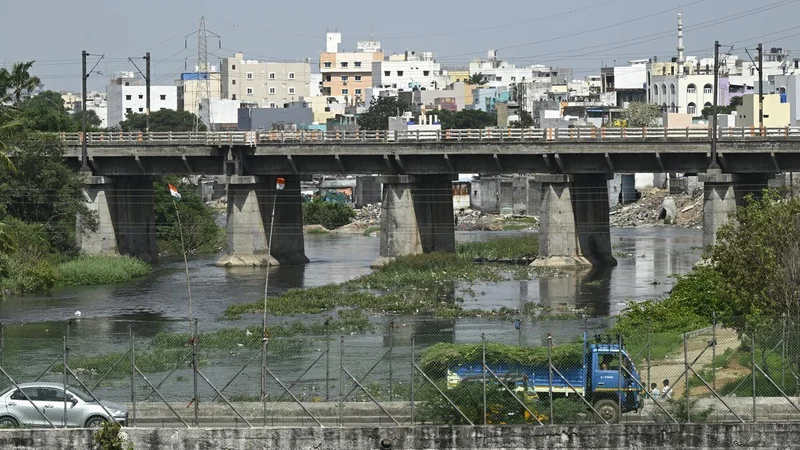
The sediment in the Musi River stretch between the twin reservoirs and Bapughat, earmarked for development under Phase I of the Musi Riverfront Development Project, is free of hazardous material, the authorities of Musi Riverfront Development Corporation Limited (MRDCL) stated during the environmental clearance process.
According to the minutes of the State Expert Appraisal Committee meeting held on July 16, the project proponent, MRDCL, presented the findings of baseline soil and sediment quality studies conducted in the project area to assess the excavation requirements.
The project was approved for environmental clearance by the State Environment Impact Assessment Authority on Monday.
As per the MRDCL, the soil quality assessment indicates that the soils are generally non-contaminated, moderately fertile and suitable for development activities, with no evidence of significant heavy metal or hazardous contamination.
Sediment quality analysis conducted at 24 locations along the river stretch indicated that contamination is primarily organic in nature, characterised by organic matter accumulation, nutrient enrichment and microbial contamination associated with sewage inflows, while heavy metal concentrations remain negligible and within acceptable limits, they said citing the Environmental Impact Assessment report.
MRDCL managing director E.V.Narasimha Reddy and Chief Engineer K.Suresh Kumar during a presentation before the committee, explained that due to non-urbanised and industrially underdeveloped terrain, the baseline data are within prescribed standards.
Accordingly, the proposed excavation depth has been determined primarily based on the thickness of accumulated waste, debris, organically enriched sediments, desilting requirements, restoration of hydraulic capacity, and river training objectives. Nevertheless, during implementation, any localised contaminated material, if encountered, shall be separately identified, handled and disposed of in accordance with applicable environmental regulations and approved waste management procedures, they assured.
It has been proposed to excavate waste at a depth ranging between 0.5 metres and two metres, based on contamination level of soil rather than to maintain the slope of water flow, the minutes said.
City-based environmentalists, who are opposing the project in its present form, are disputing the claims of the corporation about the pollution levels. The EIA report running into 692 pages did not mention pharmaceuticals, antibiotics, or AMR markers anywhere, they pointed out.
Retired scientist and member of the ‘Scientists for People’ collective Babu Rao Kalapala, alleged that chemical contamination exists even near Bapughat where pharma industries are known to dump their waste. He cited a peer reviewed research paper published in the scientific journal ‘Environmental Chemistry and Eco-toxicology, 2026’, which carried out a study on seven Indian rivers, including Musi.
As per the study, Musi has the highest concentration of several bulk drug components, including Telmisartan, Atenolol, beta blocker compounds, paracetamols, Tramadol and Erythromycin in the samples taken from 18 locations across the river’s course in the city. The lower stretch of the river, under Phase-1 of the project, carries the highest Anti Microbial Resistance risk as per the study report.
Scientists for People has written to the State Expert Appraisal Committee and State Environment Impact Assessment Authority, requesting them to condition the environmental clearance for the project on the testing for pharma residues, antibiotics and AMR markers in sediment and water, and remediation proposals to be implemented with timelines.
Mr. Babu Rao alleged that the project was passed without heeding to the pleas for an audience with the committee and written representations.
Published - August 03, 2026 09:30 pm IST