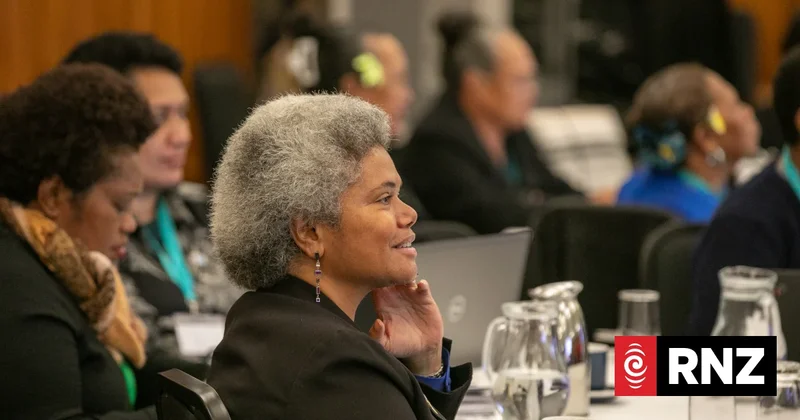
Pacific women MPs share the push for more representation in parliaments
Last week, 29 women parliamentarians from 14 Pacific jurisdictions traded their own legislatures for New Zealand's Parliament in wintry Wellington.
The women changing Pacific politics
They were in the capital to take part in the Tuākana, Tēina, Whenua, Talanoa Wānanga, a three-day programme focused on leadership development, networking and sharing ideas, with the overall theme of encouraging more women to take on leadership roles in parliaments and governments across the Pacific.
The gathering comes as Pacific nations continue to grapple with the barriers preventing more women from entering politics. Ignoring New Zealand and Australia, women make up just 7.7 percent of MPs across Oceania, compared with a global average of 27.6 percent.
Those barriers are varied, and can be cultural, with men traditionally dominating governance roles in many Pacific societies.
The barriers can be economic, with women often balancing family responsibilities alongside the demands of public office.
For some, the way women are treated in political spaces can itself be a deterrent.
Among those attending was Lenora Qereqeretabua, assistant minister and deputy speaker of Fiji's parliament.
Qereqeretabua said the model of special temporary measures had consistently proven effective in bypassing these barriers and increasing the number of women in politics.
"It starts with the political parties having that (special members) in their constitutions first, to make sure that they have adequate women, or a certain percentage of women, as candidates in every election, whether it's local government, or national government elections," Qereqeretabua said.
Although women remain underrepresented in Fiji's parliament, the parliamentarian says those who are in politics and other leadership roles are making a significant impact in boardroom, departmental and governance roles.
One example is Fiji's fisheries and forests minister, Alitia Bainivalu, the first woman to hold the portfolio.
Bainivalu said that since being in the job, she had overseen a high number of enrolments by women into the fishing and forestry industries.
Ruta Baabo Manate, meanwhile, one of just four women MPs in Kiribati's parliament, said her country's geography creates an additional challenge for women seeking elected office.
With the government centred in the capital, Tarawa, people living on the country's many outer islands can face significant barriers to participating in politics.
"The female representation of parliamentarians now in the parliament that we have is mainly women that have lived on the capital, on Tarawa, but are from these respective different islands, and so me, I've lived my whole life on Tarawa as well," Manate said.
"It's really complex that we're scattered, but it's also a blessing."
You can listen to the audio version of this story by clicking the link near the top of the page.