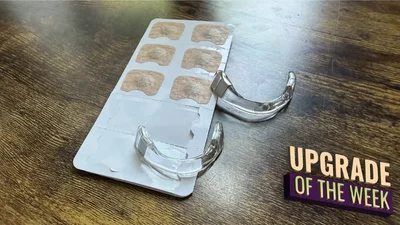
I've struggled with sleep for a while now, and I've been told (repeatedly, and not always kindly) that I'm a bit of a snorer. So when a friend recommended I try nasal strips, I figured it was worth a try. After a few weeks of wearing them to sleep (and more), I'm pleased to report my upgrade of the week is these Intake breathing strips.
Quick disclaimer before I go any further with this recommendation: My positive experience here does not have any real scientific backing. In fact, it's almost certainly a placebo effect. Even though I did notice a slight improvement in my smartwatch's sleep scores, I didn't run a controlled trial on myself and I don't have a placebo strip to compare against. (Besides, I believe any smartwatch's sleep score is a questionable metric in the first place.) Please take everything here as one person's anecdotal experience, not a clinical finding. All that being said: I've never felt more well-rested.
In the past, I had tried some cheap adhesive-only nasal strips. What I like about Intake's design is that instead of one strip that just sits there, you get adhesive tabs that stick to each side of your nose, and then a magnetic band that clicks across the bridge and gently pulls outward on those tabs and expanding the nasal valve. The adhesive holds well, and the magnetic piece is reusable, so you're just swapping the disposable tabs. Plus, the little "click" moment when the band snaps into place is weirdly satisfying. I've also started wearing them on runs, mostly out of curiosity about whether they'd help me get more air in during harder efforts.
Heading out for a run with my breathing strips.
Credit: Meredith Dietz
I first clocked how trendy nose strips have become at a Hyrox race a few months back. Nasal strips have had a few moments in the spotlight before this, and now they seem to be back, showing up on runners, lifters, and hybrid athletes. This tracks as part of a broader wave of interest in nasal breathing and breathwork generally.
What the science actually says
Again, I want to be careful not to oversell anything here. Nasal strips work by widening the nasal valve, which naturally does make breathing through your nose feel easier. But the research suggests any self-reported benefits are most likely placebo.
What do you think so far?
A review of 19 studies on nasal strips and sports performance found no statistically significant difference in VO2 max, heart rate, or perceived exertion between people wearing strips and people who weren't. On the sleep side, research indicates that external nasal strips do not significantly improve subjective measures of sleep quality and nasal congestion compared with placebo strips.
So, the fact that I'm noticing my sleep score improve can probably be chalked up to a powerful placebo effect. And hey, placebo effects are not worthless! I also have a hunch these nasal strips help me keep my mouth closed at night, which helps with my snoring. Breathing through my nose certainly feels easier with them on, both at night and mid-run, and that alone has been enough to make them a regular part of my routine.