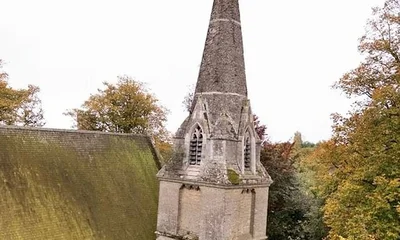
A church dubbed the 'Pisa of the Fens' is set to lose its historic wonky spire because of 'serious structural issues'.
Reverend Richard Hines of St Mark's church in Wisbech, Cambridgeshire, submitted a planning application to have the Grade II-listed building's upper section pulled down amid draining problems and leaks.
The spire's lean had developed over decades as the ground beneath the 160-year-old church moved.
But last year St Mark's was added to Historic England's Heritage at Risk register amid fears that the building's defining feature was contributing to structural problems.
Now, after Fenland council granted its permission, that section will be pulled down in a move which will 'detract from the significance of the building'.
A council conservation officer said: 'There is no getting around the fact that the proposed work will ultimately result in the detraction of the significance of the building as the principal and dominant structure within its generally open and rural setting.
'Whilst I have considerable concerns and sadness about the impacts and the loss of this important landmark feature, the spire is ultimately structurally unsound.'
Planning documents do not predict that the spire could cause St Mark's to collapse in the near future, and hopes remain that the feature could be reconstructed in the future.
St Mark's Church in Wisbech, Cambridgshire, is set to lose its spire over structural issues
The spire's lean had developed over decades as the ground beneath the 160-year-old church moved
For now, the structure will be capped until funds become available for it to be rebuilt. The cost of that work is, however, yet to be calculated.
Reverend Hines said in his application: 'It is often referred to locally as our Pisa in the Fens, given the noticeable inclination of the towers with its spire.'
He also admitted in the documents that the work 'will inevitably reduce the prominence of the church in the landscape albeit possibly temporarily'.
The Victorian Society are in support of the work, but reiterated that it will harm the building's historical significance.
Senior conservation adviser Connor McNeill said: 'It is essential if reducing the spire is approved that proposals for reconstruction are brought forward in a timely manner.
'A full record of the tower should also be made to enable proper reconstruction in the future.'
Permission to tear down the spire was granted on the condition that work begins within the next three years.
Elsewhere, another British church considered akin to Florence's Leaning Tower of Pisa is in need of £100,000-worth of repairs to save it from crumbling.
St James' Church in Dry Doddington, Lancashire, features a spire which angles at 5.1 degrees.
But earlier this year the church ward, Richard Loynes, lamented its deterioration - saying 'I wish we had the same level of funding as the Leaning Tower of Pisa'.
The tower, dating from the 14th century, is believed to have first shifted in the late 19th century and was underpinned in 1918 to prevent it from tilting any further.
Mr Loynes said: 'The church is very much part of the village and we're proud of its uniqueness.
'I wish we had the same levels of funding as the Leaning Tower of Pisa however - but that's not the case and we need help.
'I'm off to Italy with the wife soon and will be visiting Pisa so I perhaps need to get speaking to them to see what the secret is.'
The warden admitted 'we would never want to lose the crookedness of the spire' - explaining it was believed the tilt existed due to the building being on a 'big heap of clay, which can get either very wet or very dry and when it's dry it shrinks'.
He added: 'The church has no foundations and was just plonked on earth. It was underpinned to make sure it doesn't move any more.
'We think that is the most likely cause but some have said it could be on a burial ground too.'
However, Mr Loynes was assured the church is fully stable - adding the intention is 'not to correct the lean as that is what helps make the tower and church so special'.
A decision is yet to have been made on whether St James' Church's spire will remain intact, though Mr Loynes started a GoFundMe in anticipation of works beginning.