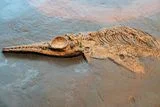
Before the Queensland Outback transformed into the dry and dusty climate it is today, it was covered by the sea. And beneath those waves, a “crime” lost to the sands of time took place.
Thanks to fossilized evidence from Richmond, Queensland, researchers found a marine reptile had eaten a flying reptile shortly before becoming a meal for a larger predator. This is some of the first fossilized evidence of its kind, according to a study in the journal Gondwana Research, and helps us better understand what happened beneath ancient waves over 100 million years ago.
“I was amazed by the size of the ichthyosaur, and shocked to see it littered with bite marks and partially exposed pterosaur remains behind the skull,” Matt White, a research associate at the University of New England and lead author of the study, said in a press release.
Fossilized Marine Predator to Prey
Inside the fossilized belly of a 19- to 22-foot ichthyosaur — a prehistoric dolphin-like marine reptile — researchers uncovered something they’d never seen before. Thanks to advanced 3D imaging, the research team found pieces of a pterosaur, a flying reptile, inside the ichthyosaur’s fossilized stomach contents.
According to the study, this is the first known evidence of an ichthyosaur consuming a pterosaur. But the ichthyosaur fossil revealed something else. On closer inspection, the ichthyosaur fossil — which belonged to a Platypterygius australis — contained huge bite marks, missing pieces, and shattered bones that are consistent with attacks, or perhaps scavenging, from Kronosaurus queenslandicus, a giant predator that ruled the ancient seas in this area.
The fossil helped preserve a prehistoric food chain event that has rarely ever been seen.
“This discovery enriches our understanding of these ancient marine reptiles and illustrates the complex interactions that shaped their prehistoric aquatic environment. The public fossicking areas near Richmond have yielded thousands of fossils over the years, including dinosaurs, birds, turtles, polycotylid, plesiosaurs, pliosaurs, pterosaurs and other marine reptiles,” White added.
From Bag of Bones to Groundbreaking Discovery
This discovery comes in pieces — in multiple ways. Mike and Cathy Freeman, along with Gary and Barb Flewelling, first uncovered the fossil during a visit to a public fossicking site near Richmond in 2019. Unsure of what creature the fossils belonged to, the bones were collected in a bag and nicknamed “Bag of Bones” or B.O.B. It wasn’t until three years later that Kevin Petersen, a curator of Kronosaurus Korner, went back to the fossil site and discovered additional remains of the ichthyosaur.
Research and volunteer teams noticed that the odd rock nodules lay behind the skull. Not wanting to damage the fossil, the team used technology from the Australian Nuclear Science and Technology Organization (ANSTO) to perform an advanced synchrotron CT scan on the nodules without damaging the fossil.
The scan revealed remains of squid-like cephalopods, fish, and the pterosaur’s jaw.
“As research continues and methodologies advance, each fossil discovery, like this Platypterygius australis, has the potential to reveal more intricate patterns and provide glimpses into the complex food webs that existed beneath the waves during a pivotal time in Earth’s history,” White said.
This finding helps to back up the claim that these ancient waters were a dangerous and complex ecosystem, showing that even the hunters can easily become prey themselves. Thanks to this fossil, science can paint a better picture of what life in the ancient Queensland sea was like 100 million years ago.
Read More: A 240-Million-Year-Old Aquatic Reptile Fossil Challenges When Reptiles Ruled the Sea
Article Sources
Our writers at Discovermagazine.com use peer-reviewed studies and high-quality sources for our articles, and our editors review for scientific accuracy and editorial standards. Review the sources used below for this article:
- This article references information from a study published in Gondwana Research: Beneath the waves: Extraordinary dietary insights from a dismembered ichthyosaur from the lower Cretaceous