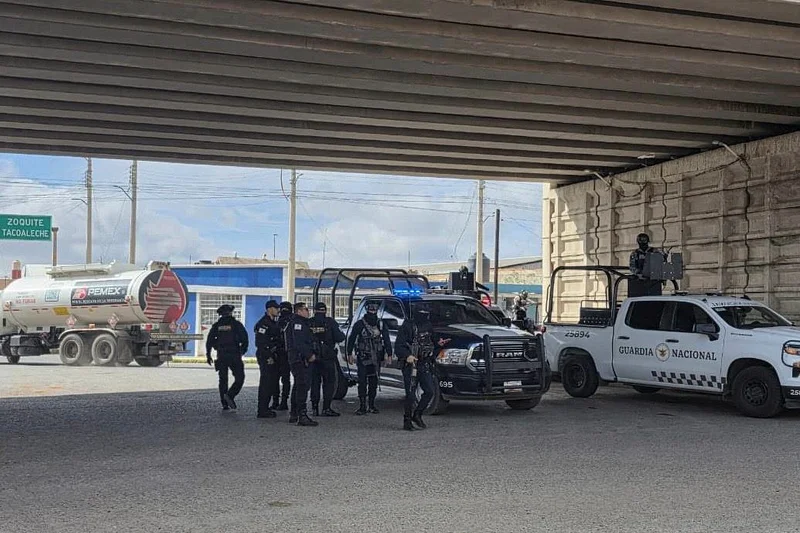
The city of Fresnillo, in the central Mexican state of Zacatecas, has been the hardest hit by the weekend massacre of 10 men. At least six of the victims worked there. The discovery of half of the bodies hanging from a bridge, partially naked and showing signs of torture after all had been kidnapped, has sparked fear among the city’s roughly 240,000 residents and shocked the entire country.
It is still unknown what ties the victims had to one another beyond their brutal killings. The state prosecutor’s office is working on the hypothesis of “possible acts of collusion and extortion by public servants.” So far five people have been detained, three of them on Tuesday: two men aged 22 and 23 and a 16-year-old girl. They were arrested during a patrol and weapons and drugs were seized.
The 10 victims were abducted at different times over the weekend, although authorities say no formal complaints have been filed. Their bodies were found at three different locations in Zacatecas. The Sinaloa Cartel, which has cells operating in the state, claimed responsibility for the murders in a defiant video showing armed, masked men.
The Fresnillo city council — the second most important city in Zacatecas — is governed by an alliance of opposition parties (PRI, PAN, PRD) against the state executive, which is controlled by the ruling leftist party Morena. Two members of that municipal body were killed: Fidel Alvarado de la Torre, who was head of Social Development, and Jesús Gerardo Muñetón Hernández, a firefighter who was part of the municipal civil protection team. On its official Facebook page the city council said both were “efficient, friendly officials who were deeply committed to their work.”
Fresnillo’s economy revolves around the automotive industry in the United States, mining — Zacatecas is home to some of the world’s largest silver deposits — and agricultural and livestock activity, in a city where 36.7% of the population is poor and 3.4% live in extreme poverty, according to Mexican government data from 2020. Two of the murdered people were business owners, a father and son: Armando Ledesma Aguirre and José Armando Ledesma Campos. They ran companies in several sectors, from mining to water and fuel transport to construction. The Zacatecas chapter of the Mexican Chamber of the Construction Industry condemned the killings and called on “civil society and the private sector” to stay “united, without normalizing violence.”
The Zacatecas chapter of the Employers’ Confederation of the Mexican Republic expressed its condolences over the killings “for the loss of people who contributed to the economic and social development of our state.” The statement added that “no society can aspire to a future of development when violence puts at risk those who work, undertake, invest, and generate opportunities for others.”
The other two victims who worked in Fresnillo were the owner of a bar called Las míster, Juan Carlos Berumen Guerrero, who also worked as a DJ, and Jesús Daniel Rivera Sandoval, a businessman involved in event organization who was involved in the local fair. Berumen was active on social media and organized concerts at his venue. The business’s last Facebook post, promoting a show by Los Palomitos and free admission for women until 11.00 p.m., was published two days before he was found dead.
Concern among business owners
The massacre has plunged the business community into uncertainty. One clear lesson from the brutality of cartel cells is that anyone who does not align with their “agreements” becomes a target of their violence.
One of the victims was Ignacio “Nacho” Castrejón Valdez, an architect and businessman who was born and spent his whole life in Sombrerete, a municipality of just over 25,000 inhabitants located about 20 miles from the namesake town in neighboring Durango. He was 59 and a cancer survivor described by relatives and close associates as determined and committed. He was the brother of the current secretary of public education of Hidalgo, Natividad Castrejón, and the father of four children.
In 2002 Castrejón founded Grupo CAVI, which he led as majority partner in Sombrerete and which began with 30 employees. He later established four other companies within the group, all related to concrete production, construction, installations, and structures. His workforce now totals some 500 people. He also provided services to mining companies inside and outside Zacatecas. The Zacatecas Mining Cluster Civil Association lamented his death and published a statement: “His legacy and contributions will remain in the memory of those who had the privilege of knowing him.” Authorities found Castrejón’s body in the municipality of Sain Alto, about 30 miles from Sombrerete.
Also among the victims was Fernando Alan Robles de la Torre, who appears in records as a representative of the Zacatecan company Robles Hermanos Construcciones, and who in 2013 won, for example, a public works tender with the government for the expansion of earthworks, paving, signage, drainage works and other complementary projects in Zacatecas. In another contract completed in 2015, De la Torre signed as the company’s legal representative on a contract with the state health services for construction and equipping of a health center.
A Sinaloa Cartel cell in a video released on July 20.
A study by the organization México Evalúa placed Zacatecas at the top of the states with the most recorded extortion cases between 2023 and 2024, with a rate of 1,500 per 10,000 businesses, noting that the phenomenon is concentrated especially in regions and microregions with an organized crime presence. In November last year, state prosecutor Cristian Paul Camacho Osnaya confirmed that 2025 had the highest number of arrests for extortion, with a total of 39, even though it had lower reporting because few victims file complaints. INEGI figures confirmed that extortion is the most frequently committed crime in Zacatecas.
José Ángel Valdéz Rivera, 53, was another of the 10 people killed. He was an agricultural producer and the leader of the livestock sector in Jiménez del Teúl, a municipality of about 4,500 inhabitants that also borders Durango. He served as president of the municipal livestock association, which, after his death, recalled his legacy and contributions to the sector. “He leaves an indelible mark,” they posted. He was affectionately known as El Moreno and was recognized in the community “for extending a hand when people needed it.” Valdéz Rivera’s disappearance was the only one of the 10 cases that was publicly reported, at least on social media.
A post from July 18 reported his disappearance as follows: “Yesterday, July 17, 2026, Mr. José Ángel Valdéz Rivera disappeared; he was last seen in Canoas, Jiménez del Teúl, Zacatecas. The second photo shows what he was wearing yesterday; any information that helps locate him would be greatly appreciated.”
Missing persons poster for José Ángel Valdéz Rivera.
Andrés Vázquez Gurrola, a former councilor and former director of public security of the municipality of Canacatlán in Durango, was also killed. He was a lawyer and spent his life in various public service roles in his municipality. He was municipal leader of Movimiento Territorial, an organization linked to the Institutional Revolutionary Party (PRI). Local media reported that during that time he coordinated community and social activities. In 2020 he resigned from the PRI and from the leadership of Movimiento Territorial to continue working independently. “Canatlán loses an exceptional human being,” friends posted on social media.
Sign up for our weekly newsletter to get more English-language news coverage from EL PAÍS USA Edition