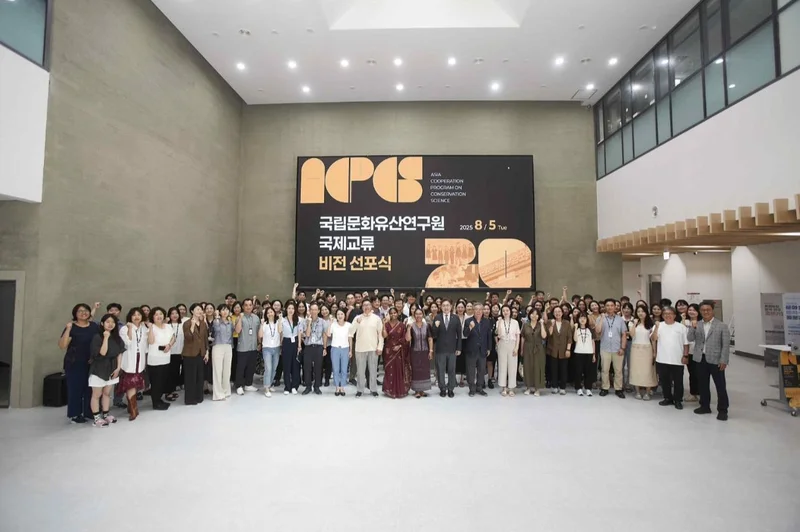
Two decades of sharing preservation expertise — painstakingly restoring ancient wooden architecture, analyzing historic pigments and fortifying archaeological sites — with neighbors across Asia have culminated in a broader mission for Korea: opening those specialized vaults to the rest of the world.
The National Research Institute of Cultural Heritage, an arm of the Korea Heritage Service, officially launched the International Cooperation Program on Conservation (ICPC) on Tuesday. The intensive 60-day initiative marks a major strategic expansion of Korea’s flagship technical training program, which had previously focused exclusively on regional Asian partnerships.
Following a highly competitive selection process that drew applicants from 31 countries, five distinguished experts were selected for the inaugural global cohort: David Nkusi of the University of Rwanda, Zilola Tulkinova of the Academy of Sciences of the Republic of Uzbekistan, Phub Thinley of the National Library and Archives of Bhutan, Fernando Andres Zambrano Luque of Ecuador’s National Institute of Cultural Heritage and Mohamed Nuhaad of the Maldives National Centre for Cultural Heritage.
Running through Oct. 1, the residency pairs each visiting researcher with a dedicated Korean mentor for individualized, hands-on technical guidance. The curriculum bridges high-tech laboratory conservation with direct field applications. Participants will travel to Korea’s landmark historic zones — including the royal palaces of Seoul, alongside ancient capitals such as Gyeongju, Iksan and Buyeo — to observe firsthand how the nation seamlessly blends modern technology with traditional restoration practices.
Each participant brings a distinct, pressing preservation challenge from their home country. Over the course of the two-month program, the researchers will explore subjects ranging from community-led management of archaeological ruins and the chemical analysis of Buddhist sculpture pigments to the preservation of ancient wooden printing blocks, comparative traditional architecture and climate-resilience strategies designed to protect vulnerable island heritage from rising sea levels.
The launch of the ICPC builds directly on a 20-year foundation established by its predecessor, the Asia Cooperation Program on Conservation Science, which trained 120 specialists across 19 Asian nations between 2005 and 2025. The institute said it plans to progressively scale up the program's class sizes and residency lengths in coming years while simultaneously refining existing joint initiatives with global organizations, such as the International Centre for the Study of the Preservation and Restoration of Cultural Property.
Through these tailored mentorships, Korean heritage officials said they aim to expand technical assistance across Latin America, Africa and island nations, positioning Korean heritage as a leading global standard for cultural preservation and international research cooperation.
This article was published with the assistance of generative AI and edited by The Korea Times.