- Published
While this summer's hot and dry weather might be enjoyed by sunbathers, it is less than ideal for farmers. Could it also have an effect on the prices we pay for food at the shops?
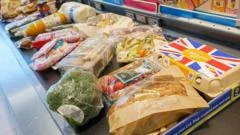
A chilled supermarket aisle might just be the most comfortable place to be as heatwaves continue to warm up the UK.
Fridges are working in overdrive to keep produce cool, shutters are being pulled down to keep the hot air at bay, and some goods are being taken off the shelves on the hottest days.
More than half of England has entered drought conditions, according to a declaration by the Environment Agency last week.
But as temperatures continue to soar, the chillers are not the only thing that retailers might be adjusting.
Extreme weather creates a knock-on effect on all parts of the supply chain, and the British Retail Consortium is warning that could force prices up.
What is a supply chain?
A supply chain involves a small number of stages, from a product being made until it gets to the shops for people to buy.
If you take a loaf of bread as an example, first the grain is grown, harvested, milled and stored until it is ready to be taken to a factory.
Those ingredients are used to bake and package the bread, which is taken to warehouses before eventually ending up on supermarket shelves.
Each stage of that process will incur expenses such as transport and storage, and rising costs at any step could end up in the product you buy being more expensive.
Last week, farmers and flour producers said they were adapting to the challenges of dealing with the earliest harvest for 50 years.
And the National Farmers' Union has warned there could be a shortage of certain food products if current drought conditions continue.
More from Cambridgeshire:
"One week of hot weather will not make a loaf of bread more expensive," says Prof Manoj Dora, director of the Centre for Intelligent Supply Chains at Anglia Ruskin University, which has campuses in Cambridgeshire and Essex.
But he says prices could rise if supplies of crops run out, largely because of how it would affect the very beginning of the supply chain.
"We may see that meat, milk, eggs, and chicken will be impacted by [a lack of] animal feed," he says.
"Across different food products, prices could surge if we do not manage these things immediately."
Dora describes the UK's supply chain as "resilient" so the effects of the heatwave may not be felt immediately.
"We need to start thinking of the long term by reconfiguring our supply chain in terms of locations and transportation, and by supporting the farmers," he adds.
Are there enough supplies?
Simon Willis, chief executive of Cambridge-based grain storage co-operative Camgrain, says drought conditions mean this year's crops have not been able to reach their full potential.
Harvest usually starts in early August, he says, but after a very dry spring it has already been and gone.
"This year's very dry harvest will mean that the quality will be good but the yield will be down," he tells BBC Radio Cambridgeshire.
David Wheatley, an arable farmer from Wisbech St Mary in Cambridgeshire, says he thinks farmers are likely to be hit harder than consumers by heatwaves.
"A lot of contracts with supermarkets are already agreed a year in advance, so [farmers] are not going to get paid any more money even though their yields are down this year.
"I don't really think it's going to affect the prices in the supermarkets, because they can just bring more food in from other countries."
But Dora says imported goods could also be affected, particularly wine from countries such as France, which has also faced severe high temperatures.
"Wine has not just a quantity problem, but also a quality problem," the academic explains.
Are retailers prepared?
The British Retail Consortium says climate change is creating challenges for both retailers and their suppliers.
"Extreme weather, including drought, can affect crop yields and place upward pressure on prices," its director of food and sustainability policy Andrew Opie says.
"Retailers are experienced in managing supply disruptions and will take all necessary steps, including sourcing from alternative suppliers where appropriate, to minimise any impact on customers."
Do you have a story suggestion for Cambridgeshire? Contact us below.