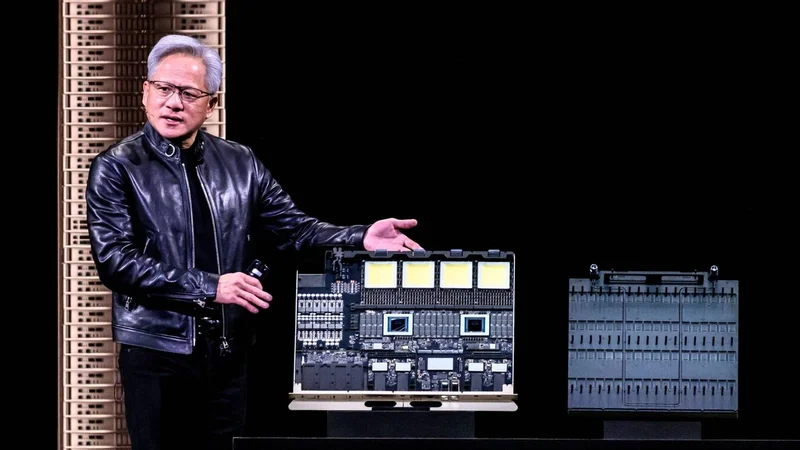
Any time there's potentially positive news about storage and memory supply—such as increasing supply from China—I can't help but think 'sure, but the AI industry will guzzle through it regardless.' Not only is demand seemingly insatiable, but sometimes new developments that encourage even more memory use come along. Case in point here with Nvidia Rubin.
As SE Daily reports (machine translated), Nvidia's new 'context memory storage' (CMX) tech, which should be here with its new Rubin servers later this year, is going to chomp through a whole bunch of NAND.
"Nvidia's CMX is equipped with 576 SSDs, providing a total storage capacity of 9,600 TB. The industry anticipates that the demand for NAND required for CMX will surge from 35 million TB this year to over 100 million TB next year."
Latest Videos From
Analyst Jukan puts these figures into context on X: "Nvidia’s Rubin CMX will quite literally soak up NAND supply like a sponge absorbs water. To put 100 million TB into perspective, it is roughly equivalent to adding another Apple-sized source of demand to the NAND market."
Samsung is apparently attempting to establish itself as a key supplier to Nvidia for this new kind of demand.
CXM essentially exists somewhere between an AI accelerator's high bandwidth memory (HBM) and its regular masses of storage. You can think of its relation to HBM as a bit similar to RAM's relation to CPU cache and SSD storage. This CXM, which can be shared across different AI accelerators, is accessible much more quickly than standard long-term storage because it connects over 'Spectrum-X Ethernet'.
It's good news for NAND makers like Samsung, of course, as there is yet more demand for storage. But it's probably not so great for consumers like you and I, at least not in the short and medium term. More NAND or DRAM demand from the AI industry, with their big contracts, seems to usually be prioritised over the consumer market.
Keep up to date with the most important stories and the best deals, as picked by the PC Gamer team.
There are some higher-ups in the memory industry that seem at least somewhat concerned about consumer prices, but I'm sceptical as to whether those sentiments will do anything to redirect any actual supply away from AI servers and into home consumers' hands.
Best SSD for gaming 2026
All our current recommendations