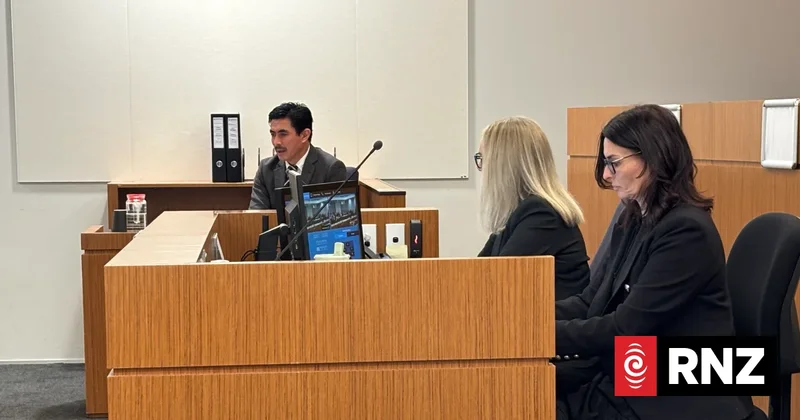
Isaac Levings death inquest: Parks manager says council sidelined him, ignored his research before drowning
A former Wellington City Council waterfront and city parks manager has slammed the council's response to thousands of hours' work and research to improve safety on the waterfront.
Shane Binnie told the court he was sidelined from the council's working groups and his role disestablished because councillors and the executive did not accept his conclusions.
The inquest into the drowning of Christchurch teacher Isaac Levings on the waterfront in 2023 entered its second day at Wellington District Court on Tuesday.
Levings' body was found in Wellington Harbour two days after he disappeared from Queens Wharf after attending a concert in 2023.
He was one of more than a half a dozen people to die on the waterfront since 2015.
On Monday the inquest was shown CCTV footage of Levings' final moments, as he made his way along the waterfront southward from the TSB Arena before falling from the wharf opposite Te Papa.
Binnie told the court he was disappointed the council had not acted on recommendations of Coroner Katharine Greig - including edge protection measures - in response to the waterfront death of Sandy Calkin in 2021.
Greig was also presiding over the current inquest.
Binnie said at the time of Levings' death it was well-known that lighting along the waterfront was "inconsistent and inefficient", resulting in very dark patches, including where CCTV later revealed Levings fell into the harbour.
He said there was no safety lighting to illuminate edges and while balustrades had been present on the wharf further east for nearly 20 years, they were not installed at the site where Levings fell.
Binnie said there were multiple reports into safety in the area and he spearheaded updates to lighting installed ahead of the Homegrown concert the year after Levings' death in March 2024.
He described the lighting project as an "engineering masterpiece" and a highlight of his career.
But Binnie said he saw the Levings death as the "last straw" of multiple incidents in the area and instigated the installation of temporary fencing along the water front shortly after the teacher's passing.
"I couldn't ignore the risks. I knew this was going to catch a lot of heat. [The fences} were not attractive and looked liked a worksite or construction zone.
"They featured in media and talk around the office. But looking at it from a health and safety lens I felt comfortable in the actions I had taken," Binnie said.
Binnie said in the first years of his role - starting in 2023 - he would meet with what was then called the Waterfront Steering Group on a monthly basis. The group was tasked with commissioning and assessing potential options to improve safety on the waterfront.
He said initial reports treated the installation of edge protection measures and lighting improvements in the area as "hand in glove" but while lighting improvements went ahead, proposals put forward to install balustrades along the waterfront were voted down by the council in August 2025.
"Ultimately, the project ground to a halt and all work ceased," Binnie said.
He said while lighting alone could provide a "perceived sense of safety", it would not stop people from falling into the harbour - especially if they were intoxicated "or not steady of foot".
He said his team had outlined a proposal that would've seen $10 million spent on lighting and another $20m on edge protection such as balustrades.
"Lighting and edge protection at the outset had to be designed and considered in conjunction with each other. Because the concept of edge protection was far more significant, it was decided [by the executive level at the Waterfront Steering Group] that they would be separate.
"Unfortunately, looking back, that was a moment in time that I wish didn't happen because ultimately we met many more road blocks in the business case for the edge protection."
Binnie said there were multiple reports into the risks present on the waterfront, including a formal risk assessment conducted by the council health and safety team and a Water Safe New Zealand report identifying the waterfront as number six in a list of "drowning black spots" about the country.
He said the former head of the council's health and safety team, Jonny Barker - who lost his job in 2025 - had written to the council expressing his concerns that the issue of edge protection was not being considered through "a health and safety lens".
"He was concerned about the political influence and resistance to change."
Binnie said the presence of identified risks in a highly public space meant the politicisation of the matter was problematic.
"If it was in a factory and there was a live wire cable flapping around you would isolate it and deal with it and fix it.
"In this case it was a wharf edge, and all the recommendations from many, many, many different experts - and also heard here in a prior coronial investigation [for Calkin] - our business case that proposed and recommended a fully [building standards] compliant balustrade, in my professional opinion, was the most practical, sensible and cost effective risk mitigation.
"But from a political point of view it comes back to money, and it's well documented that the council is not in a good financial position."
Binnie 'sidelined' from waterfront discussions following Calkin inquest
Binnie said his team prepared a variety of business cases for edge protection which included no change, options which incorporated balustrades and alternative "second chance" options such as benches and bollards designed to interrupt access to the wharf's edge. These were presented to the steering group at the end of 2024.
Following that, Binnie said he was sidelined from contributing to discussions around safety improvements and the process would lead up to the disestablishment of his role in October 2025.
"The sidelining began after the conclusion of the Calkin inquest in 2024 and intensified in the months that followed," Binnie said.
"It is my view that council executive did not want to accept our position on safety and the solutions we had provided, which were backed by thousands of hours of study and health and safety experience."
A proposal to proceed with edge protection measures near where Calkin died and on the wider waterfront was voted down by council in August 2025.
"My conclusion at the time was that the senior executive did not like the resounding evidence being accumulated or the resulting professional recommendations we had provided.
"Following my removal the council spent hundreds of thousands of dollars in consulting fees retreading the very ground myself and my team had already covered," Binnie said.
"At the time it felt that everything was being done to find an alternate solution that was not a balustrade."