“It was a glorious farce.”
That was how advertising executive and social commentator Phillip Adams once described a 1978 public competition aiming to transform Melbourne’s most prominent eyesore into a landmark worthy of the place it occupied at the gateway to Melbourne’s CBD.
Adams was one of eight judges attempting to find a defining public monument to satisfy the vision of then premier Rupert Hamer, who wanted to replace the Gas and Fuel Corporation Towers opposite Flinders Street Station with something more befitting a city on the rise.
He and his fellow judges pored over a flood of entries that could be variously described as bold, courageous, absurd and offensive. As journalists Jewel Topsfield and Royce Millar wrote in this excellent 2023 series, the competition failed to identify a standout entry and no winner was declared.
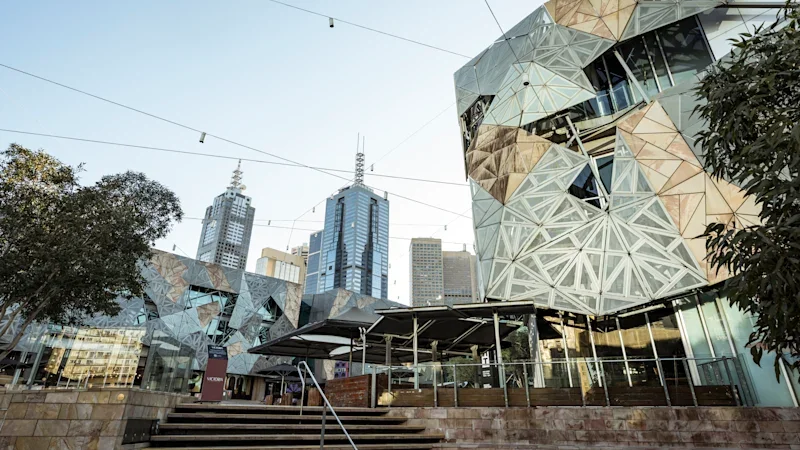
The Age hosted the competition and published the many suggestions put forward. While it didn’t identify a winning idea, it succeeded in prompting a wave of debate in its black-and-white pages. That conversation spilled out into the city’s offices, shopfronts and kitchen tables, as Victorians considered the best use for the site now acknowledged as the beating heart of a healthy metropolis. The result of that conversation was the creation of the meeting place we now call Federation Square, and the modernisation of the nearby spaces along the Yarra River that hug the back of the world-renowned Flinders Street Station.
When The Age is at its best, it is leading the conversation about the future of the city, with the input of the people whose lives it will change.
Hamer wanted a world-class monument, Melbourne’s answer to the Opera House. What we received − eventually − was something far less ostentatious than most competition entries promised, but far more suitable for this great city of congregation. We received a meeting place − a fitting tribute to a state that is both “going places” and whose citizens like to go places: a footy game, a concert, a lecture, a meal, a play or an exhibition. Fed Square gave us another place to bring Melburnians together.
The key ingredient in the Federation Square recipe was that other great Melbourne pastime: spirited public debate.
It is with those two great Melbourne traditions top of mind that I announce today the launch of an exciting new initiative from The Age: Melbourne Assembly. A forum bringing together the people, ideas and conversations shaping the future of our city. To be held from October 19-21, it will, fittingly, take place at The Edge in Federation Square − a nod to Melbourne’s lust for progress.
The Assembly will bring together globally renowned city-shapers and Melbourne’s leading thinkers to tackle four topics crucial to our future: shaping the city, education and innovation, healthy places and people, and how to make the most of our status as the nation’s leading city for sport and the arts.
Melbourne Assembly is being presented in partnership with the University of Melbourne which, like The Age, recognises the value in honest public conversations that help lay the groundwork for progress. Thanks to their support, we have been able to secure two leading international experts on cities as the headline speakers for this event.
Carlos Moreno, pioneer of the 15-Minute City concept adopted by governments around the world, will provide his unique insights on Melbourne and its future direction as part of the event.
Moreno will be joined by Bill de Blasio, former mayor of New York City, whose legacy includes meaningful action to address affordable housing and homelessness, reform of the justice system and early childhood education.
Keep an eye on The Age this week for more on De Blasio and Moreno’s conversation-starting thoughts on Melbourne’s future. As we count down to the Assembly in October, The Age will take an in-depth look at each of the forum’s four topics to consider their role in our city’s evolution.
Moreno and De Blasio will be joined by leading thinkers from Melbourne and around Australia, who we will announce in the coming weeks.
As an Age subscriber, you have early access to tickets to this event at a substantial discount, before they go on sale to the general public next week. Click on this link to see the offers available for various parts of the Assembly or enter the code ‘EditorNote’ to apply the subscriber discount. Further information will become available at the Melbourne Assembly website. Stay tuned for updates.
As was the case in the late ’70s, our city is on the cusp of profound change. We are set to become Australia’s largest city (by some measures, we already are) and a metropolis the size of present-day London by the 2050s. The questions of how we get there, and indeed whether that is where we want to go, have largely been held behind closed doors by a small group of powerful people. It is time to recapture the public conversation and invite Melburnians to help chart the course of their city.
In the shadow of a November state election, Victorians are being asked to consider two distinct visions for the kind of city and state we want. As de Blasio told The Age today, that conversation is too precious to be left to governments alone. It requires the participation of a new generation of civic leadership across Melbourne’s business, education and cultural sectors. It needs a generation of leaders and thinkers to step forward and participate in the discussion about the kind of city we want Melbourne to be − not just the one we’re told we should be.
It is not just The Age and the University of Melbourne who share that vision and believe in the value of facilitating discussion and debate. Other local institutions have come on board to back this important event. Health insurer Bupa and Melbourne’s leading sport and entertainment precinct, Melbourne Park, share the desire to recapture the public conversation about Melbourne’s successes and opportunities. Leaders at both organisations have demonstrated their commitment to that mission and I’m grateful for their support in this endeavour as major partners.
Our supporting partners, Right Angle, City of Melbourne and the Committee for Melbourne, have also embraced this mission and have been instrumental in preparing the Melbourne Assembly.
Thanks also to Future Events Lab, The Langham and MapCo for partnering with The Age to help host this essential conversation.
As was the case in the late ’70s, when Melbourne was on the cusp of a new wave of growth and change, it is time to draft its next chapter through stimulating conversation and robust debate. Leadership is required to make that happen. Leadership from The Age, its partners and, crucially, our readers and subscribers.
When Topsfield and Millar wrote their article in 2023 to mark Federation Square’s 21st birthday, they asked The Age’s former editor-in-chief Ranald Macdonald why he chose to involve the publication in the 1978 competition.
“We thought The Age should be a centre for ideas,” he said. “The concept was to see if there was any great idea that Melbourne could embrace.”
Macdonald was right then. And in 2026, the situation is no different.
When The Age is at its best, it is leading the conversation about the future of the city, with the input of the people whose lives it will change. That’s what we hope to achieve in October.
That was the spirit The Age was attempting to capture when it sparked the debate about Melbourne’s second CBD. It was in the back of our minds when we helped cast a spotlight on the opportunities and challenges facing Melbourne’s booming western suburbs. And it motivated The Age’s editorial team in the late ’70s, when the publication started a conversation that altered the heart of the city.
Although that didn’t produce the expected result, it did have a winner. It was Melbourne.