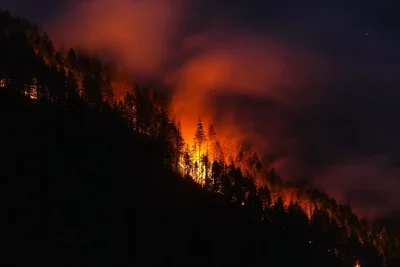
Canada’s ability to prevent and fight wildfires has been questioned by several U.S. lawmakers after smoke from Canadian wildfires drifted into the United States, prompting debate over whether Canada is doing enough to reduce the impacts of forest fires and the resulting smoke.
U.S. Donald Trump threatened Canada with tariffs because of the smoke, and this follows a letter from U.S. lawmakers sent last week to Prime Minister Mark Carney demanding Canada do more to combat wildfires, saying, “sovereignty comes with responsibility.”
But whether Canada is doing enough isn’t simply a ‘yes’ or ‘no,’ experts say, because major challenges exist in controlling some of these fires from getting out of control. The biggest challenge is that Canada’s natural landscape is covered by dense boreal forest that is often inaccessible.
“The question of ‘what is enough?’ is a really tricky one, and that’s always a question of trade-offs too, of course, but I think there certainly is a lot we need to be doing on the mitigation front,” says Eric Kennedy,associate professor of disaster and emergency management at York University.
Story continues below advertisement
“That is a problem that I think we’re only just beginning to grapple with the magnitude of.”
Related Videos
2:59
Ford hits back at Trump over wildfire smoke, says removing lumber tariffs “might make a difference”
Previous Video
Next Video
How Canada manages forest fires
Parks Canada’s strategy to manage the risk of forest fires focuses on four pillars.
First, mitigation, which includes FireSmart community risk reduction, clearing flammable vegetation from surrounding areas, public education, adhering to local fire bans and collaboration through various agencies to maintain effective communication.
Story continues below advertisement
Second, preparedness, which means strategizing how response resources are utilized to be ready for when forest fires start so they can act quickly.
Get breaking National news
Get breaking Canada news delivered to your inbox as it happens so you won't miss a trending story.
Third, the response of those same resources to fires as they break out, which are also shared with internal and external agencies where possible.
Finally, restoration of the forests by using prescribed burns and managed fires, including traditional Indigenous practices to not only manage fires, but also rehabilitate landscapes and build climate resilience.
Canada has invested hundreds of millions of dollars in recent years to improve wildfire response and prevention.
Ottawa launched an initiative in 2022 with more than $500 million spent to improve wildfire prevention, preparedness and response. This included equipment, First Nations firefighting gear, training of 1,000 additional firefighters and a specialized wildfire monitoring satellite system.
Budget 2024 also added $145 million over five years to strengthen climate resilience and deploy structural mitigation strategies, and 10 additional firefighting aircraft were leased this year.
When it comes to preventing forest fires from becoming destructive wildfires, experts say mitigation and restoration, including prescribed burns, are some of the most important, but applying these strategies for the entirety of Canada’s forests is nearly impossible.
“The boreal forest is 300 million hectares in size. There’s no way we can or should even attempt to fuel manage that entire forest. It’s just not happening. It’s not physically possible,” says professor emeritus David Martell at the University of Toronto’s Institute of Forestry and Conservation.
Story continues below advertisement
What is Canada not doing?
Although the four pillars from Parks Canada serve as a framework for managing forest fires, what Canada is not doing is attempting to manage the fuel load across all forests, which experts say is one of the biggest challenges.
Doing so is not realistic because it’s expensive and these forests are difficult to access. Agencies, instead, are prioritizing high-risk areas while accepting that some remote fires will burn because the alternative is impossible.
“Yes, there are strategies that can mitigate risk through forest management in areas where you have some development or an established forest industry, planning where harvesting is occurring to break up areas of continuous fuel, in some cases thinning, prescribed burning, all these things that we hear about can be effective, but it’s very contextual around where you are,” says Taylor.
More on Environment
More videos
“To look at doing that in remote areas, it’s just the scale of the issue is just, you know, is very challenging.”
Story continues below advertisement
2:11
BC’s wildfire fight
Is there too much fuel to burn?
The challenge of expanding prescribed burns and other forest fire management strategies comes as years of fire suppression strategies may have inadvertently contributed to the buildup of vegetation that can fuel larger fires.
“Decades of wildland fire suppression approaches, such as discouraging the intentional use of fire on the land by Indigenous Peoples or extinguishing small wildland fires near communities, have changed the makeup of Canada’s landscape. This has led to a buildup of flammable vegetation (trees, shrubs, or grassland). The forest’s natural ability to recover from a wildland fire has been interrupted, making it easier for them to spread to where people live,” said Natural Resources Canada in its 2024 Canadian Wildland Fire Prevention and Mitigation Strategy.
Story continues below advertisement
This means Canada’s forests may be at higher risk of seeing these forest fires increase to large-scale wildfires as a result of prior efforts to reduce forest fires from starting in the first place.
Forest fires, in some cases, can actually be good for the longevity of those forests because they allow for regeneration.
“Fire, it’s a natural cycle of our forests, [and] of our boreal forest,” says Danijela Puric-Mladenovic, professor of forestry at the University of Toronto.
“We have to make decisions on fire to let it go, because it’s a natural cycle. That’s how our boreal species get regenerated, how (the) forest cycle goes back.”
But those fires which may be left to burn, whether for the sake of the forest’s own long-term health, or for a lack of resources to combat the fires, or both, can result in more smoke being circulated into the atmosphere and spreading to nearby communities and beyond.
Kennedy says despite calls from the U.S. for Canada to do more to prevent wildfires and smoke from spreading, collaboration between the two countries has been and must continue to be used to combat a problem that knows no borders.
“Fire does not know borders and we have decades of collaborating between these two countries to work together where we help with American fires that blow smoke into Canada and they help with Canadian fires that blow smoke into the United States,” says Kennedy.
Story continues below advertisement
“There is probably a lot of room for shared goals when it comes to increasing our investment in mitigation, in preparedness, and in effective and efficient response.”