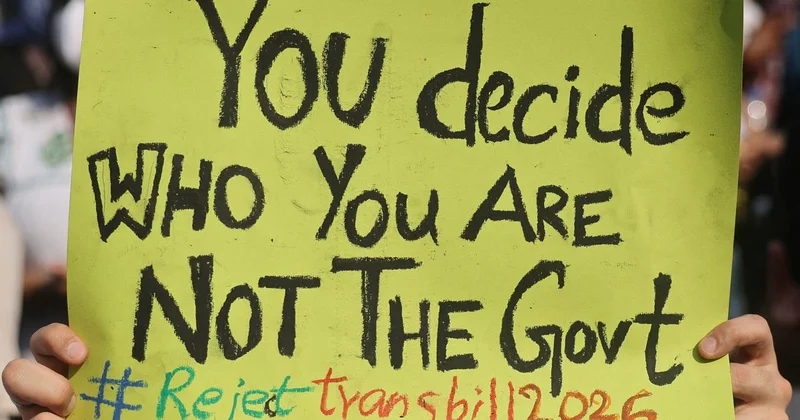
The Supreme Court on Monday verbally clarified to the Union government that the 2026 amendments to the Transgender Persons Protection of Rights Act will not retrospectively or by default invalidate transgender cards issued to members of the community under the previous legislation, The Hindu reported.
The amendments to the 2019 Act, cleared by Parliament in March, redefine who qualifies as a transgender person. They remove transgender persons’ right to a self-perceived gender identity and limit the scope of the law to those with certain biological or physiological characteristics, intersex variations, or specific socio-cultural identities such as kinner, hijra, aravani and jogta.
The law makes medical evaluation and certification mandatory for legal gender recognition. It underlines that the authority to permit such transitions is vested in medical professionals operating under a medical board.
On Monday, the petitioners, including members of the transgender community and activists, contended that the amendments give the government complete power to determine gender identity, The Hindu reported. The cards cannot be invalidated as they are an essential identity document, the petitioners said.
The counsel representing one of the petitioners sought an interim order for the government to maintain the status quo.
Justice Joymalya Bagchi said that the court was concerned about the community’s rights and verbally stated that the 2026 amendment is prospective, and cannot take away the rights of persons who have already been granted the cards, Live Law reported.
However, the bench did not pass an interim order.
The judge told the government’s counsel that “even if there is a change in legislation, the rights conferred or accrued must remain the same”, the newspaper reported.
Solicitor General Tushar Mehta was quoted as saying that the lack of clarity about gender may lead to problems in matters of succession and inheritance, and sought more time for the government to respond.
When the bill was being discussed in Parliament, Opposition leaders had expressed concerns that it undermined the right to self-identification recognised by the Supreme Court in the 2014 National Legal Services Authority v Union of India case. The verdict had formally created the “third gender” category for transgender persons that recognised them as a socially and economically backward class.
The 2014 judgement had also directed the government to ensure that the transgender community gets job quotas, admission in educational institutions, health benefits, separate public toilets and a host of other safeguards against discrimination.
Edited by Neerad Pandharipande.
We welcome your comments at letters@scroll.in.