Slasher films are treated with a good deal more respect these days than they were when Michael Myers first raided the cutlery drawer, but Gillian Anderson never got on board with them. “I had a very bad experience as a very young teen,” she says. “It was my first time smoking marijuana and somebody had a horror film on. It was The Texas Chain Saw Massacre; I think I was on a sleepover or something, but it was a really bad trip. That was the end of me and horror films.”
But Anderson is game for pretty much anything, as demonstrated by the spread of roles on stage and screen she has undertaken – from Edith Wharton to Blanche Dubois – since The X Files made her a household name. Her new film, Jane Schoenbrun’s Teenage Sex and Death at Camp Miasma, is a lurid, hectic and sexually fizzing play on the slasher genre that was the hottest talking point at the Cannes Film Festival.
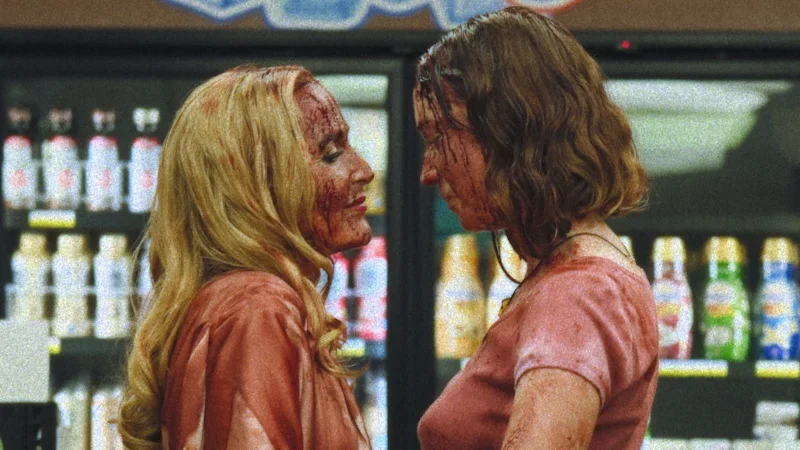
Anderson plays Billy, a reclusive actress who was the first and greatest “final girl” (the sole surviving female character) in an ’80s franchise set in a holiday camp, Camp Miasma, where squeaky-clean teens were pursued, in one film after another, by a serial killer called Little Death. A young American director – and besotted fan – seeks her out, hoping to persuade her to take part in an elevated revival of the franchise.
Hannah Einbinder, who won an Emmy last year for her role as a defiantly over-sharing bisexual comedian in Hacks, is the director, Kris, a trash connoisseur obsessed with movies filled with blood spurting from severed necks, spooky locals who warn city newcomers that they should leave immediately and – of course – tough and triumphant final girls. Perhaps she should be unnerved by discovering that Billy still lives at the decommissioned camp where her film was shot all those decades ago, but it doesn’t feel like a red light to her: nerdy nostalgia is what Kris is all about.
And she is mesmerised by Billy, swathed in satin and pearls despite the sub-zero temperature, sounding like Scarlett O’Hara but with an alarmingly squawking laugh. The Southern belle accent was Anderson’s idea. “It was so important to me,” she says. “It was a portal to so many elements of who she was, her vulnerabilities and her strengths.”
Billy and Kris bond first over their shared passion for ultra-processed snacks – “I love dipping sauce!” moans Billy – then over shared passion, plain and simple. A night of hot sex leaves them both inexplicably covered in blood. Nobody attacked them; apparently, they just foam with life in the heat of the moment.
Anderson didn’t even know what a final girl was before she agreed to do the film. There is a stack of critical writing on the genre’s subversive undermining of male power and bourgeois convention, but she wasn’t familiar with it. “So that’s been a big education and quite enjoyable,” she says. “Because it feels like there’s power in the ownership of it. That is what is of interest to me. I hadn’t realised the degree to which it had been troubling, historically.”
Einbinder goes so far as to describe the film, crazy and blood-soaked though it is, as academic. “[It’s] not something we’ve seen expressed so explicitly. It’s always been kind of subtextual before.”
Back at camp, the two women repeatedly watch Billy’s print of the film in which she starred as a teenager; this fiction within the fiction seeps and gushes into the central narrative, confounding any attempt to explain it. The killer, Little Death, is a diminutive figure with a mask made of an air-conditioning vent. Like Freddy Krueger or Ghostface, Little Death “always comes back”, Billy breathes theatrically as the two women sit on the porch step, gazing out to the snowy woods. “But Little Death’s not real!” protests Kris, thrown off balance. “Well, not with that attitude, he isn’t,” Billy snaps back.
This is fandom as a kind of ecstatic busting of boundaries between “reality” – as set up within the film’s fiction – and fantasy. “It’s coming from a place of genuine love,” Schoenbrun told Deadline magazine. “We’re not being like, ‘Let’s do a cheesy parody,’ or doing a sly, winking, modern nod to how we think of the slasher film. We’re really thinking about how it felt as a kid to watch those things … there has to be love involved in that. It has to be like, ‘Remember how awe-inspiring it felt when you were 11 years old, watching A Nightmare on Elm Street 3?’”
Schoenbrun is transgender. They exude confidence now but as a child and teenager they were nagged by a sense of not fitting in – not even into their own body. It was a feeling that they couldn’t name, but which made them feel like an outsider. A mounting desperation, once they realised they needed to transition, informed both the director’s first feature, We’re All Going to the World’s Fair and the breakthrough I Saw the TV Glow, which made many critics’ best-of lists in 2024.
In that film, teens Owen and Maddy are yet to consider gender or what they think they are, but they are in agonies that their favourite TV show has been cancelled before reaching an ending. “The metaphor at the centre of the film hinges on something being wrong,” said Schoenbrun at the time. “Almost like an identity or a path being foreclosed in the moment.”
Teenage Sex and Death at Camp Miasma makes whoopee in a different sandpit: sexual desire set free, reflecting Schoenbrun’s hard-won liberation. “Essentially, it’s a movie about learning to enjoy sex after transition,” they told Filmmaker Magazine. “Pre-transition, it wasn’t that I was asexual – I had plenty of desire – but having good sex in the wrong body was impossible. What was available was full dissociation.”
Kris is unambiguously a woman, but she is also a mess of sexual dysfunction. The only way she can have sex at all, she tells Billy as they grope on the hearth rug, is to convince herself she’s not really there. Einbinder says she found this unnervingly resonant.
“The material really challenged me to examine what was true for me as well as what was true for the character. I really feel like what Kris experiences, this shame and discomfort and sense of dissociation in her body, is so universal. So many of us experience that, especially in a sexual context. And it’s just not really talked about.”
Einbinder, 31, identifies as queer; both in her stand-up comedy and in Hacks, playing a version of herself, she is up-front about her bisexuality. She is uncertain whether individuals are more confident about sexual expression than in the past – “I think it’s person to person” – but is certain that societal attitudes are changing.
“When I was in college, I was one of three out queer girls on campus,” she says. This was, she says, just before “more of a mainstream understanding of a non-binary queerness”.
When she heard Schoenbrun talk about what was then a notional slasher project – actually, just a title – she put herself forward. “I think she very immediately knew it had to be her. And I think she was right,” Schoenbrun told Deadline. “We had a few calls and then we became incredibly close … in an uncanny way, even though I didn’t have her in mind when I wrote the role, once I saw it, I couldn’t unsee it. I was like, ‘Oh my God, it was written for Hannah.’”
In a way, Anderson was an even more obvious choice; nobody is more firmly identified with cult genre than she is. The X Files loomed large in the young Schoenbrun’s artistic mix, which also included Buffy, Twin Peaks and Donnie Darko and, they say, the early films of Christopher Nolan: stories told from the shadows of liminal imaginative zones, with Dana Scully as their indisputable queen. “I did think about Gillian while writing the script,” Schoenbrun says. “I was thinking about childhood sex symbols, and for so many of my friends, their coming of age was about Dana Scully. Growing up, I was a huge X Files obsessive from third grade on. It was my life.”
But Anderson also brought with her the imprint of her role as Jean Milburn in the TV dramedy Sex Education, giving frank counsel to school students by day and entertaining a revolving cast of paramours by night. Milburn was certainly a volte-face from buttoned-up Scully; when Anderson first read a Sex Education script, she threw it across the room into the bin, ranking it “too on the nose”. Retrieving it and reading it again, she realised it was “hilarious”. By the second series, she was embracing Milburn’s gleeful lack of shame.
The popularity of that character also led to her gig as editor of a book of women’s sexual fantasies, contributed anonymously and lightly edited by Anderson, called Want. The reaction to it astonished her. “A range of ages and representation of women reached out just to say thank you, thank you for its existence – and for really allowing women to feel seen and understood and within that, to take ownership of whatever it is they want. I couldn’t have dreamed of that kind of impact.
“It’s interesting in that the anonymity allows them the freedom and almost imbues them with the courage to be able to talk about the degree to which shame is part of their experience. And having done that, having had those very in-depth conversations while doing press around the book, to be invited to be part of this film, which is part of the same conversation!” A second volume, More, is due out in September.
Teenage Sex and Death is by no means the first slasher to tangle and then unravel characters with doubtful sexual identities, violent urges or destructive desires, which made the reactions of studio execs, who were initially enthused to see what the director of I Saw the TV Glow would do next, all the more baffling. Schoenbrun took the idea around Hollywood and was turned down everywhere.
“A bunch of folks said, ‘slasher films aren’t commercial’,” Schoenbrun told Indiewire. “I was like, ‘That’s how you know that’s transphobia. I see the f---ing shit you guys are making three times a year, and they’re slasher movies, you know?’” Pressed to compromise their wacky vision, Schoenbrun held out. Eventually, MUBI said yes.
The odd thing is that, of all popular genres, the slasher’s inherent camp humour and disregard for rules have made it the go-to vehicle for the portrayal of sexual misfits, making difference visible even as it exploits that difference to create monsters. From Psycho’s killer dressed as his mother to Buffalo Bill in The Silence of the Lambs, swathed in the skins of his female victims, murderers are invested with extra lashings of deviance.
Fans are drawn to these villains, even as they cheer on the final girls; Teenage Sex and Death burrows into that appetite for the taboo. Do the actors see it as political? “I think women and queer people, our bodies are inherently politicised,” says Einbinder. “So exploring that through a non-male gaze is political and new. Yeah! It’s definitely a political film.”
Teenage Sex and Death at Camp Miasma opens on August 6.
Want more movies and TV?
- Get The Watchlist newsletter for the latest TV and streaming recommendations.
- Jacki Weaver on the role that changed her life
- What to see at this year’s MIFF
- How Alexander Skarsgard became a total basket case