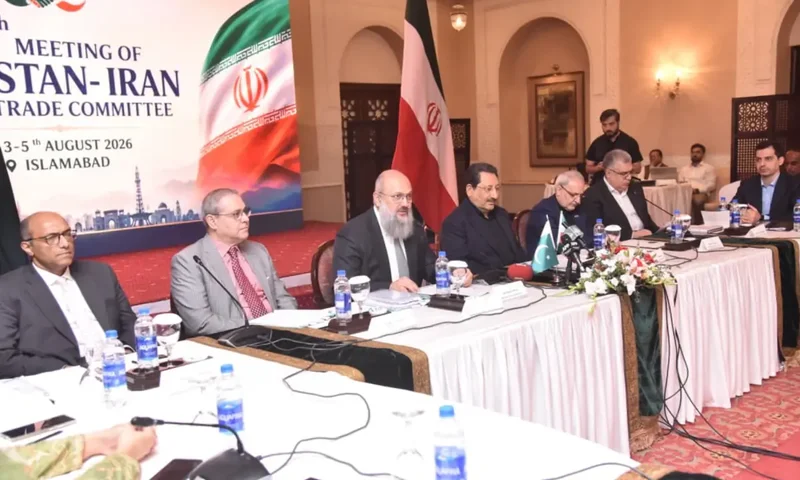
ISLAMABAD: Pakistan and Iran on Tuesday reiterated their resolve to expand bilateral trade to $10 billion, with Commerce Minister Jam calling for transforming “historic brotherly relations” with Iran into a robust economic partnership. Since March this year, both countries have rolled out a series of measures to facilitate border trade, including easing customs procedures, formalising Taftan as a customs station, and notifying new transit routes, against the backdrop of the ongoing US-Iran conflict in the Middle East that has strained economies in the region and beyond. Their latest engagement took place at the 10th session of the Pak–Iran Joint Trade Committee (JTC), which is being held in Islamabad from August 3-5. The meeting was co‑chaired by Iranian Industry, Mine and Trade Minister Mohammad Atabak and Pakistan’s Commerce Minister Jam Kamal Khan. On the occasion, Khan also underscored the urgency to finalise the Pak–Iran Free Trade Agreement, a statement issued by his ministry said. He called for the removal of barriers in border logistics and cargo movement, highlighting that joint border markets and electronic data interchange could significantly boost trade flows, it added. According to the statement, both sides reviewed the measures already taken to enhance bilateral commerce at the meeting. Moreover, the commerce minister said the private sector in both countries was prepared to expand trade, stressing that it was the responsibility of both governments to provide a “predictable and favourable” environment for business to them. He expressed hope that the JTC meeting would help evolve a practical roadmap to transform trade connectivity and raise the bilateral volume to its maximum potential, the statement said. For his part, the Iranian minister called Pakistan Iran’s “long‑term strategic trade partner”, the statement said, adding that he expressed Tehran’s desire to expand regional trade and logistics cooperation through Karachi and Gwadar ports, and the optimism that the Pak–Iran FTA would be concluded soon. Atabak said electricity trade and regional connectivity were “new avenues of economic opportunity” for both countries, according to the statement. It said Pakistan and Iran “reaffirmed their commitment to further strengthen cooperation in trade, investment, connectivity, and private sector partnerships”. Tuesday’s meeting takes place around two weeks after Iranian Interior Minister Eskandar Momeni’s visit to Islamabad, where he also held a meeting with Railways Minister Hanif Abbasi. During that meeting, the two sides agreed to expand railway cooperation and strengthen cross-border connectivity. They also discussed the revival of the Islamabad-Tehran-Istanbul (ITI) freight train service and measures to enhance regional connectivity, the statement said. As maritime trade faces uncertainty due to the Gulf crisis, Pakistan also permitted exporters in March this year to continue shipping food and pharmaceutical products to Iran via land routes without mandatory banking instruments. Simultaneously, Islamabad allowed rice exports to Central Asian Republics and Azerbaijan through Iran. In total, 10 food items — including rice, seafood, potatoes, meat, onions, maize, citrus fruits, bananas, tomatoes, and frozen chicken — along with two non‑food items (pharmaceuticals and tents) were cleared for land‑route exports without financial instruments. To strengthen border management and formalise cross‑border flows, Pakistan established the same month a new customs station at Jeerak in Panjgur district, designated as the fifth crossing point for trade and transit with Iran. The facility aims to regulate passenger movement, document personal baggage, and channel informal trade into the formal economy. This builds on earlier steps, including the opening of the Kohak Cheedgi crossing in January 2025 and the Gabd Rimdan border point in December 2024. In April, Pakistan’s commerce ministry had notified six transit routes for the transportation of goods to Iran via Pakistani sea ports in Gwadar and Karachi. The development had come amid reports that thousands of containers destined for Iran are awaiting clearance at Pakistani ports.
Pakistan, Iran reaffirm resolve to expand bilateral trade to $10bn