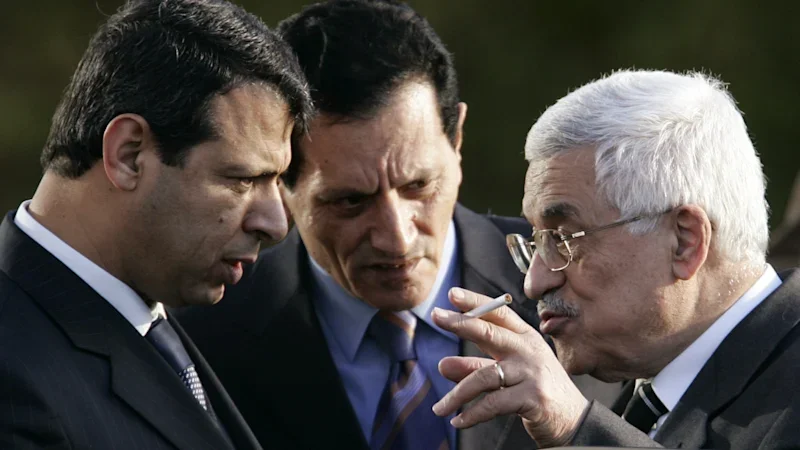
London: Of all those involved in getting the tortuous Gaza disarmament negotiations over the line, the most intriguing is Mohammed Dahlan.
Sources close to the negotiations said the exiled Palestinian politician, who has a reputation as something of a modern-day Machiavelli, played a crucial role in securing the deal.
Specifically, he is said to have been instrumental in convincing the Islamist militant group that only through disarmament could its political flame burn on.
“Over the past two days, he actually did play a major role,” a well-placed source at the heart of the negotiations said.
A second source said: “His offer to Hamas is of a political lifeline.”
Dahlan, 64, has been a fixture of Palestinian politics for more than 40 years, stretching from the Oslo Accords in the early 1990s to the Abraham Accords in 2020.
He served under and fell out with both Yasser Arafat, the late chairman of the Palestine Liberation Organisation and first president of the Palestinian Authority, and his successor, Mahmoud Abbas, the current president.
As head of security in Gaza before Hamas’ takeover in 2007, he established deep and lasting contacts with the CIA and many of the region’s intelligence agencies.
He now resides in exile amid the gleaming towers of Abu Dhabi, where he is the right-hand man of Sheikh Mohammed bin Zayed Al-Nahyan, ruler of the petro-rich state and president of the United Arab Emirates (UAE).
Dahlan is a wealthy businessman in his own right and is said to be influential in security relationships that Abu Dhabi has established in the Balkans, North Africa and Sudan.
‘Hamas has reached a point where they understand that this is not going anywhere [militarily]. So they need to be smart.’Palestinian source
In 2016, it was said that Turkey placed Dahlan on its “most wanted terrorist list”, offering a $US700,000 ($997,000) bounty, accusing him of involvement in the failed 2016 Turkish coup attempt.
Middle East specialists say there are several converging “timelines” that explain the deal coming to fruition, one of those being Dahlan’s and the UAE’s political ambitions in the region.
First, the negotiators were getting tired. The talks had been going for almost a year and, in June, the Egyptians were said to have run out of patience, issuing Hamas with an ultimatum.
“The Egyptians [said] either you give us a ‘yes’ or you don’t come back,” said a source privy to the negotiations. “It was very direct.”
After that, the process was said to have moved swiftly, with all but two clauses – clause 5 on compensation and clause 8 on disarmament – quickly agreed via the Egyptians two weeks ago.
The disarmament clause was sealed after Hamas secured a commitment that its debts to “suppliers, contractors and other parties” would be honoured up to $US400 million in clause 5, said the source.
These debts include payments due to civil servants and others, and in some instances date back 20 years. Paying them is a matter of honour, security and patronage.
Diplomatic boost
US President Donald Trump’s timeline was also pivotal.
The White House, after more than 150 days of war with Iran, was in urgent need of a diplomatic boost, said experts – one that would play well with its battered allies in the Gulf as well as at home.
“Trump wanted to point to something, wanted this wrapped up, wanted to be able to declare a win,” said Hugh Lovatt, a senior policy fellow at the European Council on Foreign Relations.
But it was the Palestinian elections to be held in the Israeli-occupied West Bank on November 28 that may have been the most important factor of all, experts said.
If they happen – a big if, given Israeli settler violence in the territory – they will be the first held in more than 20 years and will reshape the Palestinian Legislative Council, the legislature of the Palestinian Authority, for decades to come.
It was this pivotal election that Dahlan is said to have his eye on, and which explained his intervention with Hamas to get the deal over the line, sources said.
Like Hamas, his faction of the Palestinian national movement, Fatah, stands against the regime headed by Abbas and is aligned with Marwan Barghouti, the popular Palestinian politician who has spent the past 24 years in an Israeli jail.
“Dahlan put pressure on Hamas to make the final concessions, and to agree to the text in exchange for having this sort of potential political alignment going forward,” one source told London’s Telegraph.
On the principle that “the enemy of my enemy is my friend”, he was saying to Hamas that now is the time to disarm and join the political fight for the future of the Palestinian movement, a second source said.
They added: “Hamas has reached a point where they understand that this is not going anywhere [militarily]. So they need to be smart. If you want to stay as a political movement, that’s the way to do it now, by changing and joining others.”
The extent to which Dahlan represents the UAE as well as himself in these dealings is not clear, but experts said he would not risk his position in Abu Dhabi, which has made him a rich and powerful man.
Others point out that both Dahlan and Abu Dhabi have provided substantial sums in humanitarian aid to Gaza and the West Bank over the past two years, thereby cementing relationships and patronage there.
“If you look at the numbers, the UAE is the biggest humanitarian donor over the past few years for Gaza … And everyone knows that [Dahlan] is influencing this,” the source close to the negotiations said.
The one timeline that does not seem to have been considered as regards the Gaza deal is Israel’s.
The stipulations that the Israel Defence Forces withdraw from the strip, stop shooting and be replaced by a Palestinian-run bureaucracy and security apparatus are the last thing Israeli Prime Minister Benjamin Netanyahu needs before the Israeli election, scheduled for October 27.
Already, even normally friendly Israeli media commentators are getting stuck in.
“‘I will tell them no.’ That’s what Netanyahu reportedly told his ministers days before flying to Washington, in response to reported US pressure for a “series of withdrawals” across Syria, Lebanon and Gaza, wrote Israeli journalist Amit Segal on Friday.
“He later denied the issue even came up in the meeting – a denial that now appears to have been a lie.”