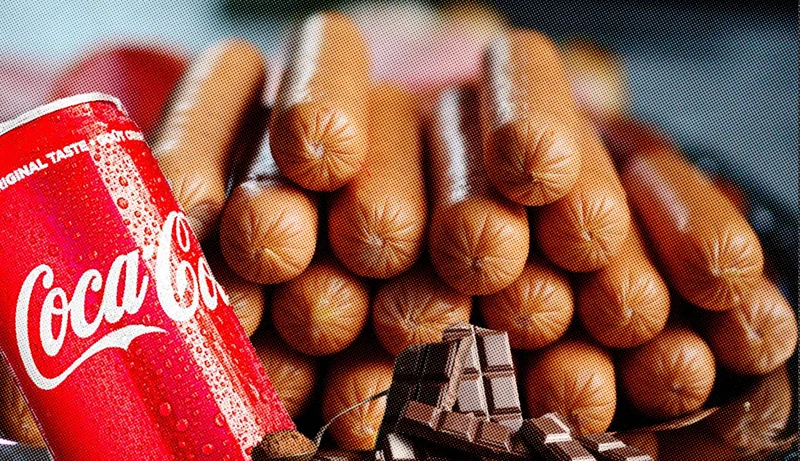
It takes 1.7 litres of water to manufacture one litre of soft drink product by Coca-Cola Beverages South Africa.
When considering the whole production lifecycle, the amount of water is actually much higher (168-309 litres/half-litre of sugar-sweetened beverage) than Coca-Colaâs estimates, said Dr Tamryn Frank, a nutrition researcher at the University of the Western Capeâs School of Public Health, to Daily Maverick.
In 2025, The Lancet journal said that diets high in ultra-processed foods (like polony, instant noodles, packaged bread and sodas) are linked to overeating, poor nutritional quality and higher exposure to harmful chemicals and additives.
A total of 87% of the packaged products analysed in SA are classified as unhealthy when combining ultra-processed food markers and food that is high in fat, salt and sugar.
**Taking aim at health policies **
In a recent global investigation by The Guardian, Lighthouse Reports, media partners and academics across four continents found that more than 200 lawsuits have been brought against governments who implemented health policies to fight high levels of unhealthy food consumption, in Mexico, Colombia, Brazil, the United States and the United Kingdom, since 2010.
It is not always clear who is behind every lawsuit â but three-quarters were filed by ultra-processed food manufacturers or trade associations representing them. Of the identifiable plaintiffs, 38% were brought by eight parent corporations: Coca-Cola, PepsiCo, MondelÄz, Kelloggâs, Danone, Ferrero, Xignux and Heartland Food Products Group.
Three-quarters of resolved cases were lost by food giants. But, they took up immense time in court â almost 600 years in total.
Sticky business of watered-down policies
The investigation found that out of 40 European countries, only 13 had a dedicated sugar tax in place. Other countries had postponed, repealed or watered down similar measures after political debate and industry opposition, they said.
Companies combine threats of litigation with warnings about job losses, declining investment and economic issues. They analysed dozens of lobbying letters sent to the governments, which then shaped political debate.
This is similar to SA, where the Health Promotion Levy taxing sugar-sweetened beverages has come under fire repeatedly for the claimed 16,000 jobs lost by the tax. Research into the job losses disputes this.
Also a new report by the Food and Agriculture Organisation said Africa had overtaken Asia as the region with the highest food insecurity, with 309 million of the 645 million hungry people worldwide.
How then is the high level of unhealthy food produced justified, when millions of people do not have a sufficient, safe and nutritious diet to carry out their daily lives, Daily Maverick asked Frank.
âQuite, simply, we canât. There is no feasible justification for this. The ultra-processed food industry should not have free rein to determine the composition of the food system, as they do not have the health of the population at heart in their decision-making,â said Frank.
âGovernment needs to act, by implementing better policies and social protection measures to protect the health of the population against the profit-driven ultra-processed food industry.â
In July 2025 the World Health Organization (WHO) launched the â3 by 35â initiative, a global effort to increase the real prices of tobacco, alcohol, and sugary drinks by at least 50% by 2035 through tax increases.
Tendai Mafuma, Senior Legal Researcher at Section27, explained to Daily Maverick that sugar-sweetened beverages have little or no nutritional value but contribute to poor health outcomes such as diabetes and obesity, which cost the country through treatment and loss of productivity. Increasing the tax to WHO-recommended levels would ânot only contribute to positive health outcomes, but would also generate much higher revenue for the stateâ.
Despite pushback from business, taxes on unhealthy beverages and food are becoming more of a norm, with more than 100 countries having some kind of tax.
Drinking one or two sugar-sweetened beverages a day raises the risk of type 2 diabetes by up to 29%, and a child being overweight by 55%.
In SA, there are over 2.3-million people diagnosed with diabetes. According to the UN childrenâs fund (Unicef), about 23% of children under five and 21% of older children and adolescents are classified as overweight or obese.
What about Africa?
âDraft regulation 3337 proposed the introduction of front-of-pack warning labels on foods that are high in salt, sugar, or unhealthy fats as well as marketing restrictions towards children. If adopted, these regulations will help protect children. The government should move swiftly to finalise the regulation,â said Mafuma.
One of the first hurdles overcome with the draft regulation 3337 was the âdelaying tacticsâ of industry, through 5,000 public comments, outlined Rebone Ntsie, Chief Director for Nutrition, Health Promotion and Oral Health at the Department of Health, speaking at the second leg of the South African Human Rights Commissionâs hearings into hunger, on 9 July. It took the national Department of Health more than a year to consider each comment â one of which was over 500 pages, she said.
In a study reviewing sugary drinks taxes in Africa from 2014 to 2024, researchers looked at whether taxes affected the amount drank, whether drinks were reformulated, and if the public accepted the tax.
It increased revenue in some countries, like SA, and there was an uptick in low- or zero-sugar options consumed by South Africans.
Ghana is imposing an excise duty of 20% on sweetened beverages, a front-of-pack nutrition labelling policy, and restrictions on the direct marketing of unhealthy beverages to children.
In Mauritius they found that more expensive drinks had a positive influence on youth consumption.
Kenya, Zambia, Rwanda and Tanzania have some form of sugar taxes â which appeared to be motivated by revenue generation rather than health promotion.
Zambiaâs sugary drinks tax rate of 15% is anticipated to reduce the obesity prevalence by 0.49% points as a result of the tax. Also, the restrictions on sugary drinks in school environments and public awareness can reduce obesity in the long term.
They suggest governments worldwide should force manufactures to reduce container size, impose a complete ban on marketing, and âpolicymakers and sugar tax advocates should demonstrate that the introduction of a sugar tax is not an economic sanction on the manufacturers or an attack on the low-income group, but a means to promote public healthâ.
For a sugary drinks tax to be sustainable, it should tax all sugar-sweetened beverages to stop people from switching to untaxed versions. Reviewing the tax rate and design is necessary to ensure it is working, they conclude.
âMy suggestion would be to increase taxes to a level that they are effective (and consider expanding to include ultra-processed foods â as Colombia has done), but at the same time use the revenue raised to support the food security of the most vulnerable in the population,â said Frank. DM